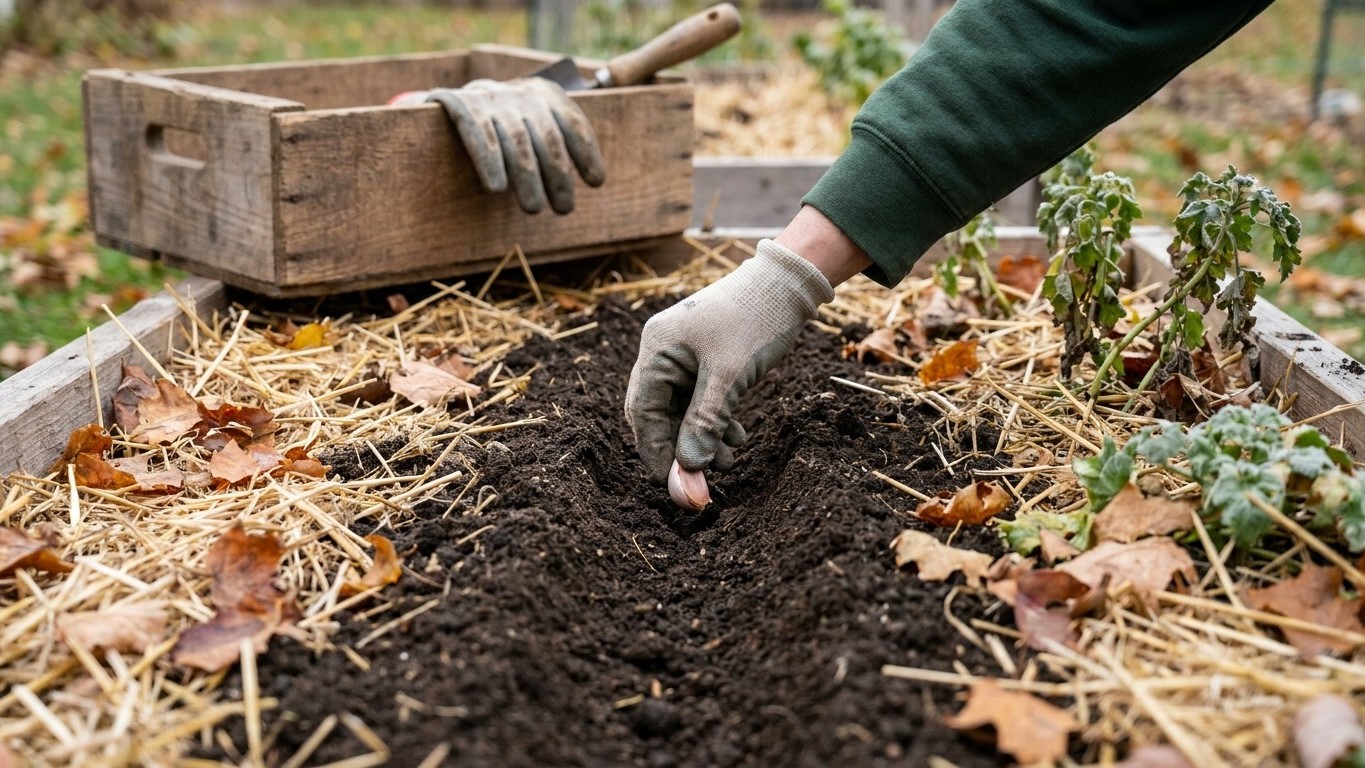

By November, Saskatchewan’s growing season is closed for the vast majority of gardens. The province’s average first fall frost lands around September 18, so soil across most of the state, er, province, is frozen solid or buried under snow well before this month begins. There’s no realistic outdoor sowing window left. What still makes sense: garlic where soil remains workable, cold frames for hardy greens, forcing roots indoors, and the dormant-season work that sets up next spring.
What goes in the ground in November

The calendar says November, but the soil doesn’t care what the calendar says. What decides whether anything can go into open ground is soil temperature and whether the frost line has already locked things up, and in Saskatchewan, that question is usually already answered by the time this month starts. The average first fall frost at the Saskatoon reference station sits around September 18, which means by early November the province has typically had six or seven weeks of freezing nights behind it. Zone 3a, the Canadian hardiness rating for that same reference city, tells the same story: this is short-season, hard-winter territory, and the open-ground planting window shut long before November arrived.
So the honest answer for most of the province is that nothing new goes into open, unprotected soil this month. That’s not a failure of planning, it’s just where the calendar sits relative to the frost. What’s still possible depends heavily on protection and on whether the ground itself has frozen yet in a given yard.
| Method | Status in November | Notes |
|---|---|---|
| Open, bare soil | Closed | Ground typically frozen or near-frozen across the province |
| Garlic and shallot cloves | Still possible early in the month | Only where soil hasn’t frozen solid yet; mulch heavily after planting |
| Cold frames and low tunnels | Open for hardy greens already established | Won’t grow much new, but extends holding time on spinach and kale |
| Bare-root and dormant woody stock | Largely closed | Ground too hard to dig in most locations by this point |
| Forced roots indoors (rhubarb, chicory) | Open | Brought in from cold storage or the garden, forced in a dark, cool space |
If there’s a window at all, it’s a narrow one for garlic, and only in gardens where the soil hasn’t frozen yet. Push the cloves in, cover with several inches of straw or shredded leaves, and let winter do the rest. Everything else this month runs on protection, not on planting.
What to start under cover
Count backward from Saskatchewan’s average last spring frost, which sits around May 18, and November is roughly six months out. That’s too early for almost any transplant that would normally get its start indoors under lights. A tomato or pepper sown now would sit rootbound on a windowsill for months before it could safely go outside, and by the time May arrived it would be leggy, stressed, and behind schedule rather than ahead of it.
What does make sense under cover this month is narrower. Herbs grown purely for kitchen use on a sunny sill, like parsley or chives, can be started anytime since they’re not tied to a transplant date. Microgreens and sprouts are on their own short clock, ready in a week or two regardless of the season outside. And for perennial seeds that need a period of cold before they’ll germinate, the winter-sowing method, seed sown into a vented container and left outdoors to freeze and thaw through the season, is timed for exactly this stretch. That’s different from starting warm-season vegetables early; it’s using the cold on purpose.
The two failure modes worth naming plainly: starting long-season vegetable transplants this early leads to rootbound, leggy plants that struggle rather than thrive once they finally reach the garden in spring. And missing the winter-sowing window for cold-stratified seed means those seeds may not break dormancy properly, since they need the freeze-thaw cycle that only happens if the containers go out while the season is still cold. November is the moment for the second kind of start, not the first.
What is ready to pick
Outdoors, the harvest is essentially finished. With the average first fall frost landing around September 18, most gardens in the province have been through weeks of hard freezes by the time November arrives, and anything left unprotected in the ground has already been damaged or killed. So the honest answer is that there’s little or nothing to pick from open soil this month.
What still feeds the household comes from what was put away earlier or protected under cover. Kale and leeks that were left standing under a heavy mulch or snow layer can sometimes still be dug in milder pockets of the province, and a cold frame that was planted up in late summer may still be holding spinach or lettuce worth cutting. Indoors, sprouts and microgreens fill the gap on a much faster cycle, ready within days of sowing regardless of what’s happening outside the window.
The bigger job this month is checking what’s already in storage. Squash should be firm with no soft spots; a single soft squash left in a bin can spread rot to its neighbors within days. Potatoes need a dark, cool spot and a check for any that have gone soft or sprouted early. Onions stored in mesh bags or crates should be turned over occasionally, since one that’s started to soften at the neck will bring down the ones touching it. Catching these early is the difference between losing one squash and losing the whole bin.
The jobs that matter this month

This is a month built around dormant-season work, and there’s a full list of it with real deadlines attached. Fruit trees and berry canes can take a light dormant pruning once they’ve dropped their leaves and gone fully dormant, though in a zone 3a climate it’s worth waiting until the coldest snap has passed rather than cutting into wood right before a deep freeze, since fresh cuts are more vulnerable to dieback in extreme cold. Perennial beds and garlic rows benefit from a thick mulch of straw or shredded leaves now, put down before the ground locks up completely, since mulch applied on top of already-frozen soil does less to buffer the freeze-thaw cycling that heaves roots and bulbs.
Seed catalogs are worth ordering from early. The most popular varieties, particularly short-season vegetables bred for prairie growing conditions, tend to sell out well before spring planting arrives, and ordering now avoids settling for a second-choice variety later. This is also the natural point to sketch out next year’s rotation plan while the current season’s results are still fresh, noting which beds carried disease or which crops underperformed.
Soil testing and amending can still happen wherever the ground remains workable, since amendments like compost or lime need months to integrate before planting resumes. Compost piles benefit from a turn now to keep them active into the cold, and tools should be cleaned, oiled, and sharpened before they sit unused all winter, a job that’s easy to skip and expensive to regret come spring when a dull pruner tears rather than cuts. Raised beds, fencing, and cold frame frames are worth repairing now too, while the ground is still soft enough to reset a post, rather than waiting for spring thaw to reveal the damage.
What not to do in November
The most common mistake this month is trusting a mild afternoon over the calendar and the soil. A warm spell in early November can feel like an invitation to get one more planting in, but air temperature and soil temperature are not the same thing, and ground that’s been through weeks of freezing nights doesn’t warm back up in a day of sun. Anything tender put in now is planted on borrowed time.
A related error is pulling mulch or row cover off beds during that same mild stretch, thinking the cold is over. It isn’t. Uncovering garlic or perennial beds after a warm spell exposes them to the next hard freeze without the buffer that mulch provides, and that swing between exposed and covered is harder on roots than steady cold ever is.
Nitrogen fertilizer is the other trap. Feeding beds or lawns with a high-nitrogen product this late pushes soft new growth right when the plant should be shutting down for winter, and that new growth is the first thing killed by the next freeze, weakening the plant going into the hardest months rather than strengthening it. If soil needs feeding, compost or a balanced amendment worked in now for next season does far more good than a nitrogen boost aimed at growth that shouldn’t be happening.
Last, don’t leave stored crops unchecked because the harvest season already feels finished. A single rotting potato or softening onion left in a bin all month can take out a meaningful share of the winter’s supply before anyone notices.
Checking this against your own county
A province-wide picture of November is a starting point, not an instruction for a specific yard. Saskatchewan spans a huge range of conditions, and elevation, local lake effect, and the difference between the province’s northern and southern reaches can shift frost timing by weeks in either direction from the Saskatoon-based figures used here. A garden in the far south may still have workable soil when one in the north has been frozen for a month.
For a local read, the Saskatchewan agriculture extension service is the place to check district-specific guidance before treating any province-wide date as a rule for a particular yard.
Common questions
Can garlic still be planted in Saskatchewan in November?
Only where the soil hasn’t frozen solid yet, and typically only in the earliest days of the month in milder, southern locations. Once the ground is locked up, garlic cloves have to wait for spring.
Is it too late to start seeds indoors for spring transplants?
Not too late, too early. With the average last spring frost around May 18, most transplants started now would sit for months before it’s safe to move them outside, resulting in leggy, stressed plants rather than a head start.
What can still be harvested from a Saskatchewan garden in November?
Very little outdoors, given the average first fall frost around September 18. Cold frames may still hold hardy greens, and overwintered kale or leeks under heavy mulch or snow can sometimes still be dug in milder pockets of the province.
What is the single most important job to finish before winter fully sets in?
Mulching garlic and perennial beds before the ground freezes completely, since mulch applied afterward does far less to buffer the freeze-thaw cycles that damage roots and bulbs over winter.
Gardeners who plant by the Moon can check the November 2026 moon planting calendar, a tradition rather than a proven method.
Related guides
Elsewhere? See what to plant in November in every state and province.