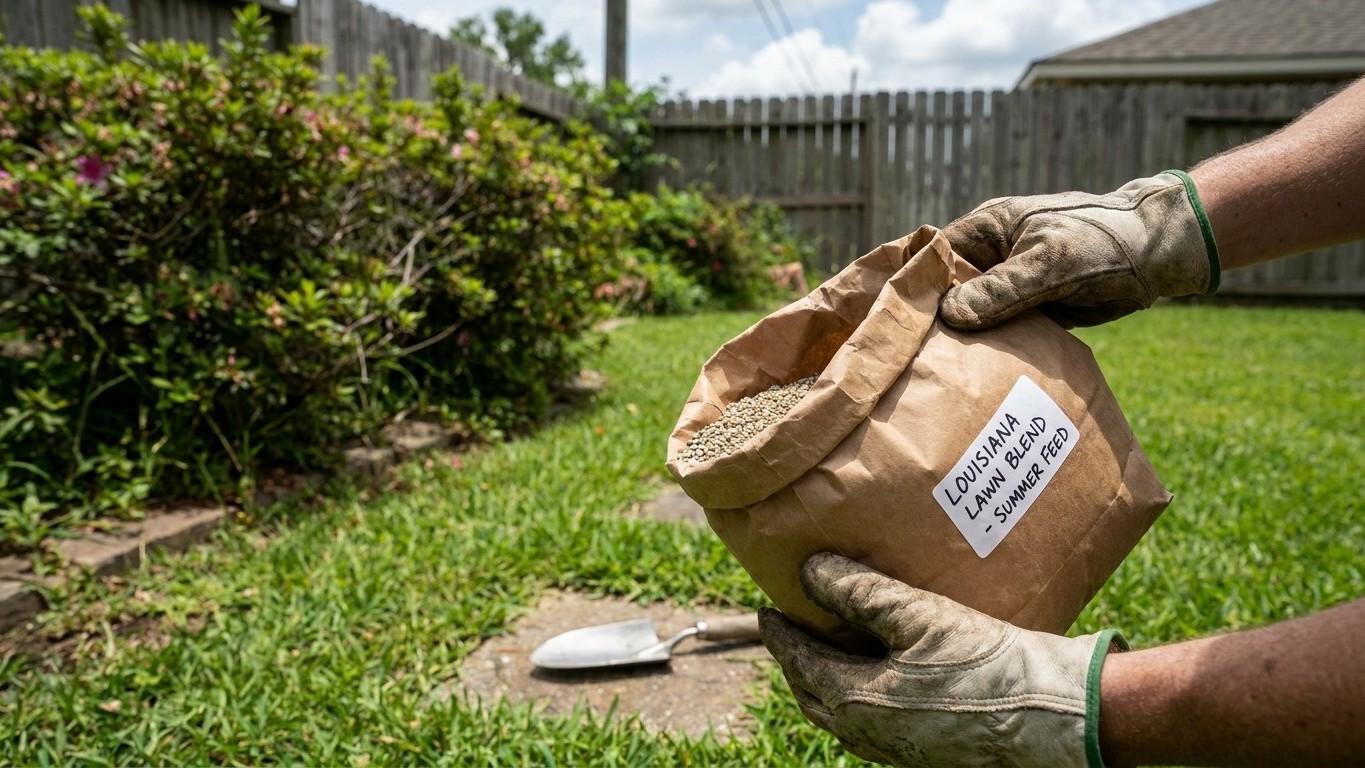

Louisiana lawn care starts with one fact: this state grows warm-season grass, not cool-season. NOAA’s 1991-2020 climate normals put the reference station at New Orleans at 70.7 days a year with a high of 90°F or better, and a coldest-month average minimum of 44.7°F, a combination that rules out fescue and bluegrass outright. The single move that saves the most trouble later is identifying which warm-season species is already growing in the yard, since every seeding date, feeding rate, and mowing height that follows depends on that answer, a sequence best tracked against a Louisiana lawn Calendar.
Which grass belongs in Louisiana

Why the numbers rule out cool-season grass
Seven warm-season grasses hold up in Louisiana’s climate, and not one of them is the obvious answer, a comparison laid out in full in this Louisiana lawn Best grass breakdown. Bermudagrass takes full sun and foot traffic better than the rest but grows fast enough to wear out a mower schedule. St. Augustinegrass shrugs off the shade a planted yard throws down, yet folds under cold and fungus in a wet summer. Centipedegrass asks for almost nothing on poor, acidic soil, and pays for that ease in paler color and slower healing.
The warm-season options and their trade-offs
Clemson Cooperative Extension’s HGIC 1214 guide to selecting a lawn grass names seven species suited to this kind of climate: Bahiagrass, Bermudagrass, Carpetgrass, Centipedegrass, Seashore Paspalum, St. Augustinegrass, and Zoysiagrass. Each carries a real trade-off, not a clear win. Bermudagrass tolerates full sun and heavy foot traffic better than anything else on the list, but it grows fast enough to demand mowing on a tighter schedule than most homeowners expect. St. Augustinegrass handles the partial shade of a planted yard far better than Bermudagrass, but it is the most cold-tender of the common choices and the most prone to fungal trouble in a wet summer. Centipedegrass asks for almost nothing once established and is the forgiving choice on poor, acidic soil, at the cost of a paler color and slower recovery from wear. Zoysiagrass forms the densest turf of the group and resists weeds well simply by crowding them out, but it is slow to fill in after installation. Bahiagrass, Carpetgrass, and Seashore Paspalum fill narrower roles: Bahiagrass on poor sandy ground that gets little care, Carpetgrass on wet low spots where nothing else holds, and Seashore Paspalum where salt spray or brackish irrigation water would kill the others outright. New Orleans sets the climate baseline here, but higher and more northern ground in the state runs a colder winter minimum than 44.7°F, so Bermudagrass and Zoysiagrass tend to outlast St. Augustinegrass there. Check your own ground rather than assuming the coastal figures apply everywhere in the state.
When to seed or sod here
The May window, and why frost barely factors in
Clemson Cooperative Extension’s planting calendar, HGIC 1203, times warm-season grass installation to around May, once soil has warmed enough for stolons and rhizomes to root quickly, while cool-season species elsewhere go in during mid to late September. Louisiana’s heat load rules that second half of the calendar out entirely. There is no fall lawn-establishment window here the way there is in a fescue state, because nothing about this climate favors a cool-season species at any time of year.
What moves the date, and why frost is not the driver
NOAA’s 1991-2020 climate normals place the first fall freeze at New Orleans somewhere between December 17 and January 8, and that 32°F freeze only shows up in 86.8 percent of years, meaning roughly one winter in seven brings no hard freeze at all. That is unusual enough to flag directly: frost is not the limiting factor for lawn timing in south Louisiana. Heat is. Sod, because it arrives already rooted, tolerates a wider window of soil temperature than seed does and can often go down over a longer stretch of spring and early summer. Seed needs a narrower band of warm soil to germinate reliably, which is why the May figure holds tighter for seeding than for sodding. North Louisiana, where winter minimums run colder than the New Orleans reference figures, should lean toward the later edge of that window and confirm soil temperature locally rather than planting by the calendar date alone. Sandy soils warm faster in spring than heavy clay, another reason the same May guidance plays out a week or two differently parish to parish.
The feeding calendar that fits this climate
Feed the growing season, not the month on the calendar
A warm-season lawn in Louisiana does its growing during the stretch of the year that produces those 70.7 annual days over 90°F recorded by NOAA at New Orleans, so nitrogen goes down after spring green-up and tapers off before growth slows heading into the mild Louisiana winter. Feeding in September, the way a cool-season fescue lawn would be fed farther north, does close to the opposite of what a Bermudagrass or St. Augustinegrass lawn needs going into its dormant stretch. Timing follows the grass’s own growth curve, not the September date printed on a bag of lawn food at the hardware store.
Rates differ by species: check the calendar for yours
Clemson’s per-species maintenance calendars set the actual pounds of nitrogen per 1,000 square feet for each feeding window, and that number is not the same lawn to lawn. The Bermudagrass maintenance calendar, HGIC 1216, runs a hungrier feeding schedule suited to full-sun, high-traffic turf. The St. Augustinegrass calendar, HGIC 1218, sets a lighter nitrogen load, because overfeeding this species pushes the thatch and blade growth that invites brown patch in a humid summer. The Centipedegrass calendar, HGIC 1215, is the lightest of the group. Oversupplying nitrogen is the single most common way home growers kill Centipedegrass, since it triggers a yellowing decline the following season rather than a quick burn. The Zoysiagrass calendar, HGIC 1217, keeps rates modest to match the species’ naturally slow growth, but the feeding windows are narrower and easier to miss.
Mowing height and watering here
Height depends on the species, and the one-third rule never changes
Each warm-season grass carries its own published mowing height, and cutting outside that range weakens the turf regardless of how much you feed or water it.
| Grass | Typical mowing height | Light needs |
|---|---|---|
| Bermudagrass | 1 to 2 inches | Full sun |
| Centipedegrass | 1 to 1.5 inches | Full sun to light shade |
| St. Augustinegrass | 2.5 to 4 inches | Sun to moderate shade |
| Zoysiagrass | 1 to 2.5 inches | Full sun to partial shade |
Whatever the height, the same rule governs every cut: never remove more than a third of the blade in a single pass. In the stretch of summer that produces most of New Orleans’s 70.7 annual days above 90°F, that often means mowing more frequently rather than raising the deck to skip a week, since fast growth plus a hard scalp is a common way to open the door to disease.
Watering: adjust for heat, humidity, and soil
An inch of water a week, split across two or three sessions, is the standard starting figure for warm-season turf almost anywhere it grows. Louisiana’s heat load pushes evapotranspiration higher than that baseline assumes, and the same humidity that adds to heat stress also feeds the fungal disease covered next, so water early in the morning rather than in the evening to give blades time to dry. Sandy soils common along the coastal parishes drain fast and often need smaller, more frequent waterings, while the heavier clay soils found farther inland hold moisture longer and can go a bit longer between waterings without the grass wilting.
What goes wrong on lawns in Louisiana

Brown patch and other fungal disease in a humid summer
Heat combined with humidity is what produces brown patch, a fungal disease that shows up as circular or irregular patches rather than an evenly browned lawn. St. Augustinegrass and Centipedegrass are the most commonly affected among the species named above, and the risk climbs with evening watering and with the kind of nitrogen overfeeding covered in the feeding section. A patchy, ring-shaped brown area in the middle of an otherwise green lawn points to disease, not drought.
Dormancy mistaken for death after a dry summer or a rare freeze
A hot, dry stretch sends warm-season grass into dormancy, and the whole lawn browns evenly rather than in patches. It looks dead. It is not. On the roughly one year in seven that south Louisiana gets no freeze at all, per NOAA’s 1991-2020 normals, this distinction barely comes up in winter, but in the years a freeze does land between December 17 and January 8, the same rule applies: the grass goes dormant and browns, then greens back up on its own once temperatures and moisture return.
- Circular or irregular brown patches with a yellowish ring at the edge: likely brown patch fungus, not drought.
- The whole lawn turning uniformly straw-colored during a dry spell: drought dormancy, not death.
- Grass still brown well after neighboring lawns have greened up in spring: dig a small plug and check for live white roots before assuming the worst.
Weeds that never stop in a mild winter
Because a hard freeze is unreliable in south Louisiana and light even when it lands, winter weeds keep growing through what would be a dead season farther north. A transition-zone lawn like the one covered in Maryland Lawn Care: What to Plant and When to Feed It gets a harder winter kill on weeds than south Louisiana ever sees, so post-emergent control here often runs on a longer calendar than a grower moving from a colder state expects.
Local help
For a soil test and advice tuned to a specific parish, the LSU AgCenter runs county-level offices across the state and can say whether a given lawn needs lime, phosphorus, or neither before any money goes into a bag of fertilizer. A soil test costs far less than a season of guessing, and it is usually the fastest way to explain why a lawn fed right on schedule still looks thin.
Common questions
Can I grow a fescue lawn in north Louisiana since it’s cooler up there?
Not reliably. Even the cooler parts of the state still run enough hot summer days to stress a cool-season grass badly, and the species named above exist because they tolerate that heat. If a section of the yard is shaded and struggling, look at a shade-tolerant warm-season option like St. Augustinegrass before reaching for fescue.
Why did my Centipedegrass turn yellow the season after I fed it heavily?
That is the decline pattern extension bulletins associate with overfeeding Centipedegrass. It does not show up as an immediate burn, it shows up as a slow yellowing the following year, which is why the Centipedegrass calendar sets a lighter nitrogen rate than Bermudagrass or St. Augustinegrass.
Is it normal for my lawn to still be green in January?
Yes, especially close to the coast. NOAA’s normals show roughly one winter in seven at New Orleans brings no freeze at all, so a warm-season lawn there can stay partly green well past the point a grower farther north would expect full dormancy.
Should I aerate or dethatch before I seed or sod?
Do it during active growth, not during dormancy or right at installation. Working matted thatch or compacted soil while the grass is actively growing lets it recover fast, while doing the same job on a dormant or newly planted lawn just adds stress on top of stress.
Can I mix Bermudagrass and St. Augustinegrass in the same yard?
You can, but expect an uneven look. The two species want different mowing heights and different nitrogen rates, and one will usually crowd out the other along the boundary between them. Most growers get a better result picking one dominant species per distinct area of the yard, sun and shade permitting.