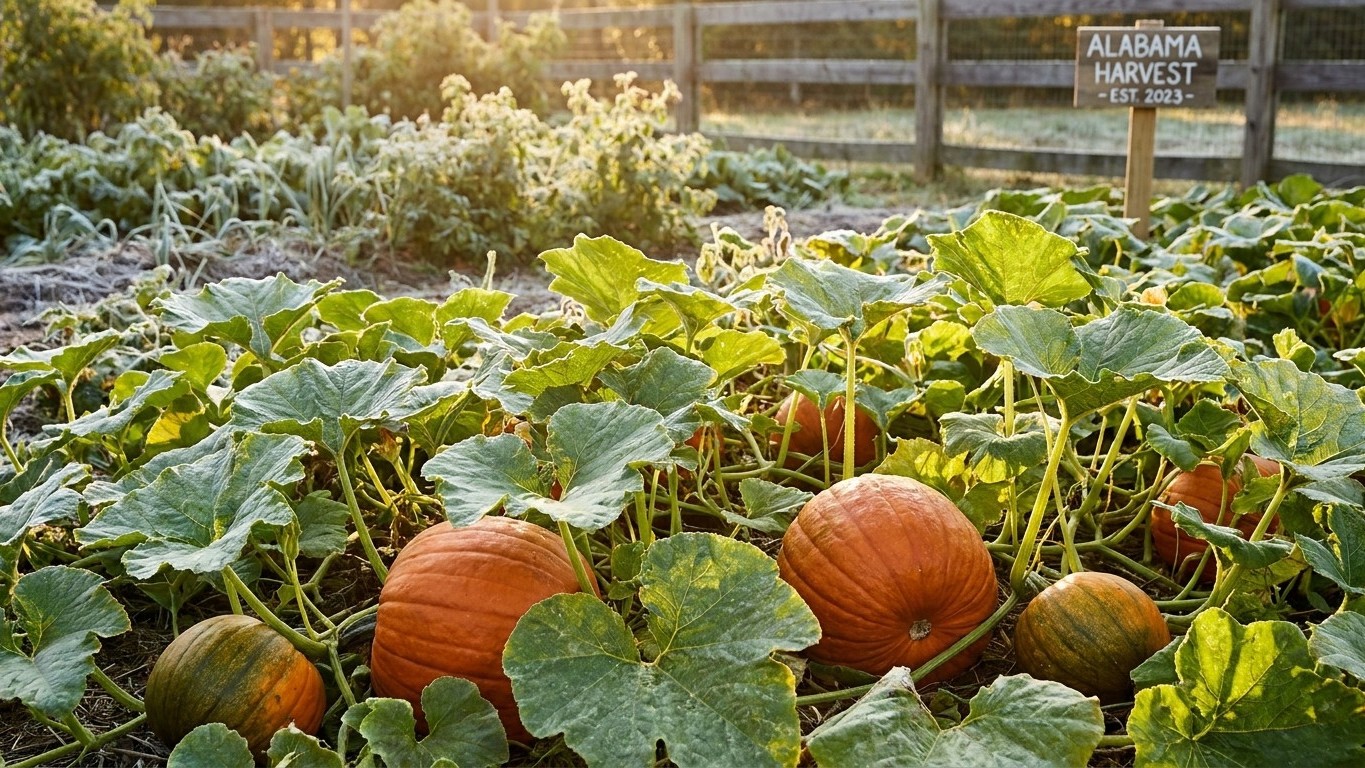

Yes, in most years Nebraska pumpkin vines have enough season left to finish the job, provided the first flowers open by the last days of August. Reference-station data puts the state’s first fall frost between October 15 and October 26. Since fruit needs 45 to 55 days after flowering, not from seeding, to mature, that frost window sets a hard flowering deadline every Nebraska grower should track on their own calendar, not just a general rule of thumb.
The short answer
Start with the frost date and work backward. That’s the only arithmetic that matters here. NOAA’s climate normals for the reference airport station put the first fall freeze at 32 F somewhere between October 15 and October 26, a spread that reflects year-to-year variability more than a fixed deadline. Subtract 45 days from the early end of that window and 55 days from the late end, and the math lands on a flowering deadline running from roughly late August to mid-September, depending on how conservative a grower wants to be.
That’s the window that actually decides whether a pumpkin turns orange or stays green on the vine. A flower that opens in the last days of August has a real shot: even in a stingy year with an October 15 frost, there’s still enough runway to clear the 45-to-55-day range from Utah State University Extension. A flower that opens in mid-September is racing a clock it usually can’t win, since even the latest frost date on record here, October 26, only leaves about 41 days, short of the 45-day minimum.
Here’s the detail most growers skip past: the clock starts at flowering, not at seeding or transplanting. A pumpkin seeded in late May might not set its first female flower, the one with the tiny fruit swelling behind the petals, until well into July. Everything before that bloom is vine-building and male flower production that pollinators visit but that never turns into fruit. Count from the wrong starting point and the whole schedule shifts by weeks in the wrong direction.
For gardeners around Omaha, Lincoln, or along the Platte, the airport-station numbers are a starting point, not a guarantee. Freeze timing in home gardens, especially those tucked into low spots, near tree cover, or in river bottoms, commonly arrives one to two weeks earlier than the reference station shows, sometimes more at higher elevation toward the western edge of the state. A grower in a known frost pocket should treat the earlier end of that flowering window as their real backstop, not the later one.
When to sow here
Sowing decisions in Nebraska hinge on soil temperature, not the calendar date of the last frost, and the two clocks run at very different speeds.
- Note the last spring frost window. The reference station’s last spring freeze falls between April 12 and April 23. That date matters for tender seedlings above ground, but it says nothing about what’s happening a few inches underground.
- Track soil temperature separately. Utah State University Extension is clear that pumpkins go in the ground once soil reaches 65 F, and in Nebraska that mark typically isn’t hit until well after the air has stopped freezing, often not until mid-May or later, since bare soil warms slowly compared to daytime air.
- Do the arithmetic in words, not a single date. If the last frost lands in mid-April and soil doesn’t reach 65 F until several weeks later, that gap is the real waiting period, and it’s longer than most seed packets imply. Planting by the frost date alone risks seed rotting in cold, damp soil before it ever germinates.
- Use row covers to buy time, not to skip the wait. Floating row covers trap daytime heat and can move an effective planting date up by about two weeks, letting a grower seed earlier without pushing seed into soil that’s still too cold to germinate reliably.
- Work back from the frost deadline once the soil is ready. With flowering needing to happen by late August to mid-September at the latest, and vines needing roughly six to eight weeks of growth before their first blooms typically appear, sowing once soil hits 65 F usually lines up with that flowering target in a normal Nebraska season.
What goes wrong here
- A late flower that never colors. This is the most common failure tied directly to Nebraska’s season length: a female flower opens in mid-September, the fruit sets, but frost arrives before it has logged 45 days on the vine, leaving a hard, green pumpkin. The remedy is planning backward from the frost window at sowing time, and pinching off new flowers that open too late in the season so the plant redirects energy to fruit that still has a chance.
- A fruit caught by frost before it finishes. Even a well-timed pumpkin can get caught by an early freeze that arrives ahead of the October 15 end of the range. Utah State University Extension advises harvesting with the stem attached before frost hits and storing where the fruit will not freeze; no source here publishes a specific storage temperature or keeping time, only that guidance about avoiding freezing conditions.
- A vine that dies back before the skin hardens. Pumpkin skin needs healthy foliage late in the season to cure properly, and a vine that collapses early, often from pest pressure, leaves fruit with soft, thin rind that won’t store. Squash bugs and cucumber beetles are common culprits behind this kind of early collapse in Nebraska gardens; for identification and control specific to this state, see the guides on squash bugs in Nebraska and cucumber beetles in Nebraska. The remedy is early monitoring, since damage caught in the first week is manageable, while damage caught after the vine has already wilted usually isn’t.
Common questions
My pumpkin is still green with frost forecast in a few days. What now?
Cut it from the vine with the stem attached and move it somewhere it won’t freeze. Utah State University Extension’s guidance stops at that point, so there’s no published timeline here for how much more coloring a green, harvested pumpkin will do off the vine.
Can I do anything to speed up flowering if my plants are behind schedule?
Pinching off excess male flowers and vine tips late in the season can redirect the plant’s energy toward the fruit already set, though this doesn’t change the 45-to-55-day maturation clock itself once a flower has opened.
Does the frost date really vary that much within Nebraska?
It can. The October 15 to October 26 window comes from one reference airport station, and home gardens in low-lying areas, near tree lines, or at higher elevation on the western side of the state often see frost one to two weeks earlier than that station records.
Is there a point in September where I should stop counting on new flowers?
Based on the 45-to-55-day maturation window measured against this state’s earliest recorded frost date of October 15, any flower opening after roughly the first week of September is working against the odds in a short-season year.