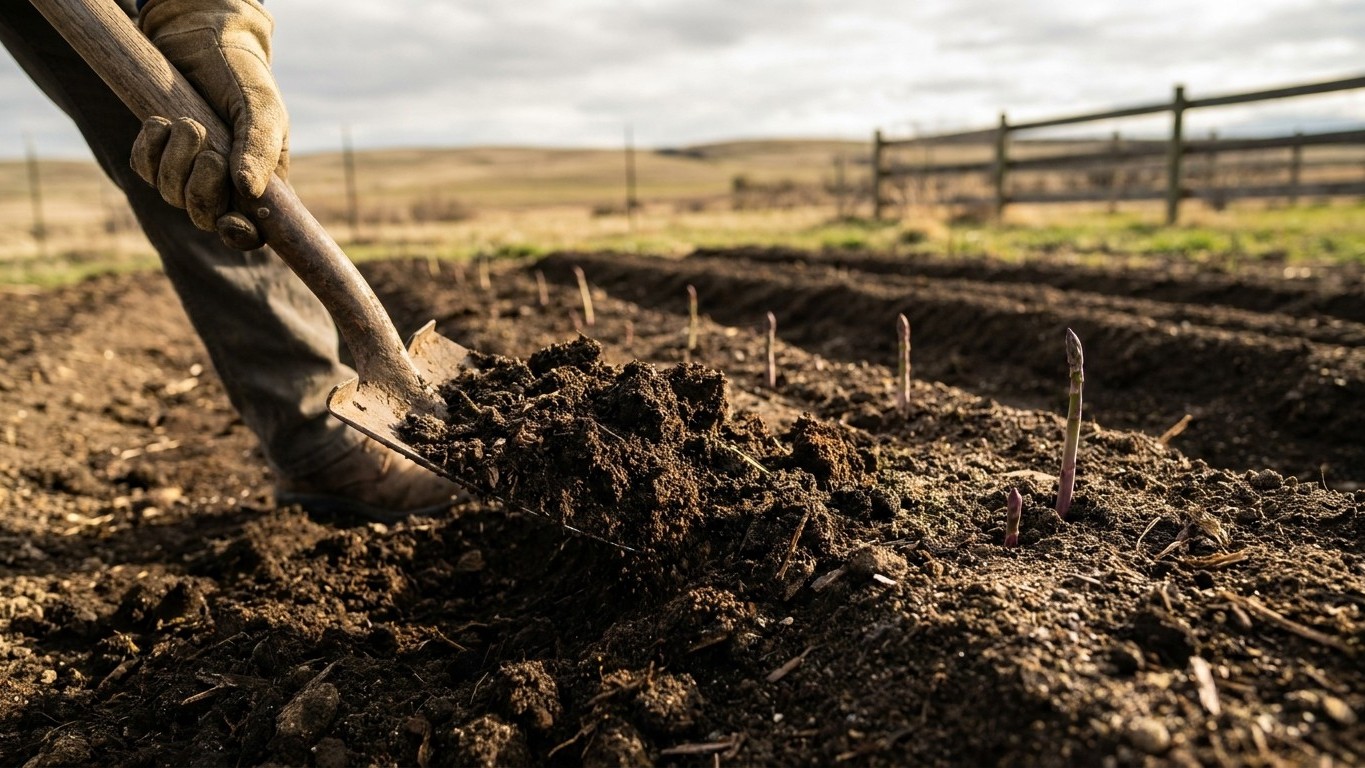

Fifteen years is a long time to bet on one patch of dirt. Will South Dakota Soil Hold an Asparagus Bed for Fifteen Years? South Dakota’s official soil, the Houdek series, drains well by nature, which means most of the state’s ground clears the first hurdle for an Asparagus Bed without any work at all. But “the state soil” and “your backyard” are not the same thing, and that gap is where this answer actually gets useful.
The short answer
Asparagus is not a crop you rotate. Once the crowns go into their furrows, the planting is expected to produce for 10 to 15 years, according to Utah State University Extension. That single fact changes how a gardener should think about soil, and about When to Plant Asparagus Crowns in South Dakota in the first place. A tomato bed with poor drainage is an annual headache, amended or cursed with every spring. an Asparagus Bed with poor drainage is a decision you live with for a decade and a half, because digging up an established stand to fix the ground underneath it defeats the purpose of planting it in the first place.
The good news, at least for anyone gardening in ground close to South Dakota’s representative soil, is that the Houdek series checks the one box asparagus actually asks for. USDA NRCS records for the surface horizon of the Houdek series describe a loam to silt loam, roughly 38 percent sand, 22 percent clay and 40 percent silt, with organic matter around 3.0 percent and a surface pH near 6.7. It’s classified well drained, and the state legislature named it South Dakota’s official soil back in 1990, a nod to how much of the state’s productive cropland resembles it. Crucially, the Utah State University source is specific: most soils will grow asparagus fine, provided they drain. Nothing else in that list, not the sand-clay-silt split, not the organic matter, not the pH, is flagged as a requirement. Drainage is the whole test.
Here’s the catch. The Houdek series is a representative profile built from measurements of its major components, a composite of what the mapped surface tends to look like across the series, not a soil test from any one garden. A river bottom lot, a hillside pasture, or a yard where a builder scraped and refilled the topsoil can behave nothing like it. So the honest answer is: if your ground resembles the state soil, or if you already know from experience that water doesn’t pool after a hard rain, you’re clear to plant and stop worrying about it. If you’re not sure, or if your yard is the kind that stays soggy for days after a storm, the fix isn’t complicated, it’s just non-negotiable before crowns go in the ground. Raised beds or mounded rows solve the drainage problem directly, and they do it once, at the start, rather than every year for the next decade and a half. A simple test works too: dig a hole about a foot deep, fill it with water, and see how long it takes to disappear. Slow drainage there means slow drainage under the whole bed, every year, for as long as that asparagus is producing.
Will the summer here water it for you?
an Asparagus Bed has a fairly specific thirst in its early years, and South Dakota’s summer rainfall doesn’t fully cover it on its own. Here’s how the numbers stack up against each other.
- The bed’s actual need: roughly 1 to 2 inches of water every other week for the first two growing seasons, tapering to about once every three weeks once the crowns are established, per Utah State University Extension guidance.
- What summer delivers, on average: NOAA’s 1991-2020 climate normals for reference station USW00014944 put June, July and August rainfall at 4.23, 3.25 and 3.34 inches respectively, for a combined 10.8 inches across the three months, out of 27.9 inches for the whole year.
- Spread that 10.8 inches evenly across roughly thirteen weeks of summer and it works out to well under an inch a week on average, below the 1-to-2-inch every-other-week target the young bed is asking for.
- July is the tightest month, at 3.25 inches, the lowest of the three summer months in the normals, which is also typically the hottest stretch, when evaporation is working hardest against whatever rain does fall.
- The practical takeaway: a new asparagus planting in South Dakota generally needs supplemental watering through its first two summers rather than relying on rainfall alone, and even an established bed benefits from a rain gauge check during dry stretches rather than an assumption that the sky is handling it.
None of this is a forecast. It’s a thirty-year average from one weather station, and rainfall in any given July can run well above or below that number. A single summer thunderstorm can also dump an inch in an hour, most of which runs off a compacted surface rather than soaking down to the crowns. The only way to know what your particular bed is getting is a rain gauge on your own property, tracked against the every-other-week target for those first two seasons.
When to put the crowns in
Crowns go into the ground in early spring, planted in furrows about 8 inches deep, according to Utah State University Extension. Timing that against South Dakota’s climate means working around the last spring frost, which NOAA’s 1991-2020 normals for station USW00014944 place at around April 29 to May 9, based on the 30-to-70-percent probability band for a 32F freeze.
That word “around” matters. A mean frost date is an average built from three decades of records at one airport weather station, not a promise about any single spring. Some years the last frost lands well before that window, some years well after it, and a rural or elevated garden away from the reference station often sees frost linger later into spring and arrive earlier in fall than the station numbers suggest. Treat late April into early May as the general target for getting crowns into workable, thawed soil, but confirm timing against your own recent frost patterns rather than treating the window as fixed.
The furrow itself isn’t filled in all at once. Crowns are set at the bottom of that 8-inch trench, and soil is backfilled gradually over the course of the year, roughly 2 inches added every other month as the shoots grow, rather than burying the crowns completely on planting day. That gradual fill gives the emerging spears room to push upward without being smothered early on.
Growing from seed is the alternative to crowns, though it adds a year to the timeline before the bed reaches the same maturity a crown-planted bed would. Whichever route a gardener chooses, the harvest clock doesn’t start early. Utah State University Extension is direct on this point: no harvest at all in the first two years, regardless of how vigorous the fern growth looks. Cutting starts in year three, and even then it’s limited, typically a few weeks of harvest that extends longer in following years as the crowns mature, with picking stopping for the season once most of the spears coming up are thinner than a pencil. That’s a physical signal, not a date on a calendar, and it’s worth checking spears against rather than guessing by the week.
On variety, Utah State University Extension names four common options: Jersey Giant and Jersey Knight, both all-male hybrids, and UC 157 F1 and Purple Passion, which run male and female. The source doesn’t rank them by flavor, yield, or regional suitability, and no nursery recommendation is published here either. The sex of the plant is the one distinction on record; anything beyond that is a call for the gardener to make on their own.
Checking this against your own county
Everything above is built on a state soil series and a single reference weather station, useful for spotting the general pattern but not a substitute for what’s actually happening on your own lot. Soil drainage varies within a few hundred feet, let alone across a county, and frost dates shift with elevation and local terrain in ways a state-level normal can’t capture.
South Dakota State University Extension, reachable at extension.sdstate.edu, is the resource built for exactly this kind of local check. A call or visit can confirm frost timing specific to your area, point you toward soil testing options, and flag anything about your particular county’s ground that the state-wide averages here don’t cover. Fifteen years is long enough that it’s worth the extra step before the crowns go in.
Common questions
Can I harvest asparagus the same year I plant crowns?
No. Utah State University Extension is clear that harvest doesn’t start until the third year after planting, regardless of how much top growth the fern puts on in years one and two.
How do I know when to stop cutting spears each spring?
Stop when most of the spears coming up are thinner than a pencil. That’s a physical signal tied to the crown’s stored energy, not a fixed number of weeks, and it changes from planting to planting.
Does South Dakota’s soil pH matter for asparagus?
The Utah State University Extension source doesn’t publish a pH requirement for asparagus, so no pH figure is given here as a target. The state soil’s surface pH runs near 6.7, but that’s a description of the Houdek series, not an asparagus growing requirement.
Is a raised bed necessary everywhere in South Dakota?
Not necessarily. Where soil resembles the well-drained Houdek series, a standard furrow planting works fine. Raised or mounded beds become the practical fix specifically where drainage is poor, since asparagus’s only real soil requirement, per the source, is that water not sit around the crowns.