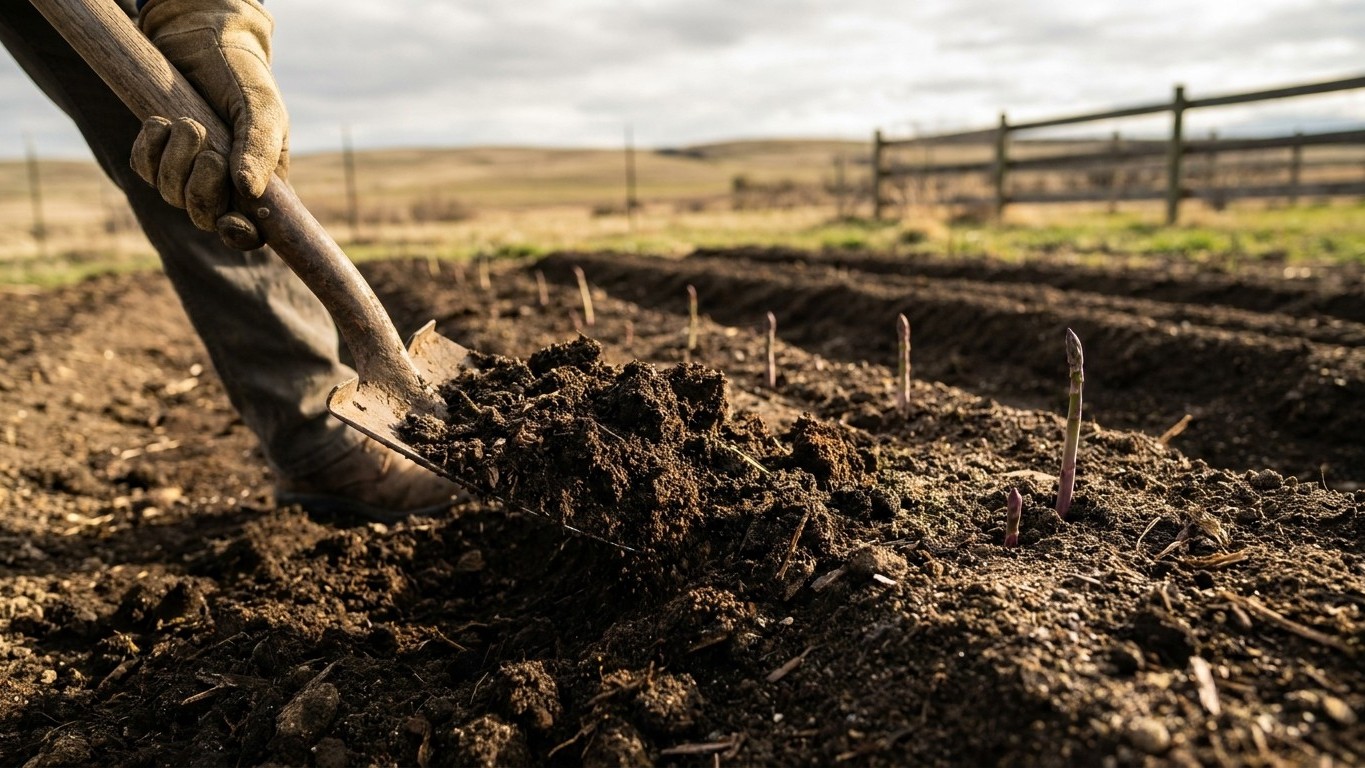

an Asparagus Bed in West Virginia can produce for a decade or more, but only if the ground it sits in drains reasonably well from day one. The state’s own representative soil, the Monongahela series, is described as moderately well drained, which is workable but not generous. Beyond that single soil condition, timing and water are what separate a bed that limps along from one that feeds a household every spring for fifteen years—which raises the real question: Will West Virginia Soil Hold an Asparagus Bed for Fifteen Years?
The short answer
West Virginia’s official state soil, the Monongahela series, is an Ultisol: old, heavily weathered, leached of nutrients over a long stretch of time. The surface horizon runs strongly acid, with a pH near 5.0, and the texture sits in loam-to-silt territory, about 27 percent sand, 18 percent clay, and 54 percent silt, with organic matter around 3.0 percent. USDA NRCS classifies it as moderately well drained. That’s the piece that matters most for a crop that expects to stay put for 10 to 15 years without complaint, because the only soil requirement published for asparagus is that the ground drains.
Moderately well drained is not the same as poorly drained, and it’s not the same as excellent, either. It means water moves through, just not fast. For most home gardeners working ground that resembles this profile, that’s enough to plant asparagus directly into a worked bed, provided the topsoil has been loosened well below the planting depth—though knowing When to Plant Asparagus Crowns in West Virginia matters just as much as the soil itself. Where the silt and clay content run higher than the Monongahela average, or where a yard sits on compacted fill from construction, that same crop can end up sitting in a bathtub every time it rains hard in spring.
The state soil is a starting point, not a diagnosis of one garden. Hundreds of soil series exist across West Virginia’s hollows, ridges, and river bottoms, and a builder’s graded lot can bear no resemblance to any of them. A cheap way to check before committing 15 years to one spot: dig a hole about a foot deep, fill it with water, and see how long it takes to disappear. If water is still standing after several hours, the fix is not to fight the native ground but to go around it, building a raised bed or a mounded row so the crowns sit above the saturation line rather than in it. A soil test through the local extension office will also confirm whether the acidity common to this soil profile needs any correction, since the asparagus planting guidance itself is silent on pH and no ideal range is published here.
Will the summer here water it for you?
Asparagus wants 1 to 2 inches of water every other week for its first two growing seasons, then eases back to every three weeks once established. Whether West Virginia’s summer sky handles that on its own, or whether a hose gets involved, comes down to how the season’s rain actually lands.
- The summer total. The reference station used for these normals shows about 13.8 inches of rain across June, July, and August combined, spread as 4.72 inches in June, 5.38 in July, and 3.75 in August, the driest of the three.
- What the young bed needs on paper. An every-other-week schedule of 1 to 2 inches works out to roughly 2 to 4 inches a month during those first two seasons, which June and July generally cover on their own, at least on paper.
- Where August gets tight. At 3.75 inches, August sits closer to the lower edge of what a first- or second-year bed wants, and that number is a normal, not a guarantee; a dry August can fall well under it.
- Why rainfall totals can still mislead. Rain that arrives as one heavy thunderstorm tends to run off rather than soak into a silt-heavy soil like the Monongahela profile, so a wet-looking monthly total doesn’t always mean the root zone actually got that water.
- The established bed. Once the every-three-week rhythm kicks in after year two, the summer normals here comfortably cover it in most years, with August again the one to watch during a dry stretch.
- The practical move. A rain gauge staked next to the bed settles the question far better than a regional average ever could, and it’s the only way to know when a supplemental soak is actually due.
When to put the crowns in
Crowns go into the ground in early spring, planted in furrows about 8 inches deep. In West Virginia, that window sits around the last spring frost date, which the reference station’s 1991-2020 normals place between April 9 and April 23. That’s a mean date, not a promise, so treat it as a target to plant around rather than a line to plant on, and keep an eye on the extended forecast before committing crowns to open ground.
The furrow itself is not filled in all at once. As the young shoots emerge and grow, soil gets pulled back in gradually, about 2 inches every other month across the first year, until the trench is level with the surrounding bed. Rushing that fill can smother new growth before it has a chance to establish.
Patience matters even more once the crowns are in, because there is no harvest at all in the first two years. The first cutting comes in year three, and even then it’s limited: about 4 weeks of harvest that first cutting year, extending to roughly 6 weeks the following year, and up to 8 weeks once the bed is fully mature. The stopping point each season isn’t a date on a calendar; it’s a visual cue. Harvest ends for the year once most of the spears coming up are thinner than a pencil, a sign the plant needs to stop being cut and start rebuilding its root reserves for next spring.
Gardeners who’d rather start from seed instead of crowns can, though it adds a full growing season before anything goes into the permanent bed, since seedlings need to be raised first and then transplanted. As for what to plant, Utah State University Extension names four varieties without ranking them on flavor or yield: Jersey Giant and Jersey Knight, both all-male varieties, and UC 157 F1 and Purple Passion, which include both male and female plants. No preference among the four is published, so the choice comes down to what’s available locally rather than any documented performance difference.
Checking this against your own county
Every figure here describes a reference station and a representative soil series, not any one backyard in Charleston, Morgantown, or the Eastern Panhandle. A river valley warms and thaws differently than a ridge a few hundred feet higher, and that shift shows up first in fall, when higher elevations across the state freeze noticeably earlier than the valley floor.
The most reliable next step is a call or visit to West Virginia University Extension, which can run a soil test on the actual dirt in question, confirm local frost timing county by county, and flag any drainage quirks tied to the specific area. That’s the kind of ground-truthing no state-level normal can replace.
Common questions
Can asparagus grow in acidic West Virginia soil without amendment?
No pH target for asparagus is published in the guidance behind this article, so no claim is made here about whether the acidity typical of soils like the Monongahela series needs correcting. A soil test is the way to settle that for a specific plot.
How long before an Asparagus Bed produces anything at all?
Nothing is harvested in the first two years. The first cutting happens in year three, and it’s a short one, expanding gradually over the following seasons as the bed matures.
Does West Virginia’s rainfall mean a new asparagus bed never needs watering?
Not reliably. June and July normals generally cover what a young bed needs, but August runs drier, and rain that falls as a single storm can run off rather than soak in, so supplemental watering during dry stretches is still often necessary.
Is one asparagus variety better suited to West Virginia than another?
No documented difference in performance is published among Jersey Giant, Jersey Knight, UC 157 F1, or Purple Passion. The published distinction is only whether a variety is all-male or includes both male and female plants.