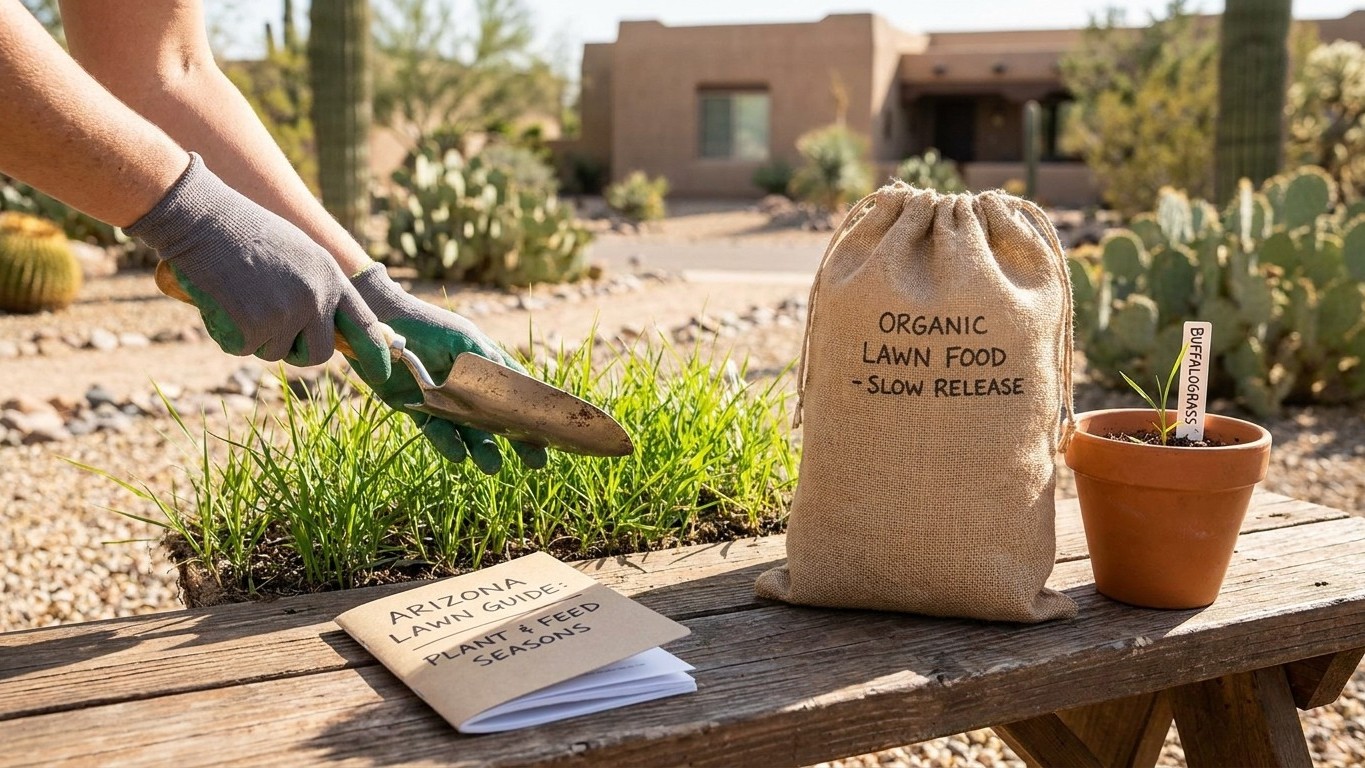

Tall fescue sown into a Phoenix yard every fall looks lush for exactly one season, then collapses the moment June heat sets in — because no cool-season grass survives 169 days above 90°F here. That mistake costs more than a dead lawn: it’s a reseed each autumn, a water bill that never drops, and bare patches all summer while the ground waits for cooler nights that won’t come soon enough. Planting the right grass at the right moment, as mapped out in the Arizona lawn Calendar, ends that cycle for good.
Which grass belongs in Arizona

Two numbers settle this. NOAA’s 1991-2020 climate normals for Phoenix put the coldest month’s mean minimum at 44.8°F, which is too mild to trigger the dormancy a cool-season grass needs, and too warm to keep one alive through a full Arizona summer once temperatures climb. The same normals record 168.9 days a year at or above 90°F, a stretch of sustained heat that a cool-season lawn simply cannot hold green turf through. Together those figures place the reference city firmly in warm-season territory, not the transition zone where a grower has to split the difference between two imperfect options.
Clemson Cooperative Extension’s guide to selecting a lawn grass, HGIC 1214, lists the species built for that kind of heat: Bahiagrass, Bermudagrass, Carpetgrass, Centipedegrass, Seashore Paspalum, St. Augustinegrass and Zoysiagrass. Not all of them fit an arid yard equally well, as this rundown of Arizona lawn Best grass options lays out in more detail. Bermudagrass and Seashore Paspalum handle drought and full sun with the least fuss, which is why Bermudagrass shows up on more Arizona lawns than any other species. Zoysiagrass tolerates the same heat but establishes more slowly from seed. St. Augustinegrass, Centipedegrass, Carpetgrass and Bahiagrass were bred for the humid Southeast, and they generally want more consistent soil moisture than a low desert yard gets without heavy irrigation.
The species options at a glance
- Bermudagrass: full sun, high heat and drought tolerance, the most common Arizona lawn grass
- Zoysiagrass: similar heat tolerance, slower to fill in from seed than Bermudagrass
- Seashore Paspalum: drought tolerant, also handles higher-salinity irrigation water
- St. Augustinegrass: prefers more consistent moisture, better suited to partial shade
- Centipedegrass, Carpetgrass, Bahiagrass: bred for humid regions, need more supplemental water here
This is a Phoenix reading, not a statewide one. Higher ground and the far north of the state don’t share that 44.8°F coldest-month minimum. Flagstaff and the high country freeze hard and sit in a different climate entirely, closer to the cool-season and transition-zone territory covered in New Mexico Lawn Care: What to Plant and When to Feed It, where elevation changes the whole calendar. A cool-season lawn of the kind grown across Pennsylvania Lawn Care: What to Plant and When to Feed It would go dormant and thin out fast under a Phoenix summer, so don’t bring that seed mix south.
When to seed or sod here
Clemson Cooperative Extension’s HGIC 1203 sets the general rule: warm-season grasses go in around May, cool-season grasses around mid to late September, because each species is planted at the start of the half-year it actually grows in. Arizona’s low desert doesn’t get a vote on the second half of that rule, since it has no cool-season lawn to plant in fall.
What’s unusual about the reference city is what doesn’t limit that spring window. NOAA’s RCC ACIS daily records for the Phoenix station show a 32°F freeze in only 6 of the last 30 springs, and NOAA lists the frost-free season there at 365 days. Frost is not the constraint on when to plant in the low desert. Heat is. A seedling or a fresh sod cutting laid down just before the run of 90°F-plus days that NOAA measures at 168.9 annually will struggle to root before it’s asked to survive full summer stress.
That leaves growers working around the same heat window from the other direction: get warm-season grass in early enough in spring that it has weeks to root before the hottest stretch of the year arrives, or wait for the same species to be planted once that peak heat has broken. Either way, the planting decision follows the heat calendar, not a frost date, because in this territory there mostly isn’t one.
The feeding calendar that fits this climate
Nitrogen goes down on the calendar the grass is actually growing on, not the one hanging in the garage. A warm-season lawn in Arizona is putting on growth from spring through the hottest part of summer, so that’s when it wants nitrogen. Fertilizing it in winter, when a warm-season lawn is dormant and brown, feeds nothing but weeds.
Clemson Cooperative Extension publishes a separate maintenance calendar for each warm-season species, and the timing and rate differ enough between them that the right one to open depends on what’s actually growing in the yard:
| Species | Feeding season | Extension calendar |
|---|---|---|
| Bermudagrass | Late spring through summer growth | Clemson HGIC 1216 |
| Zoysiagrass | Late spring through summer growth | Clemson HGIC 1217 |
| Centipedegrass | Late spring through summer growth | Clemson HGIC 1215 |
| St. Augustinegrass | Late spring through summer growth | Clemson HGIC 1218 |
Each of those calendars sets exact rates in pounds of actual nitrogen per 1,000 square feet for every month of the growing season, and the numbers are not the same across species. Bermudagrass, which carries most Arizona lawns, is fed on a heavier schedule than Centipedegrass, which is bred to run on very little. Open the calendar for the grass actually in the ground and follow its own monthly rate rather than borrowing a number from a neighbor’s St. Augustinegrass lawn.
Mowing height and watering here
Mowing
Warm-season species are mowed on their own scale, not the taller cut common on cool-season lawns. Bermudagrass is typically kept short, often under an inch and a half, while Zoysiagrass, Centipedegrass and St. Augustinegrass are usually mowed a notch or two taller. The number that matters more than any single height is the one-third rule: never remove more than a third of the leaf blade in one pass. Skip a week and let a warm-season lawn get tall, and scalping it back down in one mow stresses the plant right when Arizona heat is already doing that on its own.
Watering
An inch of water a week, delivered in one or two sessions rather than daily sprinkles, is the figure most often quoted for an established lawn. It moves in both directions here. On the days included in Phoenix’s 168.9-day average at or above 90°F, a warm-season lawn loses water faster than that baseline figure assumes, and sandy, fast-draining desert soil holds onto less of what it’s given between waterings. The practical fix is not simply watering longer. It’s watering deeply enough to wet the root zone, then letting the surface dry out before the next session, so roots are pulled down rather than kept shallow by frequent light sprinkling.
What goes wrong on lawns in Arizona

The failures that show up here follow directly from the two numbers that set the zone in the first place: long heat and a coldest month that barely dips below 45°F.
Dormancy read as death
A warm-season lawn goes tan and stops growing once temperatures drop, and it can also brown off during a stretch of extreme summer dryness if watering falls behind. Neither is dead turf. Pulling a few blades and checking for green at the crown, rather than reseeding or resodding on sight, saves a lot of unnecessary work.
Winter weeds that never quit
Because the coldest month at the reference station holds a mean minimum around 44.8°F, winter here rarely gets cold enough to knock back cool-season weeds the way a harder freeze would. A dormant, brown warm-season lawn with bare-looking turf is exactly the gap winter weeds move into, and they can keep growing right through a mild winter instead of stopping.
Fungal disease during humid spells
Most of the year, Arizona’s dryness works against fungal turf disease. During a humid summer stretch, an overwatered warm-season lawn can still develop patches of brown, thinning turf consistent with fungal disease, which is a different problem from heat dormancy and needs different watering and mowing adjustments rather than more nitrogen.
- Tan, uniform browning across the whole lawn in cool weather: dormancy, not death
- Green weeds persisting through winter in a brown lawn: mild-winter weed pressure
- Irregular brown patches with a defined edge during a humid spell: possible fungal disease
Local help
A soil test settles most of the guesswork a general calendar can’t, and county-level advice accounts for the microclimate differences a statewide figure glosses over. The University of Arizona Cooperative Extension runs county offices that handle both, and its agents can also confirm which warm-season species and feeding schedule fit conditions closer to your own address than the Phoenix reference figures used here.
Common questions
Can I grow a cool-season lawn in Phoenix if I water it enough?
Not through a full summer. Extra water doesn’t change the underlying heat load, and NOAA’s 168.9-day average of 90°F-plus temperatures at the Phoenix station is long enough to wear down a cool-season grass regardless of irrigation.
Why does my Bermudagrass lawn go completely brown every winter?
It’s dormant, not dead. Bermudagrass and the other warm-season species stop active growth and lose their green color once temperatures drop, and they green back up on their own once the growing season resumes.
Should I overseed my warm-season lawn with ryegrass for winter color?
That’s a cosmetic choice, not a maintenance requirement. Overseeding gives green color through the dormant months but adds mowing and watering work on a lawn that would otherwise rest, and it needs to be timed and phased out carefully so it doesn’t compete with the warm-season grass as it wakes up.
Why does my new sod keep dying even though it’s not frost season?
Heat stress, not cold, is the usual culprit here. Sod laid right before a run of extreme heat hasn’t had time to root before it’s asked to survive it, which is why timing around the heat calendar matters more than the frost calendar in this territory.
Is Bermudagrass the only option for a low-water Arizona lawn?
It’s the most common choice, but not the only one. Seashore Paspalum offers similar drought tolerance and also handles higher-salinity irrigation water, making it worth checking against your own water source and budget before deciding.