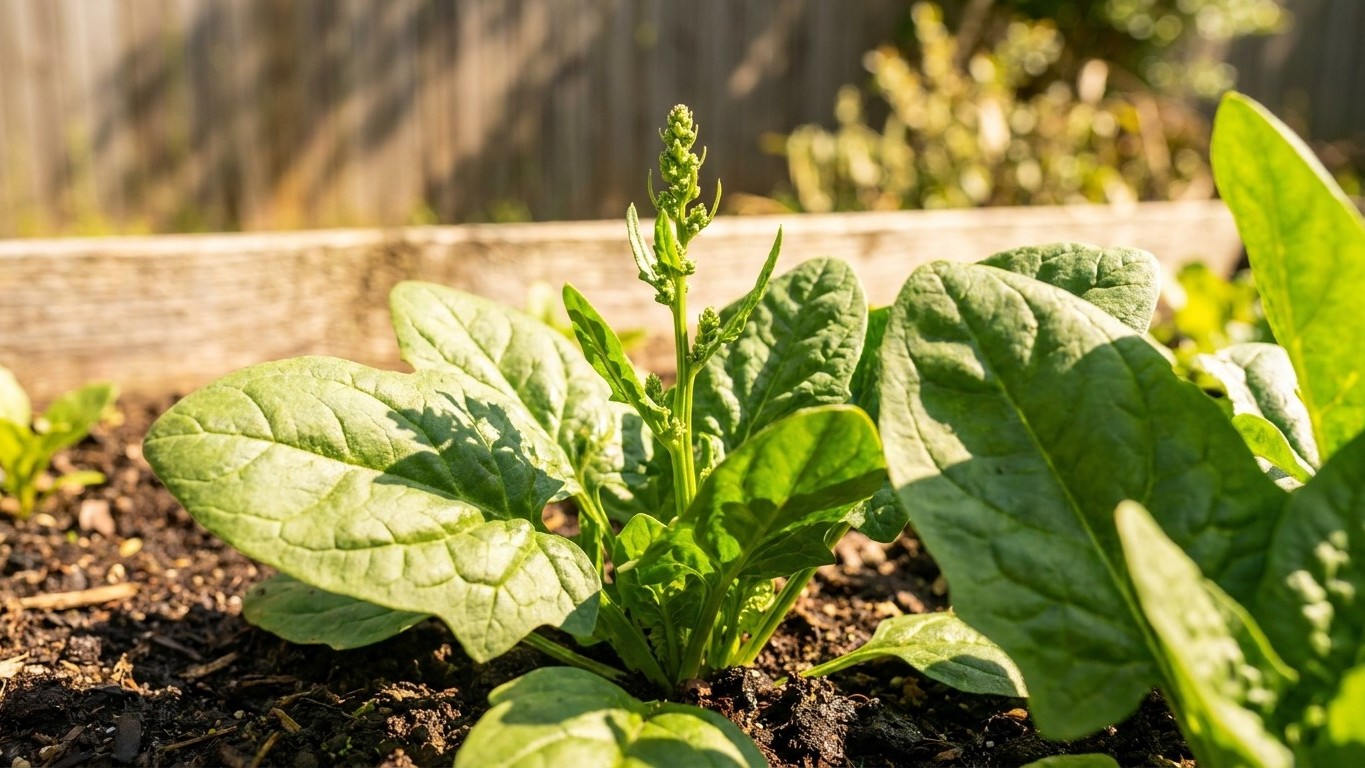

Yes, and day length is the reason, not the mercury. Wisconsin’s summer sun stays up long enough that spinach starts running to seed even in a mild June, no heat wave required. That timing forces the spring crop into a narrow window between the last frost and the first truly long days, while the more forgiving crop of the year is the one sown in August for an October harvest.
The short answer
On the longest day of the year, Wisconsin gets 15 hours and 10 minutes of daylight. That number decides spinach’s fate here more than any thermometer reading does. Long days push spinach into flower, and a mild Wisconsin June does nothing to slow that clock: the plant is reading sunlight, not the forecast. A gardener who waits out a cool spell hoping to buy another week or two of harvest is fighting the wrong variable.
That doesn’t mean heat plays no role. Wisconsin’s summer isn’t brutal by national standards; the reference station near Milwaukee averages only 7.0 days a year at 90 F or hotter. But spinach doesn’t need 90-degree extremes to suffer. Its growth ceiling sits at 75 F, and that same 75 F mark is also where the leaves start turning bitter. Ordinary June and July afternoons in southern and central Wisconsin routinely climb past that mark well before the state sees anything close to a genuine heat wave. Heat does contribute, just not the way most people assume: it’s the everyday warmth of a normal Wisconsin summer, not the rare scorcher, that finishes off what long days already started.
Put the two together and the honest answer is both, with day length doing most of the damage first. By the time day length approaches its June peak, Spinach in Wisconsin gardens is already committing to seed stalks whether or not the summer turns out mild or muggy. The 75 F ceiling then makes sure that any plant that hadn’t already bolted from day length alone gets pushed over the edge by ordinary summer warmth soon after. Northern Wisconsin, where summer arrives later and stays milder, buys a bit more breathing room than the southern part of the state, but the same daylight clock ticks at essentially the same rate everywhere in the state, since day length depends on latitude, not on local weather.
The practical result: spinach grown in Wisconsin is a spring-and-fall crop, not a summer one. Gardeners who treat it as a June-through-August vegetable, the way they might treat tomatoes or peppers, will watch it bolt before they get much of a harvest. The two workable windows sit on either side of the long-day season, and each has its own separate obstacle, worked through below in order.
How long the spring window really is
Spring spinach in Wisconsin lives inside a narrow band bounded by frost on one side and day length on the other. Working through the numbers in order shows just how tight that band really is.
- Earliest sowing date. Spinach seed goes into the ground 2 to 3 weeks before the last spring frost. Wisconsin’s last spring frost falls between April 16 and April 29, depending on where in the state you garden. That puts the earliest safe sowing somewhere between late March and mid-April.
- Germination through early growth. Once seeded, spinach grows well as long as soil and air stay below the 75 F ceiling, which is rarely a problem in a Wisconsin April or early May. This stretch of cool, workable weather is where most of the usable harvest actually happens.
- Day length climbing toward the solstice. Every week that passes after sowing, the days get longer, and Wisconsin is heading toward that 15-hour-10-minute peak in June. Because long days trigger bolting on their own, the plant doesn’t wait for a heat wave to start running to seed; it starts responding to day length well before summer heat ever becomes a factor.
- Where the two limits meet. By late May or early June, day length is closing in on its yearly maximum at nearly the same moment ordinary Wisconsin warmth starts pushing past that 75 F ceiling. The two pressures arrive almost together, which is what makes the spring window close quickly rather than fade out gradually.
- The net result. Counting from an April sowing to that late-May or early-June cutoff, Wisconsin gardeners get somewhere in the neighborhood of six to eight usable weeks of spring spinach, sooner in the southern part of the state, a little later moving north.
That’s a workable harvest, but it’s a sprint, not a season. Sowing a small patch every 10 to 14 days through that window can stretch the supply of leaves a little, but it won’t outrun the day-length clock once it finally arrives. Anyone sowing spinach in Wisconsin and expecting a spring-into-summer supply the way they might get from lettuce or kale is planning around the wrong crop.
The autumn crop, and when the soil lets you sow
The fall spinach crop is the one Wisconsin gardeners should lean on, but it comes with its own countdown, running backward from harvest instead of forward from frost.
Soil still too warm to germinate
Spinach seed struggles to sprout once soil temperatures climb above 80 F, and Wisconsin soil in early-to-mid August still carries the heat of the growing season, even though the state doesn’t see extreme air temperatures often (only about 7 days a year reach 90 F or higher at the reference station). That modest heat load means Wisconsin’s soil-cooling window likely arrives sooner and more reliably than it does in hotter states, but the obstacle is still real: seed sown into soil that hasn’t cooled below that 80 F mark will germinate poorly, if at all. Gardeners watching for the fall window need to track the soil itself rather than a fixed date on the calendar, and hold off until that midsummer heat has actually broken.
The frost that ends the season
On the other end of the fall crop sits Wisconsin’s first frost, arriving between October 17 and October 29 depending on location, later along the Lake Michigan shoreline, earlier inland and in the north. The guidance for a fall crop is to plant 50 to 75 days before the date you actually want to harvest, not before the frost date itself. Counting back from a harvest targeted around Wisconsin’s first-frost window puts fall sowing somewhere between early August and early September, with the exact date depending on how close to frost a gardener wants that final harvest to land.
Put the two obstacles together and the fall sowing window in Wisconsin is real but narrow: it opens once soil finally cools below that 80 F threshold, typically as August wears on, and it closes once the 50-to-75-day countdown from the October frost window runs out. Missing the early end means sowing into soil that won’t let seed germinate; missing the late end means running out of growing days before frost. Four spinach varieties commonly discussed for home gardens are Bloomsdale, Melody, Teton, and Olympia, though no comparative maturity or bolt-resistance data for any of them is published by the source behind these figures.
Common questions
Does a cool Wisconsin summer keep spinach from bolting?
No. Long days trigger flowering on their own, separate from temperature. Wisconsin’s roughly 15-hour-10-minute daylight around the solstice pushes spinach toward bolting regardless of whether the summer happens to run mild or muggy.
What’s the real difference between the spring and fall windows?
Spring is limited by an approaching wall of long daylight arriving right behind a short window of frost-safe, cool weather. Fall is limited by the opposite problem: soil that starts out too warm to germinate seed, with a hard stop set by the first frost roughly 50 to 75 days later.
Does northern Wisconsin get more growing time than the southern part of the state?
A little, mostly through frost timing rather than daylight. Day length at the solstice runs nearly the same statewide since it depends on latitude, but the north tends to stay cooler into early summer and reach its first fall frost earlier, shifting the fall window slightly earlier rather than lengthening it.
Which spinach variety should Wisconsin gardeners choose?
Bloomsdale, Melody, Teton, and Olympia are commonly grown varieties, but no published data compares their bolt resistance or days to maturity. Variety choice may matter at the margins, but it doesn’t change the underlying day-length and soil-temperature limits described above.