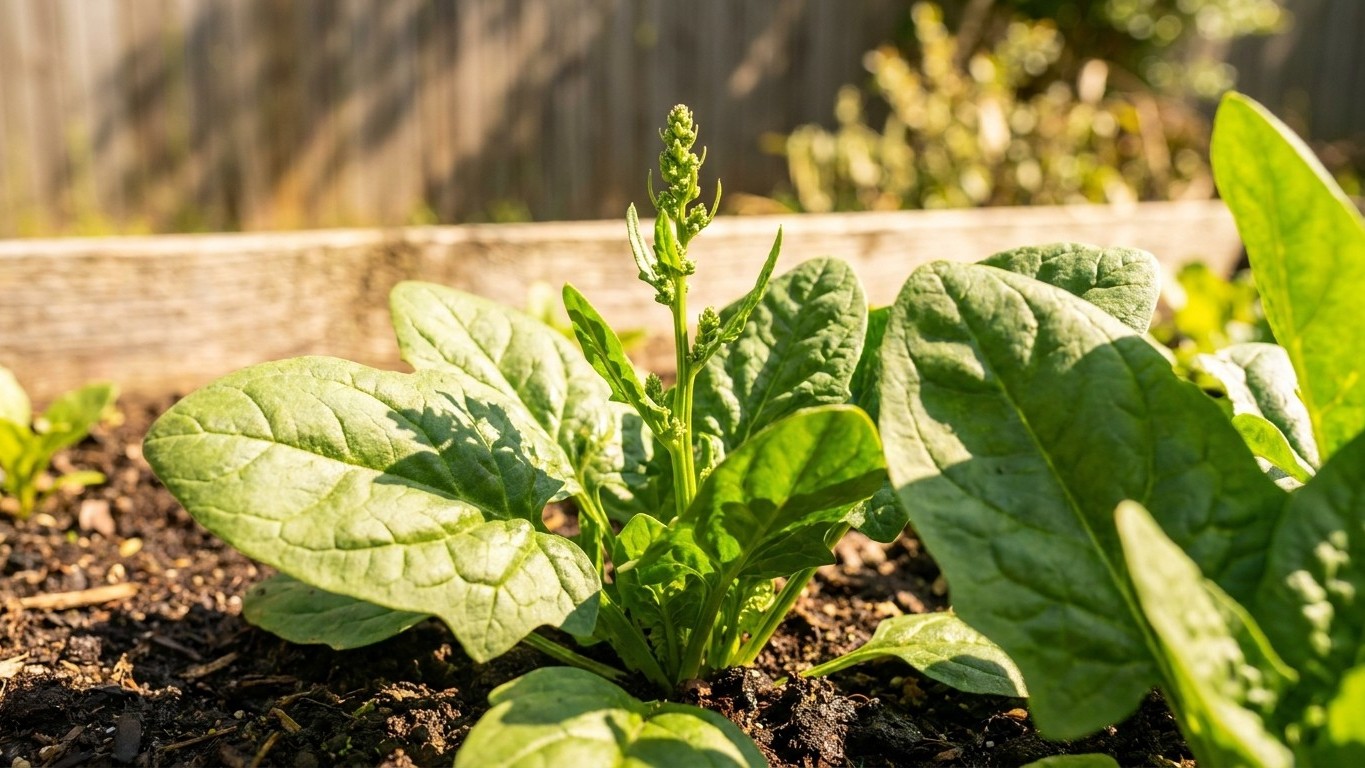

Yes, spinach bolts early almost every year in the Yukon. The trigger isn’t heat, this territory averages zero days a year above 90 F, it’s the light itself. By the time the summer solstice pushes daylight past 18 hours here, spinach reads that as its cue to send up a flower stalk, whatever the thermometer says. The real question for a Yukon gardener isn’t whether bolting happens. It’s how many weeks of leaf you can harvest before it does.
The short answer
On the longest day of the year, Whitehorse gets 18 hours and 45 minutes of daylight. That is not a typo, and it is not a fluke of one unusual summer, it is what happens at this latitude every year the sun swings this far north. For most vegetables that kind of light would be a gift. For spinach, it is closer to an eviction notice. Spinach flowers, or bolts, in response to long days and warm temperatures acting together, and the day-length trigger alone is enough to push it toward seed even when the air stays cool. That single fact reshapes everything about growing spinach here.
A gardener used to reading about “short, cool summers” might assume that a mild Yukon July buys extra weeks of leaf growth before bolting sets in. It does not. The mechanism that ends the spinach harvest is not heat stress, it is the clock of daylight hours climbing toward the solstice and staying near its peak for weeks on either side. A cool summer changes how the plant looks going into bolt, sometimes it stays a little more tender a little longer, but it does not change the underlying signal telling the plant to flower. Long days do that on their own.
So which is it here, day length, heat, or both? In the Yukon, day length is doing almost all the work. The heat side of the equation barely exists at this station: with an average of 0.0 days a year reaching 90 F, and a growing season that rarely pushes anywhere near a spinach-stressing ceiling, warmth is not what’s cutting the harvest short. It is the light. That is a useful distinction, because it means the usual advice about mulching, shading, or watering to keep roots cool, tricks that fight heat, will do very little against a bolting trigger that is really about hours of daylight. What actually helps is timing: getting a crop of leaves in and out of the ground in the window before the daylight hours climb high enough, and long enough, to flip the switch.
It also means the calendar matters more than the forecast. A Yukon gardener checking a weather app for a mild, cool stretch and assuming spinach will hold is looking at the wrong variable. The plant isn’t counting degrees. It’s counting daylight hours, and in a place where the summer sun barely dips below the horizon, that count runs high fast. This is the piece of the puzzle that catches people off guard: the very trait that makes the Yukon summer feel gentle and workable, long bright evenings, is the same trait working against a cool-season leaf crop like spinach.
How long the spring window really is
Sowing spinach 2 to 3 weeks before the average last spring frost is the standard approach, and it applies here the same as anywhere, with one caveat worth repeating: the frost date itself is only an average. Working through what that means in practice for this territory looks something like this:
- Start from the average last frost. Environment and Climate Change Canada’s climate normals put the average last spring frost at Whitehorse A on June 5. That is a mean date, not a guarantee, and in roughly half of all years frost arrives later than that, sometimes considerably later.
- Count back 2 to 3 weeks for sowing. That puts a realistic seeding window somewhere in mid to late May, with the understanding that a late frost year could still nip young seedlings if they’re sown at the earlier end of that range.
- Check the heat ceiling, and find it’s barely a factor. Spinach grows best where temperatures stay under 75 F. Given that this station sees an average of 0.0 days a year above 90 F, the plant is almost never fighting heat stress through a Yukon spring or early summer. This is one obstacle that essentially disappears here.
- Watch the daylight climb instead. Day length in mid-May is already substantial and rising fast toward the June solstice peak of 18 hours 45 minutes. This is the clock that actually matters, and it keeps advancing whether the weather cooperates or not.
- Land on a usable window of roughly three to four weeks. Seed sown in mid to late May has a shot at reaching harvestable leaf size before the lengthening days around the solstice push the plant toward bolting. That is a tight window, not a long, forgiving one, and it closes on schedule regardless of how cool the summer feels.
None of this means spring spinach is a lost cause in the Yukon. It means the window is short and light-driven rather than frost-driven, and a gardener who treats the solstice as the real deadline, rather than watching only for hot afternoons, will get more usable harvests out of it.
The autumn crop, and when the soil lets you sow
A fall planting sidesteps the solstice problem entirely, since daylight is shortening rather than lengthening by the time late-summer sowings mature. But it runs into two different obstacles on its way to harvest, one at the start of the season and one at the end.
Soil that’s still too warm to germinate
Spinach seed germinates poorly once soil temperatures climb above 80 F, according to Utah State University Extension. In many hotter parts of the country this is the obstacle that decides when a fall sowing can even begin, gardeners there have to wait for soil to cool down after a scorching summer before seed will come up reliably. In the Yukon, this barrier is close to a non-issue. With an average of 0.0 days a year reaching 90 F, soil here rarely if ever approaches an 80 F germination ceiling, even at the height of summer. A Yukon gardener planning a fall spinach crop can largely set this concern aside and focus on the other end of the calendar instead.
The frost that ends the season
That other end is the first fall frost, and it arrives early here. Environment and Climate Change Canada’s climate normals for Whitehorse A put the average first fall frost at August 25, again a mean date rather than a hard line, with roughly half of all years seeing frost arrive later than that. Utah State University Extension’s guidance for a fall crop is to sow 50 to 75 days before the date you want to harvest. Counting back from August 25 puts a sowing window somewhere between roughly June 11 and July 6, depending on how much cushion a grower wants before that average frost date.
That is a narrow, specific slot, and it is worth sitting with for a moment: a fall spinach crop in the Yukon has to be sown while summer daylight is still near its longest, which brings the bolting risk from the spring section right back into play unless the sowing happens late enough in that window that falling day length starts working in the plant’s favor before heat or light push it to flower. Growers here are threading a needle between two moving deadlines, shortening days that eventually help, and an early frost that eventually ends things, with only a few weeks of genuinely reliable growing in between.
On variety choice, several names come up often in general spinach growing guides, including Bloomsdale, Melody, Teton, and Olympia. A gardener weighing options should treat variety selection as a separate question from the timing math above, which holds regardless of which seed is in the packet.
Common questions
Does a cool Yukon summer delay spinach bolting?
Not meaningfully. Bolting in spinach is driven by long days as well as warmth, and the Yukon’s extended summer daylight, up to 18 hours 45 minutes on the solstice, triggers the flowering response on its own. A cool stretch of weather does not cancel out that light signal.
Is heat ever the real problem for Yukon spinach?
Rarely. The reference station for this territory averages 0.0 days a year at or above 90 F, so the 75 F growth ceiling for spinach is seldom under serious pressure here. Day length, not heat, is doing almost all the work in pushing plants toward bolting.
Can I trust the June 5 last frost date to plan sowing?
Treat it as a midpoint, not a promise. It’s the average last spring frost recorded at Whitehorse A over the 1981-2010 climate normals period, which means frost falls later than June 5 in roughly half of all years. Sowing 2 to 3 weeks ahead of that date still carries some risk in a late year.
When should I sow a fall spinach crop in the Yukon?
Counting back 50 to 75 days from the average first fall frost of August 25 points to sowing sometime between roughly June 11 and July 6. Warm soil isn’t the obstacle it is in hotter regions here, since germination-limiting temperatures above 80 F are almost never reached, but the early frost date still sets a firm outer boundary on the season.