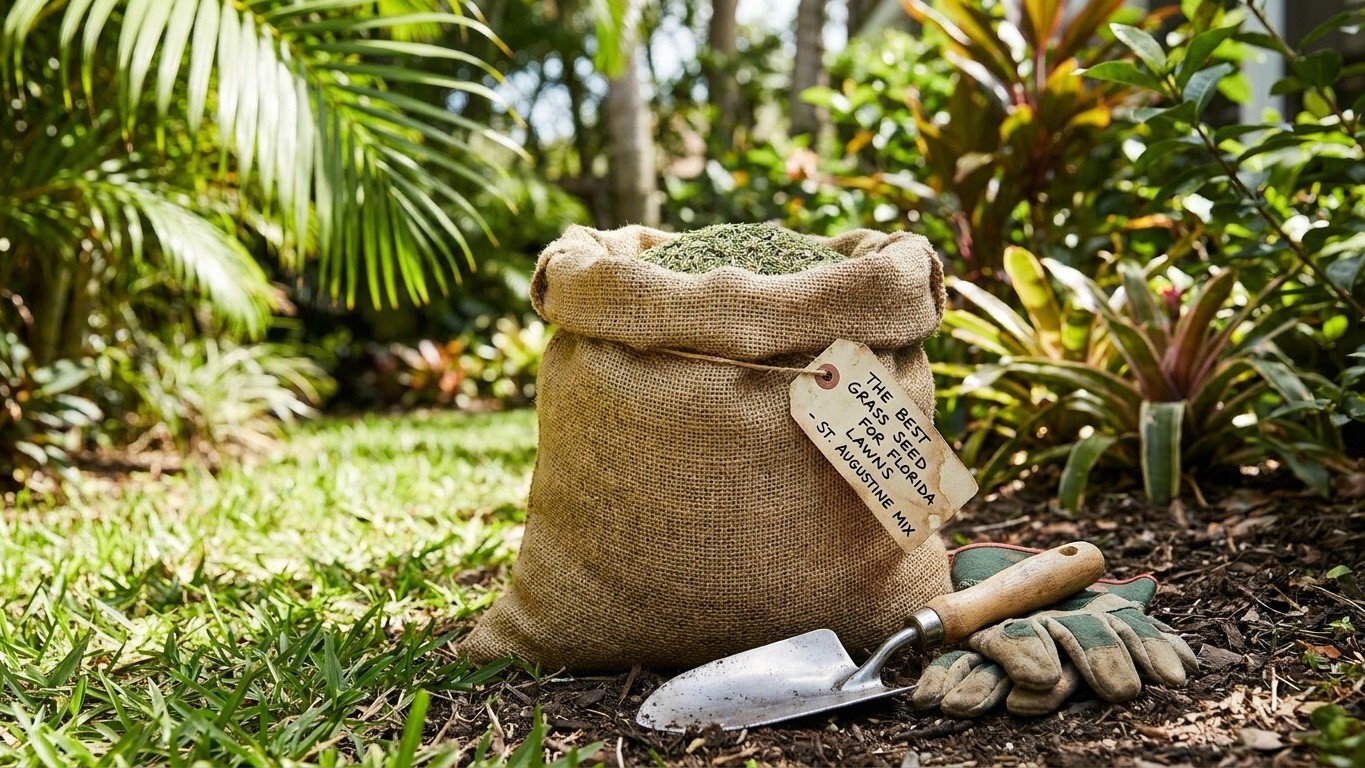

There’s no single best grass seed for your whole state — Florida is warm-season territory everywhere, but which of the seven warm-season grasses fits your yard depends on how much shade you get, how close you sit to salt water, and how much mowing and foot traffic the lawn takes. Bahiagrass and common Bermudagrass are the two you’ll actually find sold as seed and worth starting that way; the rest come with real tradeoffs or aren’t seeded at all. Before you buy anything, walk your yard and check those three things — shade, salt exposure, wear — because the wrong match fails no matter how good the bag looks.
The short answer for Florida
Florida’s grass has to be a warm-season species, full stop. Clemson’s HGIC 1214 splits US turf into cool-season, warm-season and transition-zone types, and the numbers behind this state’s placement, days at or above 90°F and the mean daily minimum of the coldest month, put north Florida squarely in the warm-season camp using Jacksonville as the reference point. Central and south Florida run warmer still, so the same seven species Clemson names as warm-season options, Bahiagrass, Bermudagrass, Carpetgrass, Centipedegrass, Seashore Paspalum, St. Augustinegrass and Zoysiagrass, are the only realistic choices anywhere in the state.
That answer depends on three things you have to check in your own yard before picking one: how much shade you get, how close you are to salt water or winter road salt runoff, and how much foot traffic and mowing you can keep up with. Skip that step and the seed itself barely matters, because a shade-intolerant species thinning under an oak canopy, or a salt-sensitive one along a brackish canal, fails regardless of germination rate or price per pound.
Seed availability narrows the seven further. Bahiagrass and common Bermudagrass are the two most widely sold as raw seed you sow yourself. Centipedegrass seed exists but germinates slowly and needs a longer establishment window than most homeowners expect. Zoysiagrass is sold as seed but is notoriously slow to fill in, which is why most Zoysia lawns start from sod or plugs instead. St. Augustinegrass, the grass most people picture when they think of a Florida lawn, is almost never sold as seed at all. It’s established from sod, plugs or sprigs, so if you’re set on St. Augustine, seed isn’t the path. If you haven’t yet handled the site prep and soil test that come before any of this, that groundwork is covered in Florida Lawn Care.
Working through the year

Rank the seven by what each one costs you, not by which name sounds most familiar.
Which species earns its place
Bahiagrass is the cheapest and most forgiving grass you can seed in Florida, tolerating poor sandy soil and long dry spells. In exchange it forms an open, coarse-bladed lawn with visible seed stalks that some homeowners find ragged next to a denser turf. Common Bermudagrass seeds in cheaply too and recovers fast from wear, which suits a yard with kids or dogs, but it needs full sun and more frequent mowing to stay dense, and it goes fully dormant and tan once north Florida’s fall frost sets in, which some owners mistake for a dead lawn rather than a resting one.
Which species costs more to get right
Centipedegrass trades a slower start for lower long-term upkeep. It needs less nitrogen and less mowing than Bermudagrass overall, but seeded Centipede takes a full growing season to close in, and it resents high soil pH and heavy fertilizer, punishing anyone who treats it like a typical lawn grass. Zoysiagrass seed germinates unevenly, and the resulting turf fills in far slower than Zoysia started from plugs, so anyone choosing Zoysia by seed should expect at least one thin, patchy season before it knits together. Seashore Paspalum, the most salt-tolerant of the seven, is worth its higher seed cost only within reach of brackish water or winter road salt spray.
Where seed alone won’t get you there
St. Augustinegrass and most improved Bermudagrass and Zoysiagrass cultivars sold at Florida garden centers are hybrids that don’t breed true from seed, so nurseries sell them as sod, plugs or sprigs instead. If a shady, high-traffic yard points you toward St. Augustine, budget for sod rather than a seed bag, and treat the seeding notes above as applying to Bahiagrass, common Bermudagrass, Centipedegrass and Zoysiagrass seed specifically.
| Species | Shade tolerance | Salt tolerance | Sold as raw seed |
|---|---|---|---|
| Bahiagrass | Low | Low | Yes, widely |
| Bermudagrass (common) | Low | Moderate | Yes, widely |
| Carpetgrass | Moderate | Low | Limited |
| Centipedegrass | Moderate | Low | Yes, slow to establish |
| Seashore Paspalum | Moderate | High | Limited, costly |
| St. Augustinegrass | High | Moderate | Rarely, sod or plugs standard |
| Zoysiagrass | Moderate | Moderate | Yes, slow to fill in |
What changes across Florida
Jacksonville, the station NOAA uses for the 1991-2020 climate normals behind these dates, sits far enough north that its first fall frost lands somewhere between November 26 and December 13. That window holds for the Panhandle and most of north Florida, but it stops applying almost as soon as you cross into central Florida. Even within north Florida it’s a single-station read: Tallahassee, at higher inland elevation, and the towns along the Georgia border often see a harder, earlier frost than Jacksonville’s coastal airport records, while the immediate coastline just south of the city rarely freezes in the same season at all.
Orlando and the rest of the central peninsula see frost far less reliably than Jacksonville, and Miami, the Keys and most of coastal south Florida are effectively frost-free. That difference does more than shift a date. In north Florida, warm-season turf goes dormant and tan for a real winter rest, and the growing calendar runs spring through fall the way most of the country thinks of a lawn season. In central and south Florida, without a hard freeze to force dormancy, warm-season grass can stay green right through winter, and the calendar effectively inverts: winter becomes the mild, workable growing season, and summer heat, humidity and the disease and insect pressure that come with it do the damage a frost would do farther north.
Coastal exposure matters the length of the state, not only in the deep south. Any yard within reach of salt spray or brackish irrigation water, on either coast or near the barrier islands, should weight the choice toward Seashore Paspalum over Bahiagrass or Centipedegrass, both of which have low salt tolerance. Inland sandy ridge soil, common through much of the peninsula’s interior, favors Bahiagrass’s drought tolerance over species that need steadier moisture to stay dense.
The mistakes this climate punishes
Feeding nitrogen late in the year is the single most common way Florida lawns get hurt. Warm-season turf that gets a nitrogen application going into fall pushes soft new growth right before the season it should be slowing down, and in north Florida that tender growth is what a frost between late November and mid-December, per NOAA’s normals for Jacksonville, damages worst. In central and south Florida, where there’s no comparable freeze to stop growth, the same late feed instead sets up the lawn for the fungal disease pressure that both humid winters and wet summers favor there.
Sowing a cool-season species, ryegrass or fescue, anywhere in Florida is the second mistake, and it shows up fast. Cool-season grass germinates readily in Florida’s mild winters and then collapses within weeks once summer heat and humidity arrive, because none of the cool-season species tolerate the sustained heat every part of this state produces for months at a stretch. A lawn that looks great in February and dead by June usually got this diagnosis.
Cutting warm-season turf too short in summer is the third mistake, and the damage shows up as thinning and weed encroachment weeks later rather than the day you mow. Scalping removes the leaf area the grass needs to shade its own root zone and outcompete weeds, and the effect compounds through the hottest months instead of announcing itself immediately, which is why the habit gets repeated all season before anyone connects the mower height to the thin patches.
Treating a brown lawn as a dead one leads to unnecessary reseeding or resodding. Warm-season turf that browns after a frost in north Florida, or a Centipedegrass lawn that yellows under summer stress, is very often alive at the crown and roots and will green back up with the next warm, wet stretch. Digging it out before giving it that chance wastes money on seed or sod the lawn never needed. For the tasks that come right before and after this stretch, work from The Florida Lawn Care Calendar, Month by Month rather than guessing at a date from a different region.
Checking this against your county
Every figure above is anchored to Jacksonville, and Florida runs roughly 450 miles from the Georgia line to the Keys, so your county’s actual frost risk, soil type and salt exposure can differ from that reference point in either direction. The University of Florida’s Institute of Food and Agricultural Sciences runs a county-by-county extension network built for exactly this kind of local variation, and its Solutions for Your Life directory connects you to the office covering your specific county rather than a statewide average.
Common questions
Can I overseed my Florida lawn with ryegrass for winter color?
In north Florida, where warm-season turf goes dormant after frost, overseeding with annual ryegrass is a common way to keep winter color while the base grass rests. It won’t survive into summer heat, and it needs to be mowed out or allowed to die back before your warm-season grass resumes growth in spring.
Why does my Bahiagrass keep growing tall seed stalks right after I mow?
Bahiagrass produces seed heads quickly during its active growing months, and mowing height doesn’t stop the next flush from coming up within days. It’s a trait of the species, not a sign of anything wrong with your mowing routine.
Is St. Augustinegrass or Bermudagrass better for a shady Florida yard?
St. Augustinegrass tolerates shade better than Bermudagrass, which needs full sun to stay dense and thins out fast under a tree canopy. If your yard is mostly shaded, St. Augustine is the closer fit, but budget for sod or plugs since it isn’t sold as seed.
Do I need to put down a pre-emergent herbicide when seeding a new lawn?
No, and doing so will stop your grass seed from germinating along with the weeds. Wait until the new turf has been mowed a few times and is established before applying any pre-emergent product.