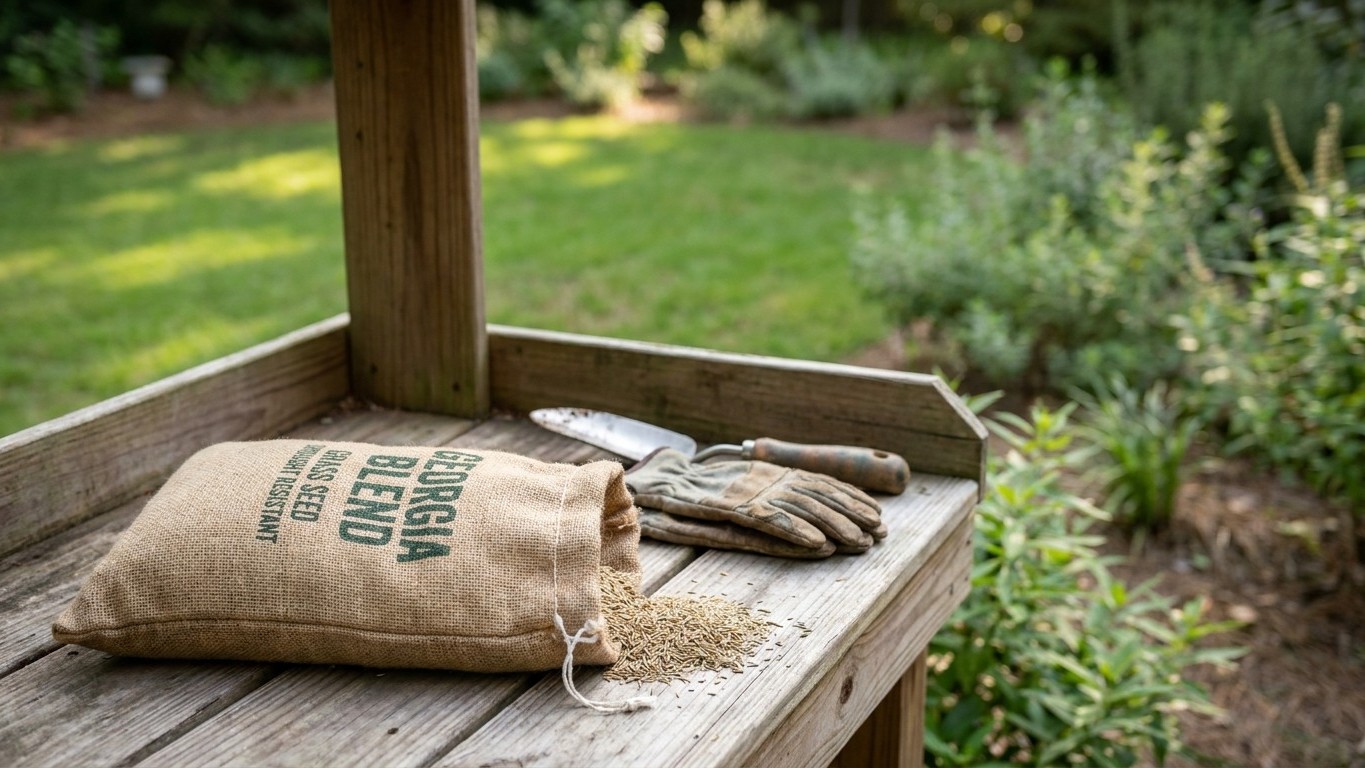

It depends on whether you want a green lawn in January or a green lawn in July, because in Georgia’s climate no single grass seed gives you both. Cool-season seed like Tall Fescue stays green through fall, winter and spring, then thins out in the worst of summer heat. Warm-season seed like Bermudagrass does the opposite: it powers through the heat, then goes brown and dormant the first hard freeze hits. Before you buy a bag, walk your yard and notice two things — how much full sun it actually gets, and how much foot traffic it takes. That’s what decides which grass belongs there, not the label on the bag.
The short answer for Georgia
There is no single best grass seed for a Georgia lawn, because the state falls in the transition zone described by Clemson’s HGIC 1214, a band where cool-season and warm-season turf both fall short of their ideal range. A cool-season lawn seeded with Tall Fescue, Kentucky Bluegrass or Perennial Ryegrass stays green through fall, winter and spring, then thins in the hottest weeks of summer. A warm-season lawn established with Bermudagrass or Zoysiagrass shrugs off that same heat, then goes dormant and brown from the first hard freeze until spring green-up. Before comparing seed bags, it helps to have the basics of Georgia lawn care settled first, since soil, sun and traffic decide more than the seed label does.
Which trade-off you accept depends on what the lawn actually has to do. A yard shaded by mature hardwoods leans toward Tall Fescue, since Bermudagrass in particular needs close to full sun to hold density. A yard with scorching, unshaded summer sun and heavy foot traffic leans toward Bermudagrass or Zoysiagrass, since both recover from summer heat that would thin a fescue stand. Brown is not the same as dead in either direction: a dormant Bermudagrass lawn in December greens back up on its own in spring, and a drought-stressed Tall Fescue lawn browning in August is usually dormant rather than dying, provided it gets rain before too long. Neither grass is wrong for Georgia. Each is a bet on which season matters more to the person mowing it.
Working through the year

Ranked by how much of the state’s lawn work each one realistically carries: Tall Fescue and Bermudagrass do most of it, Zoysiagrass fills a narrower niche, and Kentucky Bluegrass and Perennial Ryegrass mostly play supporting roles rather than standing as a lawn on their own.
| Grass | Season | Sun/shade | Winter appearance |
|---|---|---|---|
| Tall Fescue | Cool-season | Tolerates moderate shade | Green |
| Bermudagrass | Warm-season | Needs full sun | Dormant, straw-brown |
| Zoysiagrass | Warm-season | Moderate shade tolerance | Dormant, tan-brown |
| Kentucky Bluegrass | Cool-season | Full sun preferred | Green |
| Perennial Ryegrass | Cool-season | Full sun preferred | Green (often as overseed) |
Tall Fescue

Tall Fescue is the cool-season workhorse for most Georgia yards, especially with some shade. Clemson’s HGIC 1219 tall fescue maintenance calendar times nitrogen feeding, pre-emergent herbicide application and overseeding for the cool-season half of the year, and if this is the grass in your yard, that is the calendar to follow rather than a warm-season one. Mow it higher than you would a warm-season lawn; HGIC 1219 sets the exact height and feeding rate, and following it rather than guessing keeps the stand dense enough to shade out weeds on its own. The trade-off is that Tall Fescue thins during the hottest, driest stretch of summer, and because it grows in clumps rather than spreading, a thinned stand needs periodic overseeding worked into that same fall window to stay dense.
Bermudagrass

Bermudagrass is the warm-season default for full-sun Georgia lawns that take heavy use: driveway edges, play areas, anywhere Tall Fescue wears thin under traffic. HGIC 1216’s bermudagrass maintenance calendar governs its spring green-up feeding, summer mowing height and its fall wind-down ahead of frost. The cost is dormancy: it goes fully brown after the first hard fall freeze and stays that way until spring, so a Bermudagrass lawn looks its worst exactly when a Tall Fescue lawn looks its best.
Zoysiagrass

Zoysiagrass splits the difference between the other two. It tolerates a bit more shade than Bermudagrass and produces a denser, spongier turf underfoot, but it greens up more slowly in spring and establishes more slowly from seed or plugs. HGIC 1217 carries its own separate maintenance calendar, distinct from both the fescue and bermudagrass schedules. Like Bermudagrass, it browns at the first freeze and holds that color through winter.
Kentucky Bluegrass and Perennial Ryegrass

Both are cool-season species HGIC 1214 lists for Georgia, but neither typically carries a lawn on its own here. Kentucky Bluegrass is more heat-sensitive than Tall Fescue and is usually blended in at a small percentage for texture rather than seeded pure. Perennial Ryegrass germinates fast and is mostly used to overseed a dormant Bermudagrass lawn for winter color, or as a nurse grass while a Tall Fescue stand fills in, not as the permanent lawn itself.
What changes across Georgia
The frost dates used here are measured at Hartsfield-Jackson Atlanta International Airport, NOAA’s climate station USW00013874, and that reading sits in the piedmont rather than at either extreme of the state. NOAA’s 1991-2020 climate normals put the first fall freeze at that Atlanta station between November 13 and December 1, and that window is the one to use for timing Bermudagrass or Zoysiagrass dormancy and a last Tall Fescue fall feeding if you garden near Atlanta.
North Georgia’s mountains sit at higher elevation and freeze several weeks earlier than that Atlanta-area range, which shortens the growing season for a warm-season lawn and tilts the case toward Tall Fescue’s longer green window even further. The coastal plain in the southern part of the state runs milder, with a later first freeze than Atlanta’s reading, and that is exactly the territory where Bermudagrass or Zoysiagrass overseeded with Perennial Ryegrass for winter color performs best, since the dormant period there is shorter to begin with.
That same freeze range also sets the outer edge for overseeding a dormant Bermudagrass lawn with Perennial Ryegrass. HGIC’s bermudagrass calendar times that overseeding relative to the first frost, so a gardener outside the Atlanta reference area needs to shift the timing earlier or later to match their own local freeze date rather than Atlanta’s. A large airport is also its own small heat island, meaning Atlanta’s in-town frost date can run a little later than the open ground in its outer suburbs.
The mistakes this climate punishes
Feeding a warm-season lawn nitrogen in early autumn is the most common mistake made on Georgia lawns. Bermudagrass and Zoysiagrass are shutting down growth ahead of dormancy by then, and a late feeding pushes soft new growth that has no time to harden off before frost. HGIC’s bermudagrass and zoysiagrass calendars both cut nitrogen off well ahead of the freeze window for this reason. The damage shows up as winterkill in patches the following spring, not right away, which is exactly why the mistake gets repeated year after year.
Timing errors on the cool-season side
Seeding Tall Fescue in late spring or summer is the mirror-image error. Fescue seed needs to establish a root system while soil temperatures are still moderate. Sown into a hot Georgia summer, seedlings sprout and then burn off within weeks under heat and drought stress they have no root reserve to survive. HGIC’s fall-weighted tall fescue calendar exists because fall establishment, not spring, is the one real chance this grass gets to root deeply before summer tests it.
Cutting a warm-season lawn too short in the middle of summer is a slower mistake, but a costly one. Scalped Bermudagrass or Zoysiagrass loses the leaf area it needs to shade its own root zone, and turf that looked fine in June starts thinning and patching by August, right when it should be at its thickest. The same overcutting on a Tall Fescue lawn in July compounds heat stress it is already fighting, and a stand cut too short going into a hot spell can thin permanently rather than just brown temporarily.
Overseeding a dormant Bermudagrass lawn with Perennial Ryegrass too early, before the Bermudagrass has actually gone dormant, is a smaller but common error. The ryegrass competes with a lawn still trying to store energy for winter, weakening the permanent turf underneath to buy a few extra weeks of green on top of it.
Checking this against your county
Every figure above is measured at or near Atlanta, and Georgia runs from mountain counties in the far north to coastal counties on the Atlantic, each with its own frost dates and growing season length. Before buying seed or timing a fall feeding, check your own county’s numbers with the UGA Cooperative Extension Service, which keeps offices across the state. Once the grass is chosen, The Georgia Lawn Care Calendar, Month by Month lays out the routine tasks that follow in order.
Common questions
Can I mix Tall Fescue and Bermudagrass seed together?
Not as a deliberate strategy. The two compete for the same space on opposite growth schedules, and one will win out depending on shade and season, usually leaving a patchy lawn rather than a blended one. Most Georgia lawns are one species or the other, with Perennial Ryegrass sometimes overseeded onto dormant Bermudagrass purely for winter color rather than as a permanent mix.
Why didn’t my new grass seed come up?
The most common cause is sowing the wrong species outside its season, cool-season seed in summer heat or warm-season seed too early in cool soil. Poor seed-to-soil contact, birds, or letting the seedbed dry out during germination are the other usual culprits, and checking the relevant HGIC calendar for the sowing window is the fastest way to rule out timing as the problem.
Does Zoysiagrass really need less mowing than Bermudagrass?
It grows more slowly, so it can go longer between mowings during its growing season, but it still needs regular cutting once established. The slower growth also means a Zoysiagrass lawn started from seed or plugs takes longer to fill in than Bermudagrass does, which some gardeners mistake for a maintenance problem when it is really just a slower establishment rate.
Is sod better than seed for a Bermudagrass lawn?
For hybrid Bermudagrass varieties, sod or plugs are the only option, since many hybrids are sterile and produce no viable seed. Common Bermudagrass types can be grown from seed, but they establish more slowly and are less uniform than sodded hybrids, which is why heavily used areas are usually sodded rather than seeded.