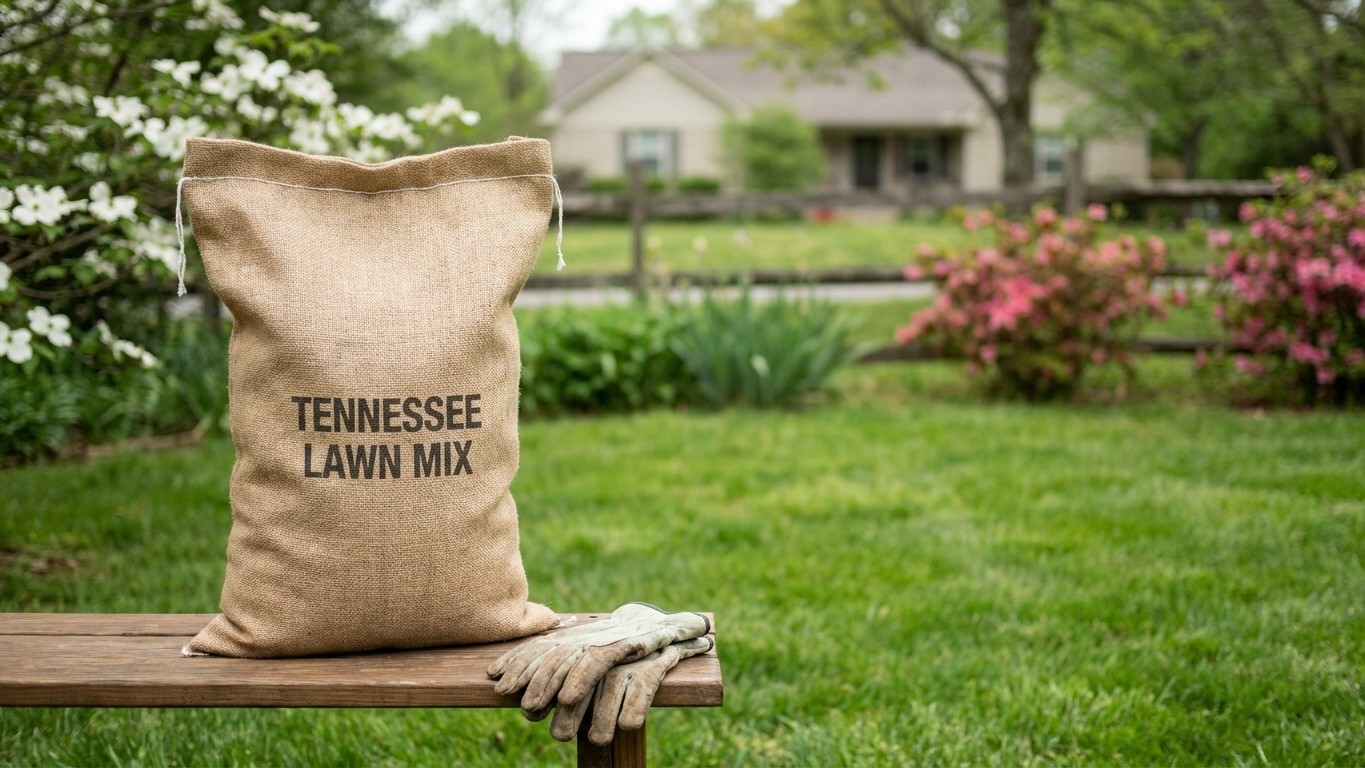

Tennessee sits in the transition zone, the band of the country where neither cool-season nor warm-season turf performs at its best, so no single grass seed earns the title of best. A cool-season lawn like tall fescue stays green through winter but struggles by midsummer, while a warm-season lawn like zoysiagrass or bermudagrass shrugs off summer heat but sits brown from fall frost until spring. Decide first whether you want winter green or summer toughness, because that trade-off picks your grass more than any bag label will.
The short answer for Tennessee
Tennessee’s transition zone is the reason a single “best” grass seed doesn’t exist here. You can pick a fescue blend that stays green through a Nashville December and watches its edges brown by August, or a zoysiagrass that shrugs off July heat and turns tan the moment frost hits, usually late October to early November around Nashville. Neither one wins outright. What changes the answer for your yard is which season you’re willing to watch the lawn suffer through.
Which one earns a spot in your yard depends on what you’re willing to give up. Choose a cool-season species if green grass in December matters more to you than a perfect lawn in late July. Choose zoysiagrass or bermudagrass if you want a lawn that shrugs off a Tennessee summer with little supplemental water, and accept a tan, dormant lawn from roughly the first fall frost to mid-spring, which for the Nashville area falls between October 28 and November 8, per NOAA’s 1991-2020 climate normals for that station. That window runs later in the cooler parts of the state, so treat it as a Nashville-area reference rather than a statewide date.
If you’re building a lawn from bare dirt rather than renovating an existing one, get the site prep right first. See Tennessee Lawn Care for grading, soil testing and seedbed prep before you settle on a species at all.
Working through the year

The five species Clemson and Penn State list for a transition-zone lawn split cleanly into two calendars. Cool-season grasses are seeded, fed and mowed on a fall-to-spring rhythm, and warm-season grasses work on a spring-to-fall rhythm. Mixing the two calendars is the single most common way a Tennessee lawn goes wrong, so know which half of the year your grass actually grows in before you do anything else.
| Species | Season | Growth habit | Summer heat tolerance | Winter appearance |
|---|---|---|---|---|
| Tall Fescue | Cool | Bunch-type | Moderate | Green |
| Kentucky Bluegrass | Cool | Rhizome spreading | Low | Green |
| Perennial Ryegrass | Cool | Bunch-type | Low | Green |
| Zoysiagrass | Warm | Stoloniferous, dense | High | Dormant, tan |
| Bermudagrass | Warm | Aggressive stolons and rhizomes | Highest | Dormant, straw-brown |
Tall Fescue

Tall fescue is the default cool-season choice for most Tennessee lawns because its deep root system handles a dry August better than bluegrass or ryegrass alone. Clemson’s tall fescue maintenance calendar (HGIC 1219) sets mowing height, nitrogen timing and overseeding windows by month, and it’s worth following rather than guessing. It’s a bunch-type grass, so it doesn’t spread to fill bare patches the way zoysia does, which means thin spots from summer stress have to be overseeded rather than left to close on their own.
Kentucky Bluegrass

Kentucky bluegrass spreads by rhizomes and knits into a denser sod than fescue, but it has the least summer heat tolerance of the three cool-season species here. It’s rarely seeded alone in Tennessee. Most seed blends use it as a minority component alongside tall fescue, where its rhizomes help repair the bare spots fescue leaves behind.
Perennial Ryegrass

Perennial ryegrass germinates faster than fescue or bluegrass, which makes it useful as a nurse grass in a new seeding or as a quick fall overseed. On its own it has the weakest summer performance of the cool-season group, and it isn’t a realistic stand-alone lawn grass for a Tennessee summer.
Zoysiagrass

Zoysiagrass is the warm-season choice for a lawn that needs to handle both foot traffic and heat without going patchy. It’s dense enough to resist weeds once established, but establishment itself is slow, and a zoysia lawn from plugs or sod can take a full season or two to fill in. Clemson’s zoysiagrass calendar (HGIC 1217) covers mowing height and nitrogen timing through its active growing season, and dormancy from the first fall frost through spring is normal, not a sign of a dead lawn.
Bermudagrass

Bermudagrass tolerates heat and drought better than any other species on this list, and it recovers from wear faster too. That toughness comes with an aggressive stolon-and-rhizome spread that will cross into flower beds and gravel paths if it isn’t edged regularly. Clemson’s bermudagrass calendar (HGIC 1216) lays out the mowing height and feeding schedule for its growing season, and like zoysia it goes dormant and straw-brown at the first fall frost.
What changes across Tennessee
The frost window and zone placement above are both anchored to a Nashville-area station in NOAA’s 1991-2020 climate normals. Tennessee is not one climate, and the reference point matters more the farther you get from Middle Tennessee.
East Tennessee and the Cumberland Plateau sit at higher elevation, and the caution attached to this data set flags that region as running cooler and later in spring than the Nashville station. A cool-season lawn there can often stay comfortable a week or two further into what would already be stressful heat in Nashville, and fall seeding windows likely open a bit earlier as temperatures drop sooner. A warm-season lawn on the plateau faces the flip side: a shorter true growing season and a longer stretch of brown, dormant turf each winter.
Lower elevation in a transition-zone climate generally runs warmer, which would tend to favor bermudagrass and zoysiagrass earlier in spring and later into fall, but that’s a general pattern, not a documented number for West Tennessee. If you garden outside the Nashville area, treat every date here as a starting estimate and confirm it against your own county’s extension office before committing a whole yard to one seeding window.
The mistakes this climate punishes
Tennessee’s transition-zone climate is unforgiving of calendar mistakes, because the penalty for feeding or seeding at the wrong time of year doesn’t show up for weeks, by which point it’s too late to undo.
Feeding a warm-season lawn in fall
Nitrogen applied to bermudagrass or zoysiagrass late in the year pushes new growth right before dormancy, and that new growth is the tissue least able to survive winter cold. The damage doesn’t show until spring, when green-up is patchy or delayed exactly where the lawn was fed too late. Both Clemson calendars (HGIC 1216 and HGIC 1217) cut off nitrogen well before dormancy for this reason.
Seeding cool-season grass too late in spring
Tall fescue, bluegrass and ryegrass seed sown after the fall window has closed germinates into seedlings with no root system built before summer heat arrives. Those seedlings die in the first serious dry spell, usually by midsummer, and the failure gets blamed on the seed rather than the timing. Fall is the reliable seeding window for cool-season grass in Tennessee, not spring, because it gives roots a full season to establish before summer stress hits.
Cutting too short in a hot summer
Mowing a cool-season lawn down low during a hot, dry stretch removes the leaf area the plant needs to shade its own root zone, and the stress shows as browning within a week or two of the low cut. This is one of the few mistakes whose damage is visible almost immediately rather than months later.
Watering on a fixed schedule instead of the lawn’s actual need
A sprinkler timer set once in spring and left alone all summer either drowns the lawn during a wet stretch or starves it during a dry one, and neither cool-season nor warm-season turf forgives either extreme for long. Watch the grass instead of the calendar for this one, especially through the shoulder seasons when growth is slowing down or ramping up.
Checking this against your county
The University of Tennessee Institute of Agriculture’s extension service is organized by county and is the right place to confirm local frost dates, seeding windows and any pest or disease pressure specific to your area before you buy seed.
For the month-by-month sequence of everything covered here, from fall seeding through summer mowing, see The Tennessee Lawn Care Calendar, Month by Month, and cross-check it against your county extension agent’s own recommendations.
Common questions
Can I plant bermudagrass and tall fescue together?
You can, but they won’t blend into one uniform lawn. Bermudagrass spreads aggressively into fescue over a few seasons, and where they meet you’ll always see a visible seam because the two species green up and go dormant on different schedules.
Will my zoysia lawn come back after it turns brown in winter?
Yes, dormancy is normal, not death, for a warm-season lawn once fall frost hits. Green-up returns in spring as soil temperatures climb, and a lawn that was properly mowed and fed through its growing season should come back fully.
Why did my new grass seed die in June even though I watered it?
It was almost certainly seeded too late in spring for a cool-season species. Cool-season seedlings need a full fall-through-spring season to build roots before summer heat, and watering can’t fully substitute for that missing root depth once a real heat wave hits.
Is it worth overseeding fescue every fall or just patching bare spots?
Whole-lawn overseeding pays off if more than a small fraction of the yard thinned out over summer, since tall fescue is a bunch-type grass that won’t spread on its own to close gaps. Spot-patching is fine for a handful of small bare patches, but a lawn that’s thin all over is better overseeded wholesale on the schedule Clemson’s tall fescue calendar sets out.