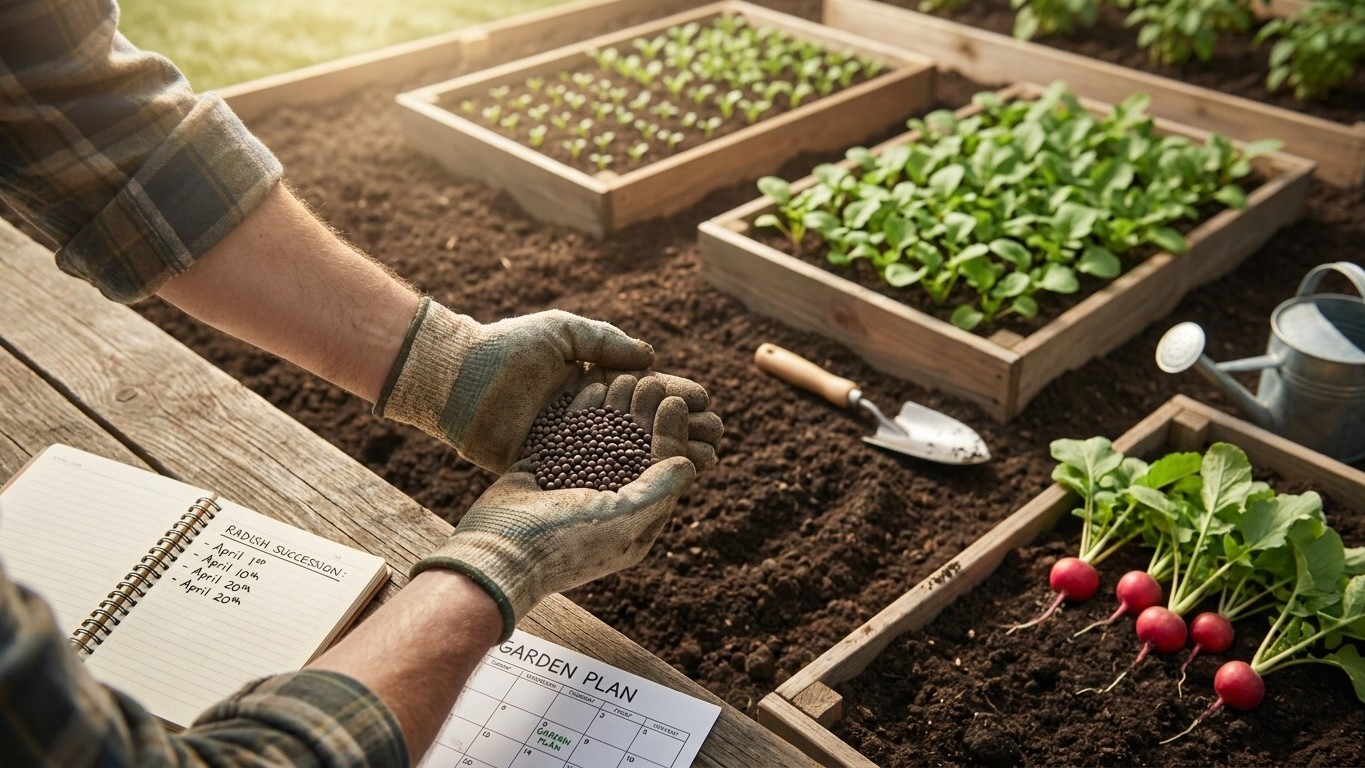

Ten days. That’s the sowing interval Utah State University Extension recommends for radishes if you want a steady supply instead of one glut followed by a gap. No other crop on this site asks for a rhythm this tight. Beans and peas can wait two to three weeks between plantings. Radishes can’t.
The short answer
Utah State University Extension is direct about it: plant radishes at 10 day intervals to maintain a steady supply throughout the year. That’s the number, and it’s tighter than almost anything else you’ll grow. The reason isn’t complicated once you see the crop’s timeline. A radish goes from seed to harvest fast enough that a single sowing is basically done, edible, and past its prime within a few weeks. If you want radishes on the table in June, July, and August rather than a single mountain of them in early summer, you have to keep the pipeline loaded.
Start counting from your own last spring frost date, not a calendar month. The extension guidance is to plant 2-3 weeks Before the Last Frost in spring, since radishes tolerate cold soil better than most root crops. Soils just need to have warmed to 40°F for the seed to sprout at all, though germination happens fastest between 55°F and 75°F, taking 5-10 days to emerge in that range. So your first sowing date is anchored to your frost date, and every sowing after that is anchored to the one before it: ten days, then ten more, then ten more.
The fall crop works the same way but from the other direction. Instead of counting forward from a spring frost, you count backward from your area’s first heavy fall frost or freeze, since radishes should be harvested before heavy frosts or freezes hit. The extension sheet frames its fall-planting advice around avoiding summer heat, which for gardeners outside Utah translates into a simple rule: figure out how many days your local variety needs to mature, then count 25-45 days back from your expected hard frost to land your last practical sowing date. Anything sown much later than that risks small, undersized roots that never quite finish before the cold shuts growth down.
So the short answer has two parts. Within a growing window, sow every ten days. And that window itself is bounded on one end by soil Temperature and last frost, and on the other by first frost and the 25-45 day countdown. Miss either boundary and the ten-day rhythm doesn’t matter much, because the crop either won’t germinate or won’t finish.
What actually decides it

Everything about radish care comes back to one thing: speed. This is a crop built to swell a root fast, and almost every defect gardeners run into is really a slowdown in disguise. Understand that, and the whole plant makes a lot more sense.
Why germination speed sets the whole clock
Radishes are always grown from seed, direct-sown into the bed where they’ll finish, never started indoors and transplanted. That single fact matters because it means the plant’s entire lifespan starts the moment the seed hits moist soil, with no head start from a greenhouse. Seeds need a uniformly moist soil surface to get a good, even stand. Let that surface dry out for even a day or two right after sowing and germination stretches out unevenly, some seeds popping up on schedule and others lagging behind by however many extra days the dry spell cost them. That unevenness is the first slowdown, and it cascades into everything downstream: uneven germination means uneven root sizing at harvest, some radishes ready while their neighbors are still marble-sized.
Why the root-swelling window is narrow
Once a radish germinates, it doesn’t linger in a leafy growth phase the way lettuce or spinach does. It pushes straight toward root swelling, and that swelling has a short window of quality. Left in the ground past that window, roots overshoot their prime, and internal tissue starts to hollow out or turn woody, and the flavor turns hotter and more pungent than what you sowed for. This is why the “harvest before heavy frosts or freezes” instruction functions less like a suggestion and more like a hard deadline: the window closes whether or not the gardener is paying attention.
Why crowding and heat both cause the same failures
Anything that slows the plant down (crowded rows competing for space, stretches of heat, a dry soil surface) pushes the root toward the same set of failures: leafy growth with little root beneath it, or roots that bolt to seed instead of swelling. The plant’s speed depends on room to expand and enough consistent moisture to keep growing without interruption, so spacing and watering aren’t just tidiness, they’re the mechanism itself.
How to do it
- Wait for the soil, not the calendar. Radishes can be sown once soils reach 40°F, and they’ll germinate fastest between 55°F and 75°F. Check the soil rather than guessing from the air temperature.
- Prepare a loose, well-drained bed. Radishes are direct-sown, so the seed goes straight into its final growing spot. No transplanting, no starting trays.
- Sow seeds a half inch deep. That’s the depth the extension body specifies, consistently and without a range attached to it.
- Space seeds 1-2 inches apart, in rows 10-12 inches apart. This spacing gives each root the room it needs to swell without competing hard for space or light.
- Keep the soil surface uniformly moist from sowing through emergence. Radishes take 5-10 days to come up in that temperature range, and a dry surface during that stretch is the single easiest way to get uneven stands.
- Mark your next sowing date immediately. Ten days from today, not “next week sometime.” The whole point of this rhythm is that it doesn’t wait for you to remember.
- Repeat every 10 days for as long as your growing window allows, starting your first sowing 2-3 weeks before your last spring frost.
- For a fall run, count backward. Take your area’s first expected heavy frost, subtract the 25-45 days needed to avoid finishing in summer heat, and treat that as your final practical sowing date.
- Harvest before heavy frosts or freezes arrive. Don’t let a late sowing linger into weather that will damage the crop before you get to it.
What Goes Wrong
- Roots taste hot and pungent instead of mild. This is almost always a slowdown problem: roots left too long past their swelling window develop a sharper, hotter flavor. Harvest promptly once roots size up rather than letting them sit for “just a bit longer.”
- Roots are hollow or pithy in the center. A different symptom of the same root cause: overmaturity. Radishes held in the ground past their quality window start to break down internally even while looking fine on top. The fix is tighter attention to your sowing calendar so you’re pulling roots on time, not by memory.
- Lots of leafy top growth, little to no root. This points to crowding or heat stress rather than overmaturity. Seeds sown too close together, closer than the 1-2 inch spacing, compete for room and put energy into leaves instead of root swelling. Thin crowded seedlings early, and stick to the 10-12 inch row spacing.
- Plants bolt to flower before roots size up. Bolting is a stress response, usually triggered by heat or a dry, inconsistent soil surface interrupting steady growth. Keep the surface uniformly moist from sowing onward, and avoid pushing sowings too far into the hot stretch of your season.
- Germination is patchy, with gaps in the row. Almost always a moisture problem right after sowing. A soil surface that dries out during the 5-10 day emergence window leaves some seeds stalled while others come up on schedule. Water gently and consistently until you see a full, even stand.
Common questions
Can I start radish seeds indoors and transplant them?
No. Radishes are always grown from seed, direct-sown into the bed where they’ll mature. Utah State University Extension doesn’t describe a transplant method for this crop, and disturbing the root during a transplant would work against the fast, uninterrupted swelling the plant depends on.
What if I miss a sowing date by a few days?
A few days of slack in the ten-day rhythm isn’t a disaster; it just shifts your harvest window slightly and may create a small gap in continuous supply. What matters more is getting back on the interval afterward rather than letting gaps compound into a longer stretch with no radishes ready.
How do I know when my last practical fall sowing date is?
Work backward from your area’s expected first heavy frost or freeze, since radishes should be harvested before that hits. Subtract 25-45 days to account for the maturity time and to avoid the crop finishing in lingering summer heat, and that gives you your cutoff date for the year.
Does variety change the sowing rhythm?
Utah State University Extension names five varieties (Champion, Cherry Belle, Daikon Long White, Icicle, and Easter Egg) without attaching specific days-to-maturity or size figures to any of them. Without that data, the safest approach is to keep the same 10-day interval and rely on your own observation of how quickly your chosen variety sizes up in your soil and climate.