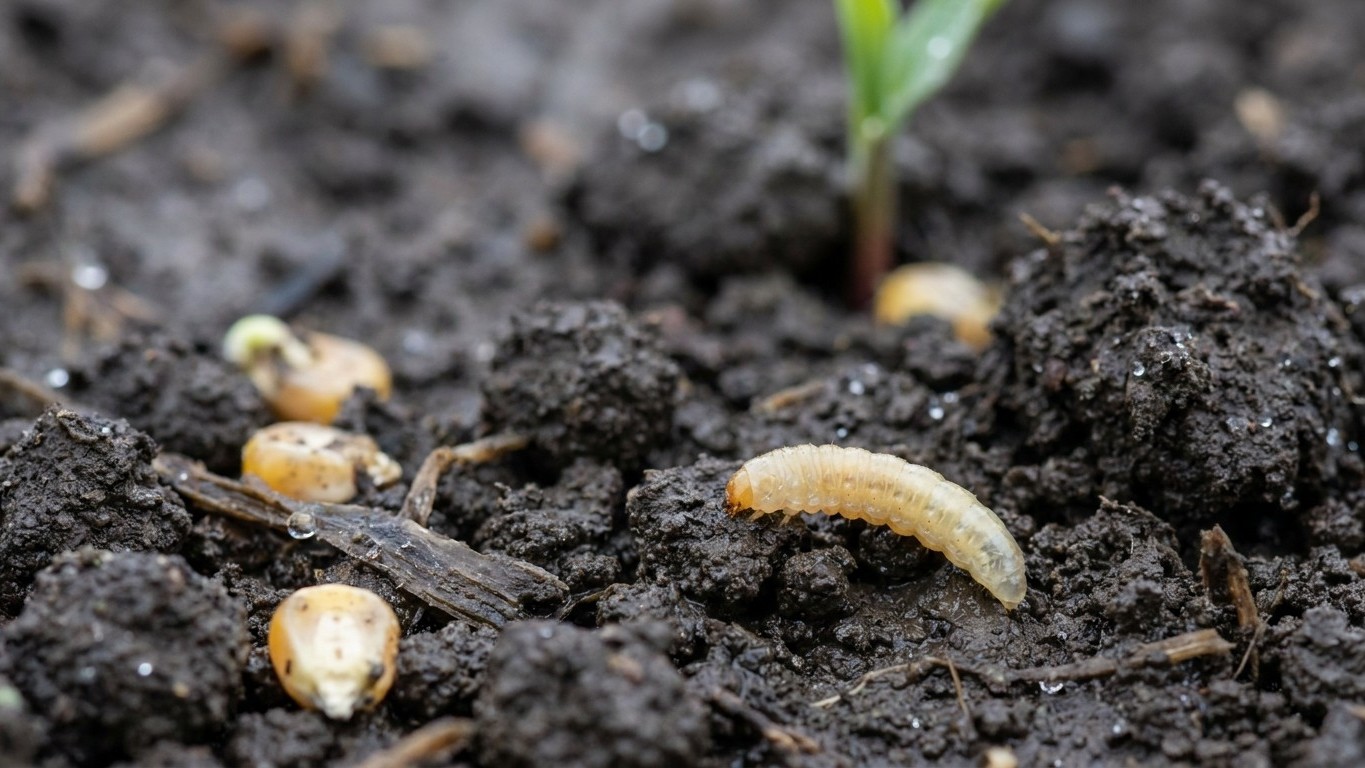

Seedcorn maggot shows up in Indiana fields every spring, usually between late April and early June, whenever cool, wet soil delays germination and slows young seedlings down. The insect itself isn’t picky about location within the state, it’s active from the Ohio border to the Illinois line, but its damage clusters in fields with heavy organic matter, tight rotations with small grains or cover crops, and soils that stay cold and soggy longer than average. Seed treatments containing insecticide, combined with planting timing that avoids the pest’s peak flight windows, remain the most reliable defense.
What Seedcorn Maggot Actually Is

Seedcorn maggot is the larval stage of Delia platura, a small fly related to the more familiar onion maggot and cabbage maggot. The adult fly is gray, about 1/5 inch long, and easy to overlook in a field. The damage-causing stage is the larva: a legless, yellowish-white maggot that tapers at the head end and grows to roughly 1/4 inch before pupating in the soil.
Unlike pests that target leaves or stems, this maggot feeds directly on the seed itself, or on the tender tissue of a germinating seedling before it ever breaks the soil surface. That’s what makes it frustrating for Indiana growers, by the time a stand problem is visible above ground, the feeding damage happened weeks earlier, underground, where nobody was watching.
Corn, Soybeans, and a Long List of Other Hosts
Corn and soybeans get most of the attention because they’re Indiana’s dominant row crops, but seedcorn maggot isn’t fussy. It also attacks beans, peas, cucurbits, and a range of vegetable seedlings in home gardens. Soybean fields tend to show more visible injury because the crop’s growing point sits closer to the seed, and a damaged seedling often produces the telltale “snake head” symptom, a swollen, twisted stub where the growing tip should be.
When Seedcorn Maggot Shows Up in Indiana
Timing runs on temperature, not the calendar. Entomologists track seedcorn maggot activity using a degree-day model with a base temperature of 39°F, accumulating from January 1. The first generation’s flight typically peaks around 200 to 300 accumulated degree days, which in a normal Indiana spring lands somewhere in the second half of April through mid-May, depending on how fast the season warms up. A second, generally smaller flight follows roughly a month later.
That degree-day dependence explains why some springs are brutal for seedcorn maggot and others barely register. A slow, wet, cool start to planting season, the kind Indiana growers saw in several recent years, stretches out the window when germinating seeds are vulnerable. Corn or soybeans that sit in cold soil for two or three weeks before emerging give the maggots far more time to find and feed on them than seed that pops up in five or six days under warm, dry conditions.
Three to four generations occur per year in Indiana, but the first is almost always the most damaging one for row crops, simply because it coincides with planting season. By the time later generations are active in June and July, most corn and soybean seedlings have already outgrown their vulnerable stage.
What Attracts It to a Field
Adult flies are drawn to decomposing organic matter, and that single fact drives most of the practical risk factors growers deal with in Indiana.
- Fields with recently incorporated cover crops, especially legumes or brassicas turned under within two to three weeks of planting
- Manure applications, particularly fresh or partially composted manure worked into the soil close to planting
- High crop residue from the previous season, especially in no-till or reduced-till fields with heavy trash cover
- Poorly drained or low-lying spots that stay saturated longer after spring rains
- Fields coming out of a small-grain or hay rotation, where more organic matter is breaking down in the soil
The common thread is decomposition. Rotting plant material releases odors that female flies use to locate egg-laying sites, and they lay eggs directly in the soil near that organic matter, often right next to a newly planted seed. When the eggs hatch, the larvae don’t have to travel far to find a meal.
Spotting the Damage Before It’s Too Late
Because the feeding happens underground, growers usually notice seedcorn maggot problems only after a stand fails to fill in evenly. Digging up a few unplanted-looking spots is the fastest way to confirm the cause. In corn, look for seeds that are hollowed out, discolored, or reduced to a soft, decayed shell. Seedlings that did emerge but look stunted or yellowed may have scarred mesocotyls that never fully recovered.
In soybeans, the classic sign is that snake-head symptom mentioned earlier, where larvae fed on the cotyledons and growing point before emergence, leaving a seedling that can’t unfurl normal leaves. Some of these plants survive but stay stunted all season; others die outright, leaving bare patches in an otherwise healthy stand.
Gaps that show up in irregular patches rather than straight rows across a field often point to organic-matter hotspots, like a low spot with extra crop residue or a strip where manure application overlapped. That patchiness is a useful diagnostic clue, since uniform stand loss across an entire field usually has a different cause, like a planter issue or a herbicide injury problem.
Managing Seedcorn Maggot Risk in Indiana Fields
Control decisions mostly get made before the seed ever goes in the ground, since there’s no effective rescue treatment once larvae are already inside a seed or seedling underground.
Seed Treatments
Insecticide seed treatments, often paired with a fungicide component, are the standard protection for corn and soybeans in fields with elevated risk. These treatments create a protective zone around the germinating seed during the window when it’s most vulnerable. They don’t eliminate risk entirely in a heavy infestation, but they substantially reduce the odds of a maggot successfully feeding through to the point of killing the seed or seedling.
Timing Around Degree Days
Growers who track the regional degree-day accumulation can make more informed planting decisions, particularly in fields already flagged as higher risk due to manure or cover crop history. Planting into warm, drying soil, ideally above 50°F with a forecast for continued warming, shortens the germination window and gives seeds less exposure time. It’s not always possible to wait, given Indiana’s tight planting calendar and unpredictable spring weather, but even a few days’ difference in soil temperature at planting can matter.
Managing Organic Matter
Since decomposing organic matter is the primary attractant, timing tillage and termination of cover crops matters as much as the choice to use them at all. Terminating a cover crop three to four weeks before planting, rather than right before or right after, gives the plant material time to start breaking down before seeds go in the ground, reducing the overlap between peak fly attraction and seed vulnerability. The same logic applies to manure: incorporating it well ahead of planting, rather than immediately before, lowers the odds that egg-laying females target that exact spot in the field.
Drainage and Field Selection
Fields with chronic wet spots carry extra risk every season, not just because of organic matter buildup but because saturated soil slows germination and stretches out the vulnerable window for seedlings. Improving tile drainage or avoiding early planting on the wettest ground can reduce exposure, even though it doesn’t address the pest directly.
None of these tactics work as a single fix. A field with heavy cover crop residue, poor drainage, and a cold, wet planting season stacks several risk factors at once, and that’s exactly the scenario where Indiana growers report their worst stand losses. Fields with better drainage, later cover crop termination, and a warm planting window tend to get through the same spring with barely a mention of the pest.