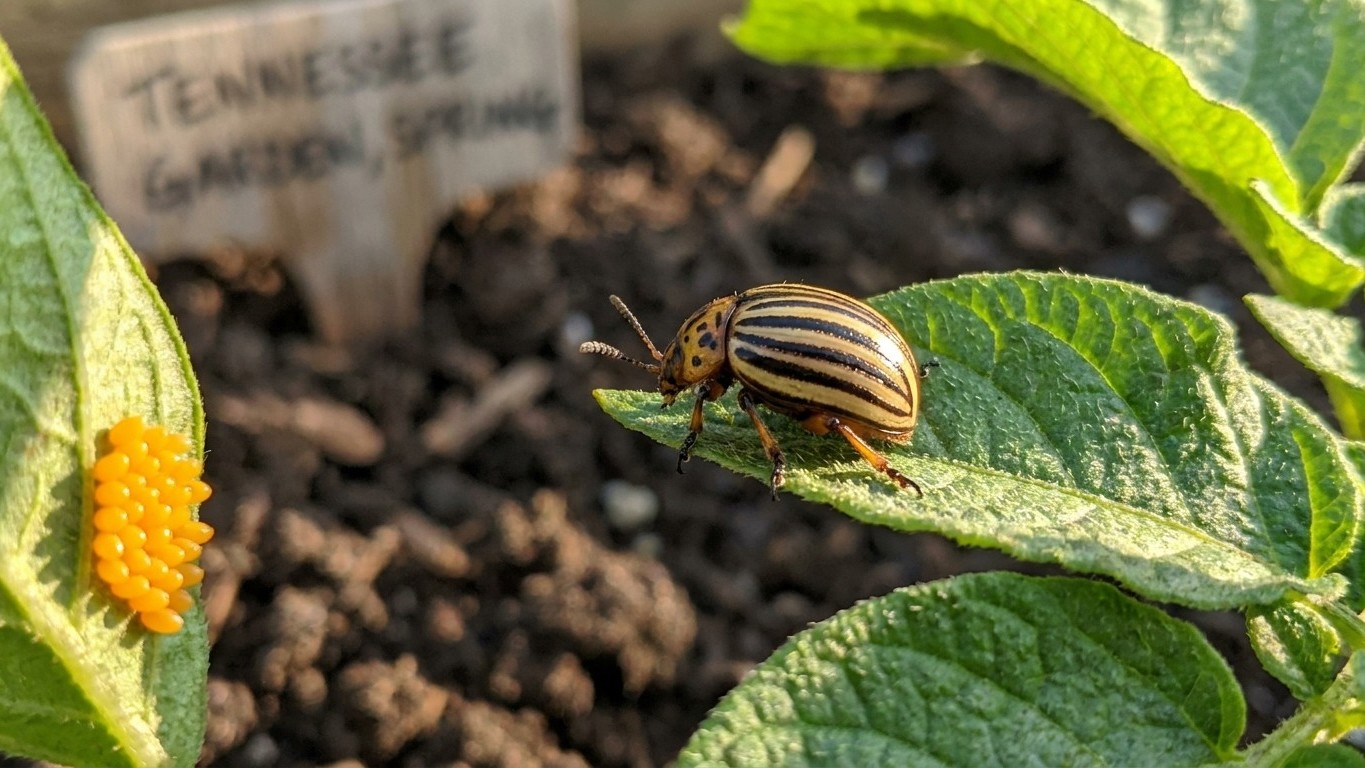

Colorado potato beetles show up in Tennessee gardens as soon as the soil warms into the low 50s, usually mid-April in West Tennessee and closer to late April or early May in the cooler Cumberland Plateau and East Tennessee valleys. They don’t migrate in from Colorado or anywhere else. They spend winter buried in the dirt right next to last year’s potato patch, waiting for the ground to warm enough to dig out and start eating.
Once they’re active, they don’t let up. Tennessee’s long growing season lets this pest run through two full generations a year, sometimes a partial third in a warm fall, which is why a light infestation in May can turn into a defoliated potato row by July if nobody intervenes.
When Colorado Potato Beetles Appear in Tennessee

Overwintering adults dig out of the soil once temperatures hold steady above 50°F for several days in a row. In practice, that lines up with the first hard flush of spring growth on potatoes, eggplant, and tomato transplants. Memphis and the Mississippi River bottomlands typically see beetles first, sometimes in the first half of April. Nashville and Middle Tennessee follow a week or two later. East Tennessee’s higher elevations, including areas around Knoxville and up into the mountains, often don’t see activity until late April or into May.
The adults that emerge in spring aren’t the generation that does the worst damage. They feed for a couple of weeks, mate, and the females start laying clusters of bright orange-yellow eggs on the undersides of leaves, sometimes 300 to 500 eggs per female over her lifetime. Those eggs hatch into larvae within a week to ten days depending on temperature, and the larvae are the real damage machine. A second generation of adults typically emerges by mid to late summer, and in a mild fall, some of those adults produce a third partial generation before everyone burrows down for winter.
Why the Timing Matters for Control
Missing the early window is the single biggest reason home gardeners lose their potato crop. Treating overwintered adults right as they emerge, before they’ve laid eggs, knocks out the source population for the entire season. Wait until larvae are already stripping leaves in June, and you’re playing catch-up against two more generations before frost.
How to Identify Colorado Potato Beetles at Every Stage
This is one insect where confusing the life stages leads to bad timing on treatment, so it helps to know what each one looks like.
- Adults: About 3/8 inch long, rounded, with a yellow-orange body and five bold black stripes running down each wing cover. They look almost like a fat, striped ladybug.
- Eggs: Bright orange-yellow, laid in tight clusters of 20 to 30 on the underside of leaves. Easy to spot if you flip leaves over during a garden walk.
- Larvae: Humpbacked, soft-bodied, brick red to orange when young, fading to a duller pink-orange as they grow, with two rows of black spots along each side. These are the ones that do the heaviest feeding.
- Pupae: Larvae drop into the soil to pupate for about 5 to 10 days before emerging as new adults, which is why soil disturbance around plants can interrupt the cycle.
A garden with a mix of egg clusters, small larvae, and adults all at once isn’t unusual in June. Multiple overlapping generations mean you’ll often see every life stage on the same plant at the same time.
What Colorado Potato Beetles Damage in Tennessee Gardens
The name is misleading. This beetle isn’t picky about potatoes alone. It feeds on the entire nightshade family, which in a typical Tennessee vegetable garden means potatoes take the worst hit, followed by eggplant, then tomatoes, and occasionally peppers. Weeds like horsenettle and jimsonweed, both common along Tennessee fence rows and field edges, serve as a wild host reservoir that lets beetle populations survive even in years when no potatoes are planted nearby.
Larvae are the destructive stage. A heavy larval population can skeletonize an entire potato plant, stripping leaves down to the veins in a matter of days. Since potato yield depends heavily on leaf area feeding the tubers underground, defoliation early in tuber development cuts yield hard, sometimes by half or more on unprotected plants. Adults do damage too, chewing irregular holes in leaves, but it’s the larval stage that growers watch most closely.
Eggplant tends to get hit almost as hard as potatoes, and because eggplant doesn’t regrow foliage as fast, damage there can be more visually dramatic even if the plant survives. Tomatoes usually see lighter feeding, mostly from adults, and rarely suffer the kind of total defoliation potatoes and eggplant do.
Cultural and Physical Controls That Actually Work
Chemical sprays aren’t the only tool, and for home gardens, they’re often not even the first one worth reaching for. Colorado potato beetle populations respond well to a handful of low-cost habits that interrupt the life cycle before it gets out of hand.
Crop Rotation and Site Placement
Because adults overwinter in the soil right where last year’s potatoes grew, planting this year’s potato or eggplant patch at least 50 to 100 feet away from last year’s location can delay and reduce infestation significantly. Beetles crawl to find host plants in spring, and distance slows them down. Rotating the planting site every year, even in a small backyard garden, is one of the most effective free controls available.
Mulch and Row Covers
A thick layer of straw mulch, 3 to 4 inches deep, makes it harder for emerging adults to navigate to host plants and can also support ground beetles and other predators that eat beetle eggs and larvae. Floating row covers placed over young plants at transplant time keep emerging adults out entirely, though they need to come off once plants flower if the crop requires pollination, which doesn’t apply to potatoes but does matter for eggplant and tomatoes.
Hand-Picking and Trap Crops
For a garden under a quarter acre, hand-picking adults and squashing egg clusters on the underside of leaves twice a week during peak emergence in April and May can keep populations low enough that no spray is ever needed. Planting a small trap crop of an early, sacrificial potato row a couple weeks before the main planting draws overwintered adults to a concentrated spot where they’re easier to pick off or treat.
Soil Disturbance
Since larvae drop into the soil to pupate, shallow tilling around plants in mid to late summer, after the first generation of larvae has fed but before adults emerge, can crush pupae and reduce the size of the second generation. This works best in loose garden soil rather than compacted clay.
Biological and Chemical Options for Heavier Infestations
When cultural controls aren’t enough, particularly on larger potato plantings, a few targeted products and natural predators fill the gap without wiping out the rest of the garden’s beneficial insects.
Bacillus thuringiensis subspecies tenebrionis (sometimes labeled Bt-tenebrionis or Bt-san diego) is a bacterial insecticide that specifically targets young larvae and leaves most other insects, including bees, unaffected. It works best applied as soon as larvae hatch, since it has to be ingested and older larvae are less susceptible.
Spinosad, derived from a soil bacterium, controls both larvae and adults and is commonly used in organic production, though it does carry some risk to bees if applied while plants are flowering, so evening applications after bee activity drops are the safer window.
Natural predators already present in most Tennessee gardens help more than gardeners often realize. Lady beetles and lacewing larvae feed on Colorado potato beetle eggs, and the spined soldier bug, a native predatory stink bug found throughout the state, preys on both eggs and small larvae. Avoiding broad-spectrum insecticide sprays early in the season preserves these predators, which can meaningfully reduce the need for repeat chemical treatments later.
For gardeners who need a conventional insecticide, products containing pyrethrins offer quick knockdown on adults and larvae with a short residual, which limits harm to pollinators if applied in early morning or evening. Because Colorado potato beetle populations have developed resistance to several insecticide classes in parts of the country over the decades, rotating between different modes of action rather than using the same product repeatedly all season helps slow resistance buildup in the local population.
Tennessee’s warm, humid summers also mean that fungal diseases like Beauveria bassiana, a naturally occurring insect pathogen, can knock down beetle populations on their own in wet years, sometimes visible as sluggish, discolored larvae that die before pupating. It’s not something to count on for full control, but it’s one more reason a wet Tennessee summer sometimes produces a lighter beetle year than a dry one, even with no extra intervention from the gardener.
Related guides
- Colorado potato beetle in Virginia: When It Shows Up and What Stops It
- Colorado potato beetle in Georgia: When It Shows Up and What Stops It
- Colorado potato beetle in Vermont: When It Shows Up and What Stops It
- Colorado potato beetle in Washington: When It Shows Up and What Stops It
- Colorado potato beetle in Manitoba: When It Shows Up and What Stops It