
Utah spans three IECC climate zones across its 29 counties: Zone 5B covers 21 counties, Zone 6B covers 7, and Zone 3B covers just 1. Under the 2021 International Residential Code, an interior vapor retarder is required in Zones 5B and 6B. It is not required in the state’s single Zone 3B county. There is no one answer for the whole state.
What the code asks for in Utah

Yes, for most of Utah, a wall does need a vapor retarder. Section R702.7 of the 2021 International Residential Code states plainly that “a vapor retarder of the class given by Table R702.7(2) shall be provided on the interior side of frame walls.” That’s the baseline rule, and it applies to nearly every county in the state. Twenty-one counties sit in Zone 5B and seven sit in Zone 6B, and neither of those zones appears on the code’s short list of exemptions.
That exemption list is short and specific. The code says: “A vapor retarder shall not be required in Climate Zones 1, 2 and 3.” Utah has exactly one county in that range, its lone Zone 3B county, where builders are not obligated to install one. Every other county in the state, all 28 of them, falls under the requirement.
This is where a lot of confusion starts. Homeowners hear “vapor barrier” discussed on national forums, in videos filmed in Florida or Texas, and assume the rule is the same everywhere. It isn’t. The zone number is what selects the row in the code table, and the zone is set county by county, not state by state. A house near the Wyoming border and a house two counties over can technically answer this question differently, even though both are still Utah addresses under the same statewide building code adoption.
The word “required” also gets misread. The code doesn’t demand a specific product, thickness, or brand. It requires a vapor retarder that meets one of three permeance classes, and the class allowed depends on the zone and the wall assembly. A builder in Zone 6B, where winters run longer and colder, will typically end up specifying a more restrictive class than a builder working the milder end of Zone 5B, even though both are technically satisfying the same section of code.
Why the county matters more than the state
None of this is about picking a side. It’s about matching the vapor control to the direction moisture actually travels through the wall, and that direction depends on how cold the winters get and how humid the summers run. Utah’s spread across three zones is exactly why a statewide “yes” or “no” answer would mislead a chunk of its readers. A wall built to the wrong class doesn’t announce the mistake with a stain on the drywall. It shows up years later as soft sheathing, and by then, the fix is a wall tear-out, not a caulk gun.
Why the answer is the opposite in a warm climate
Utah’s counties fall on the cold and moderate side of the country’s climate zones, which is exactly why the vapor retarder requirement applies to nearly all of them. But the same code that requires a retarder in Zones 5B and 6B removes that requirement in Zones 1, 2, and 3, and the reason isn’t bureaucratic housekeeping. It’s about which direction the water vapor is moving.
In a cold climate, the moisture problem starts inside the house. Showers, cooking, breathing, all of it loads the indoor air with water vapor, and in winter that warm damp air is constantly pushing outward through the wall toward colder, drier air. If nothing stops it, that vapor drives into the wall cavity, hits the cold sheathing, and condenses there. A Class I or Class II retarder on the interior side blocks that migration before it starts. That’s the logic behind Utah’s requirement in its 21 Zone 5B and 7 Zone 6B counties.
Flip the climate, and the whole mechanism reverses. In a warm-humid climate, the outdoor air carries the moisture load, and it’s pushing inward, toward the cooler, air-conditioned interior. If a builder installs the same impermeable interior vapor retarder that works so well up north, that sheet becomes the coldest surface the incoming vapor can find. The U.S. Department of Energy’s Building America program spells out exactly what happens next: “If the wall contains a vapor retarder on the interior side of the Insulation, the water vapor will condense on this cool, impermeable surface,” and the result is “ruined Insulation, mold, and structural rot of framing members.”
That single sentence is the entire reason the code splits by zone instead of applying one national rule. It isn’t that regulators in warm states decided vapor control doesn’t matter. It’s that the same material, installed in the same position, solves a problem in one climate and creates a worse one in another. A retarder that blocks moisture moving outward does nothing useful against moisture moving inward, and can actively trap it against the framing.
Utah’s lone Zone 3B county sits close enough to that warmer, drier boundary that the code drops the requirement rather than risk the same trapped-moisture scenario the DOE describes. It doesn’t mean a retarder is banned there. It means the code stops mandating one, and leaves the call to the specific wall assembly and the judgment of whoever is building it.
The three classes, and why the word matters
“Vapor barrier” gets used as a catchall term, but the code doesn’t recognize a single material called that. It recognizes three classes, sorted purely by how much moisture they let pass, measured in perms. The class assigned to a wall is what actually satisfies R702.7, and Table R702.7(2) is what tells a builder which class fits which zone and assembly.
| Class | Example materials | Permeance range |
|---|---|---|
| Class I | Sheet polyethylene, nonperforated aluminum foil | 0.1 perm or less |
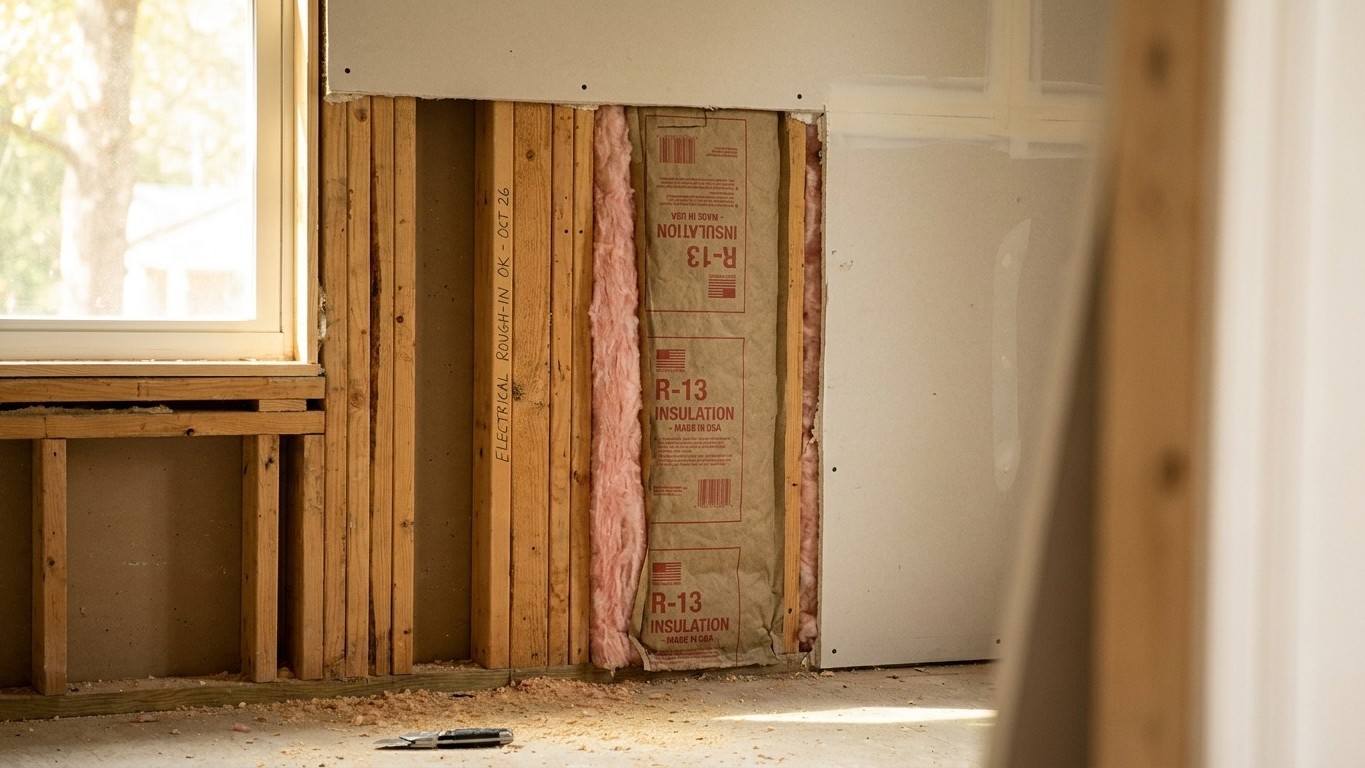
| Class II | Kraft-faced fiberglass batts, vapor retarder paint | Above 0.1 up to 1.0 perm |
| Class III | Latex or enamel paint | Above 1.0 up to 10.0 perm |
Polyethylene sheeting is Class I, the tightest and most restrictive of the three. It’s often what people picture when they hear “vapor barrier,” but calling it that without the class label skips the part of the code that actually decides whether it belongs in a given wall. A Class I sheet does one job in a Zone 6B assembly and a very different, potentially damaging job in a warm-humid assembly, which is why the class distinction, not the presence or absence of a sheet, is what the disagreement between builders in different zones is really about.
Class III is the one most homeowners already own without realizing it. Ordinary latex or enamel paint falls squarely in that permeance range, above 1.0 and up to 10.0 perm. A couple of coats on interior drywall can, in some assemblies, satisfy the code’s retarder requirement on its own, no separate sheet needed.
One distinction worth holding onto: a vapor retarder is not an air barrier. Controlling water vapor diffusion and stopping bulk air leakage are two separate jobs in a wall assembly. Some products, like certain sheet membranes, are built to do both at once, but the code treats them as separate requirements, and satisfying one doesn’t automatically satisfy the other.
Where the rule stops
R702.7 isn’t a blanket mandate. The code lists four exceptions where the interior vapor retarder requirement doesn’t apply, regardless of what zone the wall sits in:
- Basement walls
- The below-grade portion of any wall
- Construction where accumulation, condensation, or freezing of moisture will not damage the materials
- Climate Zones 1, 2, and 3, as covered above
The basement exception is the one most Utah homeowners actually run into, since finished basements are common in both the state’s 5B and 6B counties. A poured concrete foundation wall behaves nothing like a framed exterior wall. Concrete holds moisture for years after the pour, and it continues absorbing and releasing groundwater moisture through its life. If a builder wraps that wall in an interior vapor retarder, the assembly loses its ability to dry to the inside, and moisture that would otherwise pass through slowly instead gets trapped between the concrete and the finish materials. That’s the opposite of what a retarder is supposed to accomplish, so the code exempts basement walls outright rather than forcing an assembly that fights itself. The specifics of how to handle a below-grade wall correctly are covered in the basement wall vapor barrier guide on this site.
The third exception, for construction where moisture won’t damage the materials, covers less common assemblies, things like certain unfinished or utility spaces where the framing and finish materials aren’t vulnerable to the kind of slow-motion damage a retarder is meant to prevent. It’s a narrower carve-out than the basement rule, but it exists for the same underlying reason: the retarder requirement is there to prevent damage, and where there’s nothing to damage, the code doesn’t force the installation.
Who actually decides, in Utah
The 2021 IRC is a model code. Utah, like every state, adopts its own edition, sometimes with amendments, and individual jurisdictions can layer on local requirements on top of that. The county-by-county zone split described above, 21 counties in 5B, 7 in 6B, 1 in 3B, comes from the IECC’s climate zone table, but which edition of the code is actually enforced on a given permit is a question only the local building department can answer.
Salt Lake City International Airport’s official 1991-2020 climate normal runs about 5,154 heating degree days a year, alongside roughly 1,420 cooling degree days. That’s a heavy heating-degree-day count, meaning a long, demanding winter that piles up cold day after cold day rather than one that dips low occasionally and recovers fast. That’s the kind of climate load that makes the interior vapor retarder question carry real weight in Utah, unlike in a state where winters are short and the degree-day total stays low. It’s also a single-station figure. A mountain county elsewhere in the state can run considerably colder, which is exactly the kind of variation that keeps this a county-level question rather than a statewide one.
None of that changes what this page can responsibly tell an individual reader: nothing about what to install in their specific wall. The rule depends on the county’s zone, the wall assembly, and whichever code edition the local jurisdiction has adopted, and only the local building department can confirm which of those applies to a given address. A wall built with the wrong class of vapor control doesn’t show a problem on move-in day. It shows up years later, as rot inside a wall nobody thought to open.