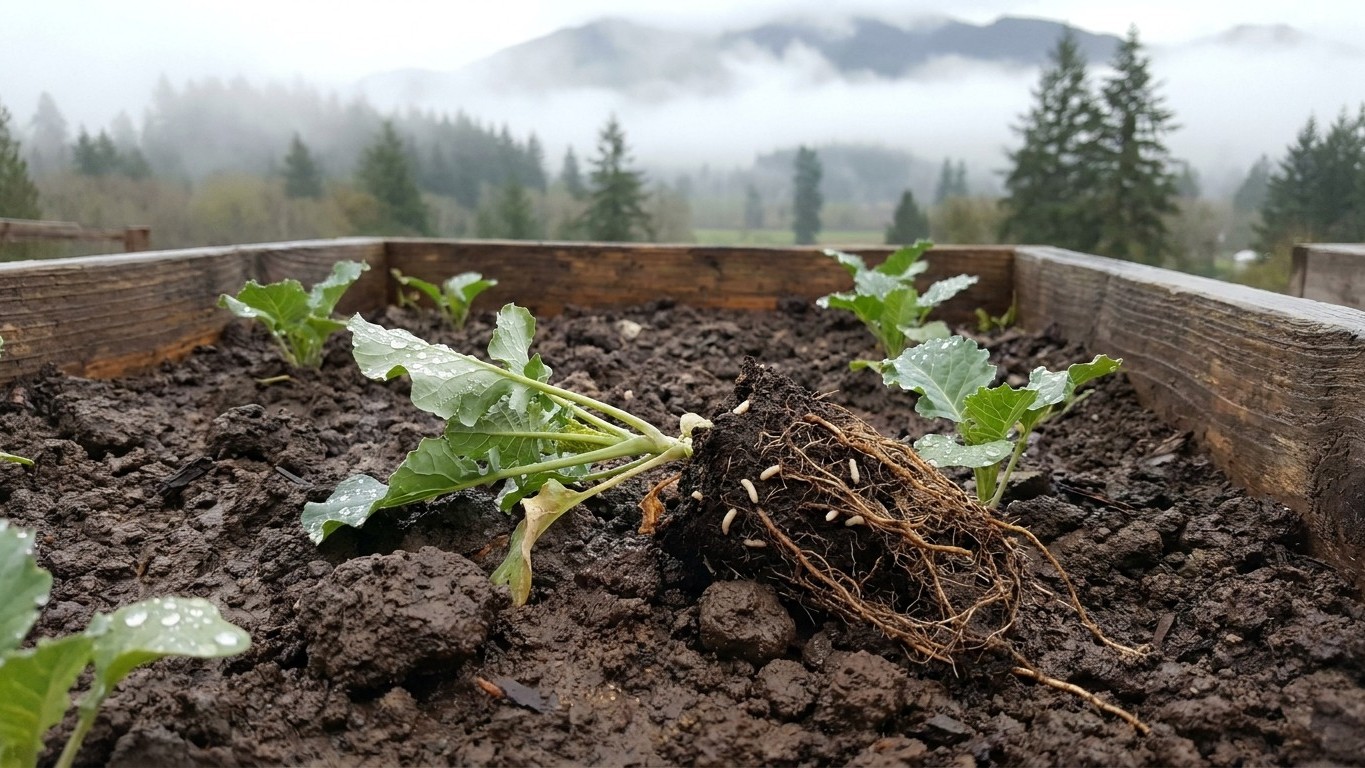

Cabbage maggot (Delia radicum) hits Oregon brassica crops hardest in the cool, damp regions west of the Cascades, with two active flight periods each year: a spring wave that typically runs March through May in the Willamette Valley, and a second, often larger fall flight in September and October. The larvae tunnel into roots of cabbage, broccoli, radish, turnip, and related crops, and the surest way to stop them is timing your planting and transplant protection to dodge those flight windows rather than treating after damage appears.
The weeks to watch

This pest favors moisture and moderate temperatures, which explains why it’s a bigger headache in the Willamette Valley, the coastal counties, and cooler high-elevation gardens than it is east of the Cascades. Growers in Deschutes or Malheur County deal with it too, but the hot, dry summers there compress the damage window and often knock down populations naturally between generations.
Soil type matters almost as much as climate. Heavy, poorly drained clay holds moisture longer after spring rains, giving overwintering pupae a stable, humid environment to survive in. Sandy or well-drained garden beds tend to see lighter pressure, one reason raised beds with amended soil sometimes outperform in-ground rows for brassica crops in wetter parts of the state.
The Oregon Timeline: When Adults Fly and Larvae Feed
Cabbage maggot overwinters as a pupa two to six inches deep in the soil, usually right where the previous crop’s roots were left behind. Adults, small gray flies about a quarter-inch long that look a bit like a slimmer housefly, emerge once soil temperatures at that depth hold near 50°F for several consecutive days. In the Willamette Valley, that threshold typically falls in late March or early April, though a mild winter can push emergence into the second half of March.
Spring Flight and Peak Damage Window
Females start laying eggs at the base of host plants within days of emerging, favoring the soil crack right at the stem. Eggs hatch in two to seven days depending on temperature, and the resulting larvae feed on roots for three to four weeks before pupating. This spring generation is the one that wrecks young transplants and direct-seeded radishes, since seedlings have almost no root mass to spare. Oregon State University’s pest management guidance ties peak spring activity to an accumulated degree-day count starting around 200 to 360 degree-days (base 43°F, biofix from January 1), which growers using sticky trap monitoring can track than relying on the calendar alone.
The Fall Generation Gardeners Forget
A second and sometimes third generation flies in late summer into fall, often catching gardeners off guard because they’ve mentally filed cabbage maggot as a spring problem. Fall brassica plantings, particularly turnips, radishes, and fall cabbage started in July or August, sit right in the path of this later flight. Damage here is less about killing the whole plant and more about tunneled, unmarketable roots on crops grown specifically for their roots.
Spotting the Damage Before the Crop Is Lost
Above ground, infested seedlings wilt during the heat of the day even when soil moisture looks fine, and older transplants show stunted, off-color growth that resembles nutrient deficiency more than insect damage. Pull a struggling plant and check the roots: healthy cabbage roots are firm and white, while maggot-damaged roots show brown, slimy tunnels and sometimes visible cream-colored larvae less than half an inch long.
On radish and turnip, the damage is more direct since the root is the harvested part. Even light tunneling that wouldn’t kill the plant can make the crop unsellable at a farm stand or simply unappetizing to serve at the table. Secondary rot organisms often move into those tunnels after the larvae have finished feeding, which is why an infested root sometimes looks fine at harvest and turns to mush in storage a week later.
What Actually Stops Cabbage Maggot in Oregon Gardens
No single tactic handles this pest on its own. The combination that works best in Oregon growing conditions layers timing, physical exclusion, and habitat management, with insecticides reserved as a backup rather than a first move.
Timing and Row Covers
Delaying transplant dates by even two to three weeks past the predicted spring emergence can let seedlings develop enough root mass to tolerate light feeding without collapsing. Where an early start matters, floating row cover installed immediately after transplanting or seeding, and sealed tight at the soil edges with staples, pins, or a shovel of dirt, physically blocks adult flies from reaching the base of the plant to lay eggs. The seal at ground level is the part gardeners most often get wrong; a gap of even an inch gives the fly an entry point.
Row cover works only if it goes on before the flies find the crop, since it traps adults inside just as effectively as it keeps them out. Once flight activity has started in a given bed, cover offers no benefit and can even make things worse.
Crop Rotation, Soil Health, and Natural Enemies
Rotating brassicas away from the previous year’s brassica ground by at least one full growing season reduces the odds that overwintering pupae emerge directly under next year’s crop. Clearing old brassica roots and stems out of the bed at the end of the season, rather than tilling them under, removes the food source that lets late-season larvae finish development and pupate for winter.
Ground beetles and rove beetles are active predators of cabbage maggot eggs and young larvae in undisturbed soil, and a parasitic wasp, Aleochara bilineata, attacks the pupal stage. Gardens that skip broad-spectrum insecticide sprays and keep some permanent mulched or perennial border areas nearby tend to support higher populations of these natural enemies, which knocks back maggot numbers over a season or two without any direct intervention from the gardener.
When to Consider Insecticide Options
For home gardeners, options are limited and timing-dependent. A drench of an insecticide labeled for cabbage maggot applied right at transplanting, before eggs are laid, targets the soil zone where young larvae would otherwise establish. Applications made after larvae are already tunneling into roots come too late to save the plant. Diatomaceous earth worked into the soil surface around the stem base can deter egg-laying females on a small scale, though it needs reapplication after rain or irrigation to stay effective.
Commercial growers in Oregon’s vegetable regions typically rely on degree-day monitoring paired with yellow sticky traps to time a single well-placed spray to the start of adult flight, rather than spraying on a fixed calendar date. That approach cuts down on unnecessary applications and protects the beneficial insect populations that help suppress the next generation.
Radish and turnip growers who’ve been burned by tunneled roots often switch to a simple physical barrier instead of chasing spray timing: a plastic or cardboard collar pushed an inch into the soil around each seedling stem blocks the female fly from reaching the exact spot where she needs to lay eggs, and it costs nothing but a few minutes with a pair of scissors.