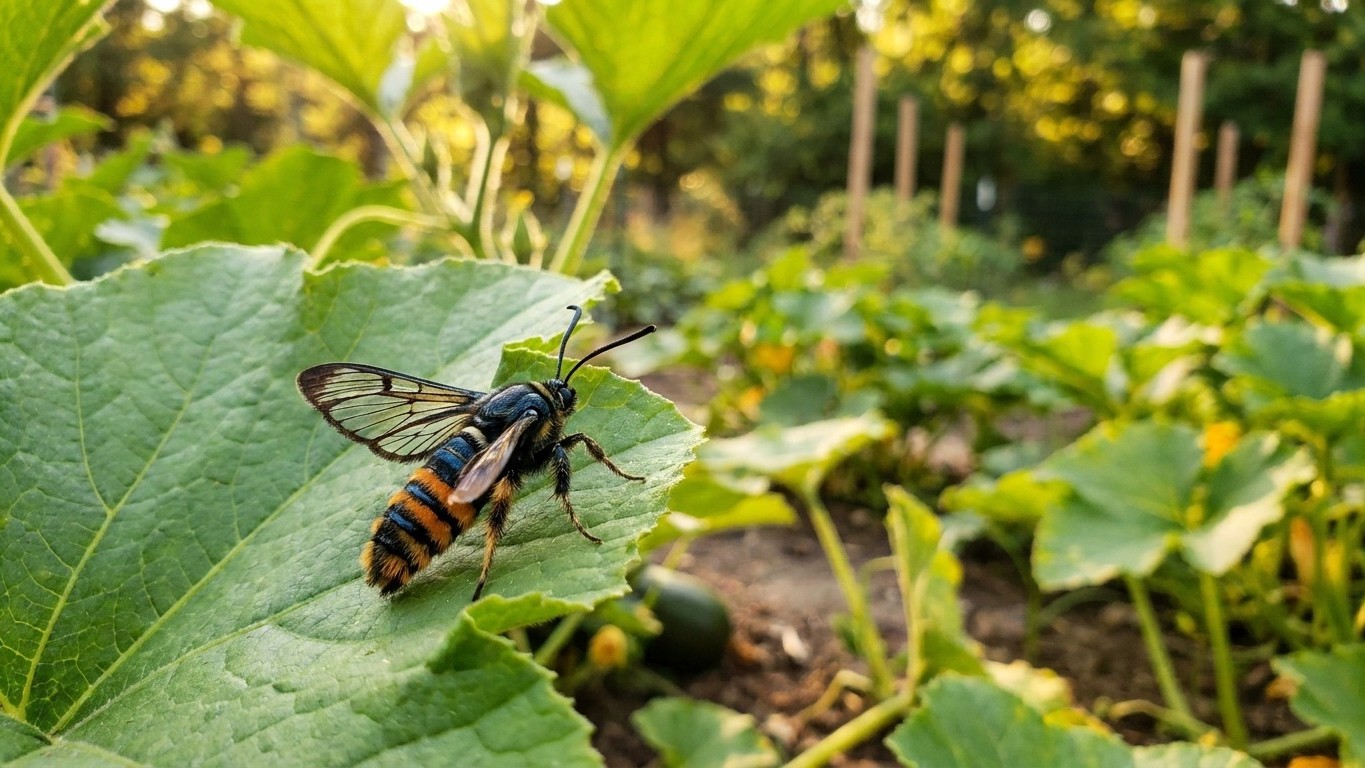

Squash vine borer moths start flying in Nebraska in late June, with activity peaking through July and tapering off by mid-August. Unlike gardeners in Texas or Oklahoma who deal with two generations a season, Nebraska growers typically face just one wave of moths per year, tied to soil warming past roughly 60°F several weeks earlier. That single-generation pattern is actually good news: get your timing right during that six-to-eight week window, and you can protect a squash patch without spraying all summer.
Stopping this pest comes down to three things working together: catching the moths before they lay eggs, spotting larvae before they tunnel deep into the stem, and choosing squash varieties that shrug off the damage even when a borer gets through. None of these work well alone.
The Squash Vine Borer’s Nebraska Calendar

The squash vine borer (Melittia cucurbitae) spends winter as a pupa tucked one to two inches deep in the soil, usually right where last year’s squash plants grew. When the ground warms in late spring, adult moths chew their way out and start flying, sometimes as early as mid-June in southeastern Nebraska’s warmer river valleys, more commonly the last week of June across the rest of the state.
These moths look nothing like the gray, dusty millers most gardeners associate with cutworms. They’re day-fliers with an orange and black abdomen fringed in hairy scales, often mistaken for wasps buzzing around the garden at noon. A female can lay 150 to 200 eggs over her lifespan, dropping them singly at the base of squash stems, near leaf nodes, or right at the soil line. Eggs hatch in about a week, and the newly emerged larvae immediately tunnel into the stem, where they’ll feed for four to six weeks before dropping to the soil to pupate.
That single Nebraska generation means the real danger window runs from late June through early August. By the time frost hits in October, any larvae still active have already burrowed down to overwinter. Gardeners who till their soil in fall or early spring, before that late-June emergence, interrupt the cycle before it even starts.
Spotting the Damage Before the Plant Collapses
The first sign most gardeners notice isn’t a bug. It’s a healthy-looking zucchini plant that wilts hard in the afternoon sun despite soaked soil. By the time wilting shows up, larvae have usually been feeding inside the stem for a week or more, chewing through the vascular tissue that moves water up to the leaves.
Look closer at the base of the plant, right where the stem meets the ground, and you’ll often find small holes surrounded by a wet, sawdust-like material called frass. That frass is the giveaway. It’s essentially larval excrement mixed with chewed plant fiber, and it’s usually the clearest sign of an active infestation before the whole vine collapses.
Not every squash faces equal risk. Zucchini and yellow summer squash have hollow, relatively thin stems that larvae tunnel through easily, making them the most frequent casualties in Nebraska gardens. Hubbard squash is also highly attractive to egg-laying females, which is why some gardeners plant a row of Hubbard along the garden edge purely as a sacrificial trap crop, checking it obsessively while their main crop stays cleaner. Butternut and other Cucurbita moschata varieties have solid, more fibrous stems that larvae struggle to penetrate, which is why they rarely show the same dramatic wilting.
What Actually Stops Squash Vine Borer
Timing Is Everything
Row covers are the single most effective physical barrier, but only if they go on before moths start flying and come off in time for pollination. In most of Nebraska, that means covering young squash plants by early June and keeping them sealed at the edges (soil, not just tucked loosely) through late June. Once female flowers appear, covers need to come off so bees can do their job, which unfortunately lines up right with peak moth activity. Some gardeners split the difference by hand-pollinating flowers each morning and keeping covers on a few extra weeks, sacrificing a bit of yield for a lot of protection.
For gardeners who’d rather use an insecticide, timing beats product choice. Applications targeted at the stem base, not the leaves, starting in late June and repeated every seven to ten days for three to four weeks, catch larvae before they tunnel in deep enough to be protected from contact sprays. Once a larva is an inch into the stem, spraying the outside does almost nothing. Products containing spinosad or those labeled for vine borer control on cucurbits work best applied in early evening, since that’s when adult moths are laying eggs and larvae are most exposed during hatching.
Mechanical and Cultural Controls
Gardeners who catch an infestation early sometimes perform what’s essentially minor surgery: slitting the stem lengthwise with a sharp knife right where frass appears, picking out the larva by hand, then mounding moist soil over the wound. Squash stems root readily at the nodes when buried, so a plant that loses part of its main stem can often push out new roots and survive if you bury a few inches of vine at each leaf joint as it grows, a technique called vine layering. It won’t save every plant, but it buys time for a damaged vine to keep producing while a healthier section of stem takes over water and nutrient transport.
Fall tillage matters more than most Nebraska gardeners realize. Turning over the soil after harvest, and again in early spring before moths emerge, exposes overwintering pupae to freezing temperatures and predators. Crop rotation helps too, since moving squash to a different bed each year means emerging moths have to travel farther to find host plants, and some simply won’t. Removing and destroying infested vines immediately after harvest, rather than leaving them to break down in a compost pile, also cuts down the number of pupae overwintering in your garden.
Choosing Varieties That Fight Back
Plant genetics do real work here. Butternut, cushaw, and other moschata-type squash resist borer damage well enough that many Nebraska Extension gardeners recommend switching entirely if borers have been a recurring headache. These varieties still get eggs laid on them, but the solid stems mean larvae rarely establish a tunnel large enough to cut off water flow to the plant.
Succession planting offers a partial workaround for gardeners committed to growing zucchini or yellow squash anyway. Starting a second round of seeds in early July, after the peak egg-laying window has passed, can produce a late-season crop that dodges most of the damage, assuming there’s enough frost-free growing season left, which in most of Nebraska runs into early-to-mid October depending on the region. It’s a gamble worth taking for gardeners who’ve already lost a first planting and want a fall harvest rather than nothing at all.
One detail that surprises a lot of home gardeners: those trap-crop Hubbard squash planted specifically to lure egg-laying females away from the main crop need to be pulled and destroyed, not just left in place. If the Hubbard plants get infested and are left standing, they become a launch pad for larvae to pupate right in the garden bed, feeding next year’s problem instead of solving this year’s.
Related guides
- Squash vine borer in South Dakota: When It Shows Up and What Stops It
- Squash vine borer in Iowa: When It Shows Up and What Stops It
- Squash vine borer in New Brunswick: When It Shows Up and What Stops It
- Squash vine borer in Newfoundland and Labrador: When It Shows Up and What Stops It
- Squash vine borer in Connecticut: When It Shows Up and What Stops It
- Squash vine borer in Arkansas: When It Shows Up and What Stops It