
Squash vine borer moths start showing up in Louisiana as early as April in the southern part of the state, and thanks to the long growing season, a second wave often hits again in late July or August. That second generation is what catches most home gardeners off guard, since they assume the danger passed once their spring squash made it to harvest.
Stopping this pest means working around its timing rather than reacting after vines collapse. Once the larvae are tunneling through a stem, there’s no rescuing that plant. Everything that works against Squash vine borer in Louisiana happens before or right at egg-laying, not after.
Why Louisiana Sees Two Waves of Squash Vine Borer

The squash vine borer (Melittia cucurbitae) overwinters as a larva or pupa tucked inside a cocoon a few inches under the soil surface, usually right where last season’s squash plants grew. In colder states, that single generation emerges once, does its damage over the summer, and that’s the whole show for the year. Louisiana’s mild winters and hot, extended summers change that math.
Adult moths tend to emerge once soil temperatures hold steady in the low 60s Fahrenheit for several days running. In south Louisiana, that threshold is often crossed by early to mid-April. North Louisiana, running a few degrees cooler in early spring, usually sees emergence a couple of weeks later, into late April or early May. From there, the first generation lays eggs, larvae feed for four to six weeks, then pupate and emerge again as a second flight of moths sometime in July or August, right when fall squash and pumpkin plantings are getting started.
That overlap is the real problem. A gardener who plants a fall crop of squash in late July, thinking they’ve dodged the spring borers, often plants directly into the path of the second generation’s egg-laying window.
Recognizing the Signs Before Your Vines Collapse
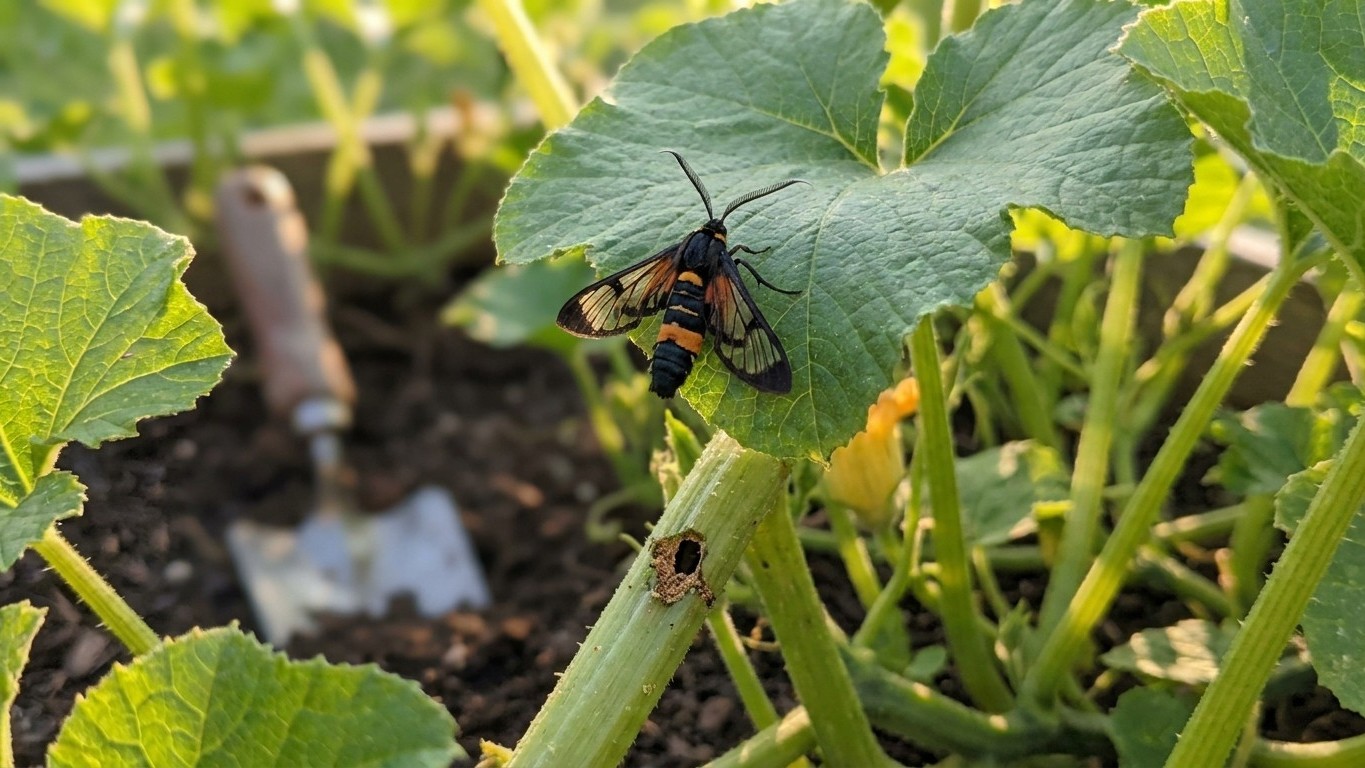
The adult moth is easy to mistake for a wasp on first glance. It’s about an inch to an inch and a half across, with metallic greenish-black front wings and clear back wings edged in black, plus a body ringed in orange and black. It flies during the day, unlike most moths, and you’ll often spot it hovering low around the base of squash plants in the morning.
Eggs are the detail most gardeners miss entirely. They’re tiny, oval, and reddish-brown, laid singly at the base of the stem right at or just below the soil line. A single female can lay well over 100 eggs over her lifespan, scattering them across whatever squash and pumpkin plants she finds. Once those eggs hatch, usually within a week to ten days, the larvae immediately bore into the stem and start feeding, and that’s when visible symptoms show up.
The giveaway is a greenish-yellow, sawdust-like frass pushed out of small holes near the base of the stem. It looks like wet sawdust and it’s the clearest sign of an active infestation. Wilting follows soon after, and it’s often sudden and severe even when the soil is plenty moist, because the larvae have chewed through the vascular tissue that moves water up the stem. By the time a whole vine has collapsed, there are usually multiple larvae already inside, each one capable of destroying several inches of stem.
What Actually Stops Squash Vine Borer in Louisiana Gardens
Timing plantings around the two generations
Since Louisiana’s growing season allows for two flights of moths, timing plantings to slide between them cuts down exposure significantly. Getting squash in the ground as early as the soil allows in March lets plants get well established and often past their most vulnerable early stage before the first generation of moths peaks in April and May. For a fall crop, waiting until mid-to-late August to plant, after the second generation’s egg-laying has largely wound down, reduces the odds of a repeat infestation.
Succession planting, staggering smaller plantings every two to three weeks rather than one big planting, also spreads the risk. If borers hit one round of plants hard, the next round planted a few weeks later may avoid the worst of that generation’s activity.
Physical barriers and stem checks
Floating row covers keep adult moths off young plants entirely, and they’re one of the more reliable tools available. The catch is timing: covers need to come off once flowers open, since squash needs pollinators to set fruit, and that’s exactly the point at which the plant becomes vulnerable again. Some gardeners hand-pollinate covered plants in the early morning to keep protection in place longer.
Checking the base of each stem weekly during egg-laying periods, mid-April through May and again in July through August, catches the problem before larvae ever get inside. The eggs scrape off easily with a fingernail. It’s tedious, but it’s the single most direct way to intervene before damage starts.
Choosing less vulnerable squash varieties
Not all squash is equally attractive to this pest. Varieties in the species Cucurbita moschata, which includes butternut squash and tromboncino, have solid, less hollow stems that borers find harder to colonize, and they show noticeably less damage even in heavily infested gardens. Zucchini, yellow crookneck, and acorn squash all belong to Cucurbita pepo, the species most consistently hit hardest. Gardeners who’ve struggled season after season with squash vine borer often find that swapping a chunk of their planting over to butternut cuts their losses substantially, even without changing anything else about how they garden.
Biological and targeted chemical control
Bacillus thuringiensis subspecies kurstaki (Bt) works against squash vine borer, but only within a narrow window. It has to be applied to the base of the stem before eggs hatch or right as young larvae are first chewing their way in, since Bt only affects larvae that ingest it, and older larvae tunneled deep inside the stem are already out of reach. Weekly applications to the stem base during the egg-laying windows give the best odds of catching larvae early.
Spinosad and permethrin, applied as targeted sprays to the stem base rather than the whole plant, are the more common conventional options, and both need to go on during the same egg-laying windows to matter. Spraying after wilting has already started is a waste of product; the larvae are already inside and no topical spray reaches them there.
Beneficial nematodes applied to the soil around the base of plants offer another biological angle, targeting larvae and pupae in the soil rather than the adult stage. Results vary by soil moisture and nematode species used, but it’s a reasonable layer to add alongside other tactics rather than relying on it alone.
Cleaning up after harvest matters more than most gardeners realize
Since the pest overwinters in the soil right where squash grew, leaving old vines and root balls in place after harvest gives the next generation a head start. Pulling and destroying spent plants, then tilling the soil where they grew, exposes overwintering cocoons to weather and predators like birds. This step does double duty in Louisiana: it reduces the population feeding into the second summer generation, and it lowers what survives the mild winter to emerge again the following spring.
Rotating where squash and pumpkins get planted from one year to the next, even just moving them to a different bed or corner of the garden, adds another layer of disruption, since emerging moths often start their search for host plants close to where they pupated.
Some Louisiana gardeners plant a stand of Blue Hubbard squash, a variety that borers find especially attractive, at the edge of the garden as a decoy. The moths tend to concentrate their egg-laying there instead of on the main crop, and that trap planting gets pulled and destroyed once it’s thoroughly infested, taking a chunk of the local borer population with it.
Related guides
- Squash vine borer in Texas: When It Shows Up and What Stops It
- Squash vine borer in Arkansas: When It Shows Up and What Stops It
- Squash vine borer in Maine: When It Shows Up and What Stops It
- Squash vine borer in Manitoba: When It Shows Up and What Stops It
- Squash vine borer in Prince Edward Island: When It Shows Up and What Stops It