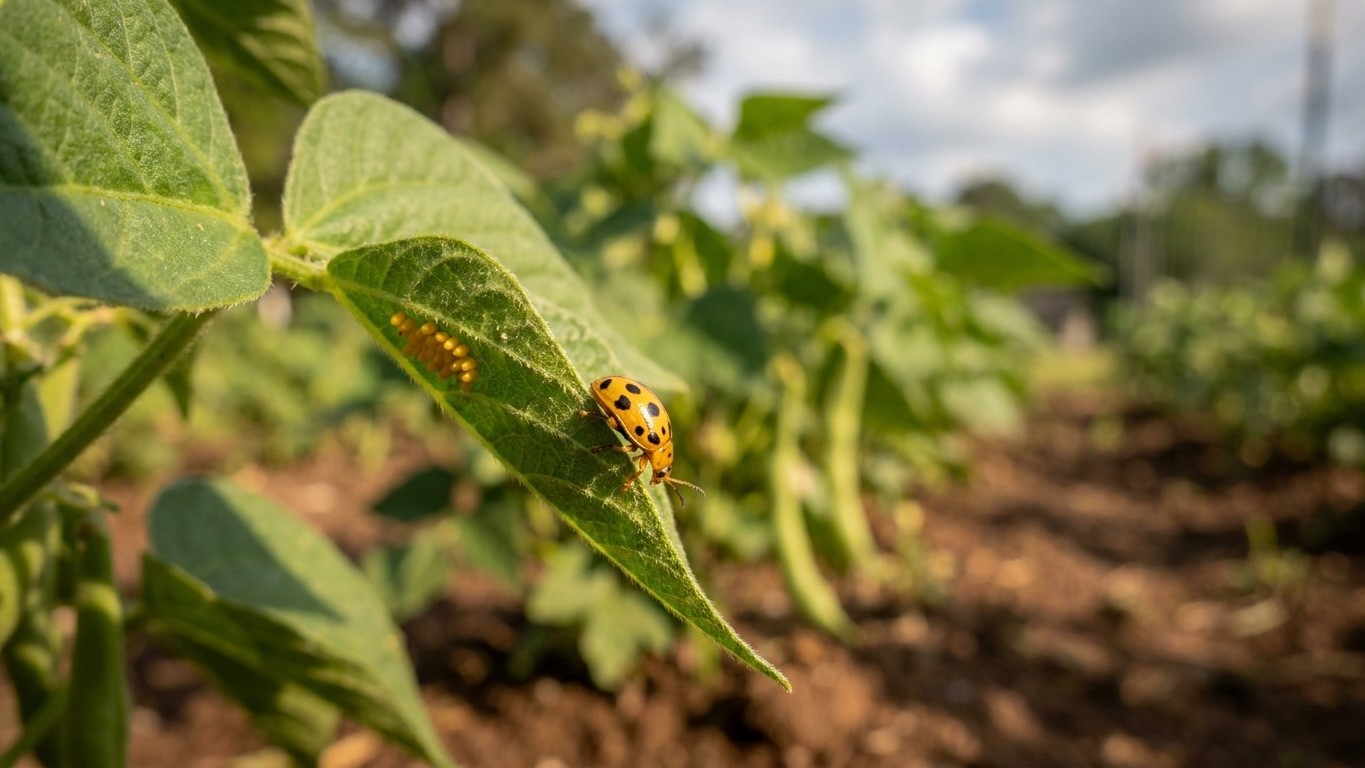

Mexican bean beetles start showing up in Georgia gardens in April, once daytime temperatures hold steady in the 65 to 70 degree range, and they stick around causing damage clear through October. Two to three generations hatch out during that stretch, which is why a bean patch that looked fine on Memorial Day can be reduced to lace by the Fourth of July. Sanitation, row covers, and a parasitic wasp called Pediobius foveolatus are the three tools that actually knock populations down, far more reliably than reaching for a spray bottle every weekend.
When Mexican Bean Beetles Show Up in Georgia

Adult beetles spend the winter tucked into leaf litter, brush piles, and the edges of wooded lots bordering fields and gardens. They don’t fly south or die off with the first frost like some garden pests. In Georgia’s mild winters, especially in the Coastal Plain and lower Piedmont, a good number of adults survive to spring no matter how cold December feels. Once soil and air temperatures climb into the 60s, usually by mid-to-late April in central Georgia and a couple weeks earlier along the coast, those overwintered adults crawl out and head straight for the nearest legume patch.
Mating happens fast. Within a week or two of emerging, females start laying clusters of 40 to 75 yellow-orange eggs on the undersides of bean leaves. Those eggs hatch in five to fourteen days depending on temperature, and the whole life cycle from egg to adult takes roughly a month in Georgia’s summer heat. That short turnaround is what allows two full generations in a mild year and three in a hot one, with the heaviest damage typically landing in July and August when populations from the first generation are laying eggs for the second.
North Georgia gardeners in the mountains and upper Piedmont usually see beetles arrive a week or two later than growers in Macon or Albany, and they generally only get two generations instead of three. That difference matters for timing control measures. A gardener in Blairsville working off a south Georgia beetle calendar will spray or release beneficials too early and miss the actual pressure window.
Telling a Mexican Bean Beetle From a Lady Beetle
This is where a lot of Georgia gardeners go wrong, because the adult Mexican bean beetle looks almost exactly like a large, coppery lady beetle. Both are round, both have spots, and both show up on the same plants. The giveaway is color and spot count: Mexican bean beetle adults run copper to yellow-tan with sixteen black spots arranged in three rows across the wing covers, while most beneficial lady beetles common in Georgia gardens (the multicolored Asian lady beetle, the convergent lady beetle) tend to be more orange-red with fewer, less evenly spaced spots.
The larvae settle the confusion fast, because nothing else on a bean plant looks like them. Mexican bean beetle larvae are bright yellow, spiny, and shaped like tiny fuzzy caterpillars, feeding in clusters on the underside of leaves where they skeletonize the tissue between veins. Lady beetle larvae, by contrast, look like small dark alligators with orange markings, and they’re hunting aphids, not eating your bean foliage.
Damage patterns confirm the diagnosis. Mexican bean beetle feeding leaves a lacy, translucent window pattern on leaves, sometimes skeletonizing them down to just the veins, and heavy infestations will also scar pod surfaces. Snap beans, lima beans, and cowpeas take the worst hits in home gardens; soybeans and other legumes get attacked too, but usually with less economic consequence in a backyard setting.
What Actually Stops Mexican Bean Beetles
Handpicking still works, and it’s not as tedious as it sounds if you catch the problem early. Checking the undersides of leaves every few days in May and June, before the first generation’s eggs hatch, lets you crush egg clusters and knock adults into a jar of soapy water before numbers build. This single habit, more than any product, determines whether a garden has a mild or a devastating beetle year.
Floating row covers installed at planting and left on until bloom keep the earliest overwintered adults from ever finding the crop. Once beans start flowering, covers have to come off for pollination, but by then the plants are often sturdy enough to tolerate some feeding without collapsing.
Biological Control With a Parasitic Wasp
The most effective tool in the Southeast, and one most Georgia home gardeners have never heard of, is a tiny parasitic wasp called Pediobius foveolatus. This wasp doesn’t overwinter reliably in most of the country, including Georgia, so it has to be purchased and released fresh each season, typically in June when the first Mexican bean beetle larvae appear. The female wasp lays her eggs inside beetle larvae, and each parasitized larva turns into a hardened, golden “mummy” that releases 20 to 25 new wasps instead of a beetle. University Extension programs in the mid-Atlantic and Southeast have used mass releases of this wasp for decades in commercial soybean and snap bean fields, and the same suppliers who sell it to farm co-ops also sell smaller quantities to home gardeners.
For a release to work, timing matters more than volume. Wasps need actively feeding beetle larvae to parasitize, so releasing them onto a plant with only adult beetles or only eggs wastes the purchase. Scouting for young larvae first, then releasing wasps directly onto infested leaves, gives populations a real shot at establishing through the rest of the season.
Insecticidal soap and neem oil knock down larvae and soft-bodied adults on contact and carry low risk to bees if applied in the evening after flowers close. Spinosad, an organic-approved option derived from soil bacteria, has good activity on beetle larvae but should still be applied at dusk to limit contact with foraging pollinators. Pyrethrin-based sprays work faster but are broader-spectrum, meaning they’ll also kill the very lady beetles and wasps that would otherwise help control the problem, so they’re best reserved for infestations that have already outrun other methods.
Reducing Next Year’s Infestation
Fall cleanup does more long-term good than any spring spray. Because adults overwinter in plant debris and leaf litter, clearing bean plants, vines, and fallen leaves from the garden bed after harvest removes a huge share of the shelter population depends on to survive a Georgia winter. Tilling under crop residue in late fall exposes overwintering adults to cold and predators instead of letting them tuck in undisturbed.
Rotating bean crops to a different part of the yard each year, ideally at least 100 feet from the previous season’s planting site, slows down how quickly emerging spring adults find the new crop. It won’t stop a determined beetle from flying across a suburban lot, but it buys time, and time is what lets natural predators and the first handpicking passes get ahead of the population.
Staggering planting dates spreads risk. Planting an early crop that matures before beetle pressure peaks in July, alongside a second planting timed to flower after the first generation has died back, means at least one crop is likely to dodge the worst of the damage. Some bush bean and soybean varieties also carry documented tolerance to beetle feeding, producing usable yields even under moderate pressure, which is worth asking about at a local Georgia nursery or through a county Extension office before ordering seed for next season.