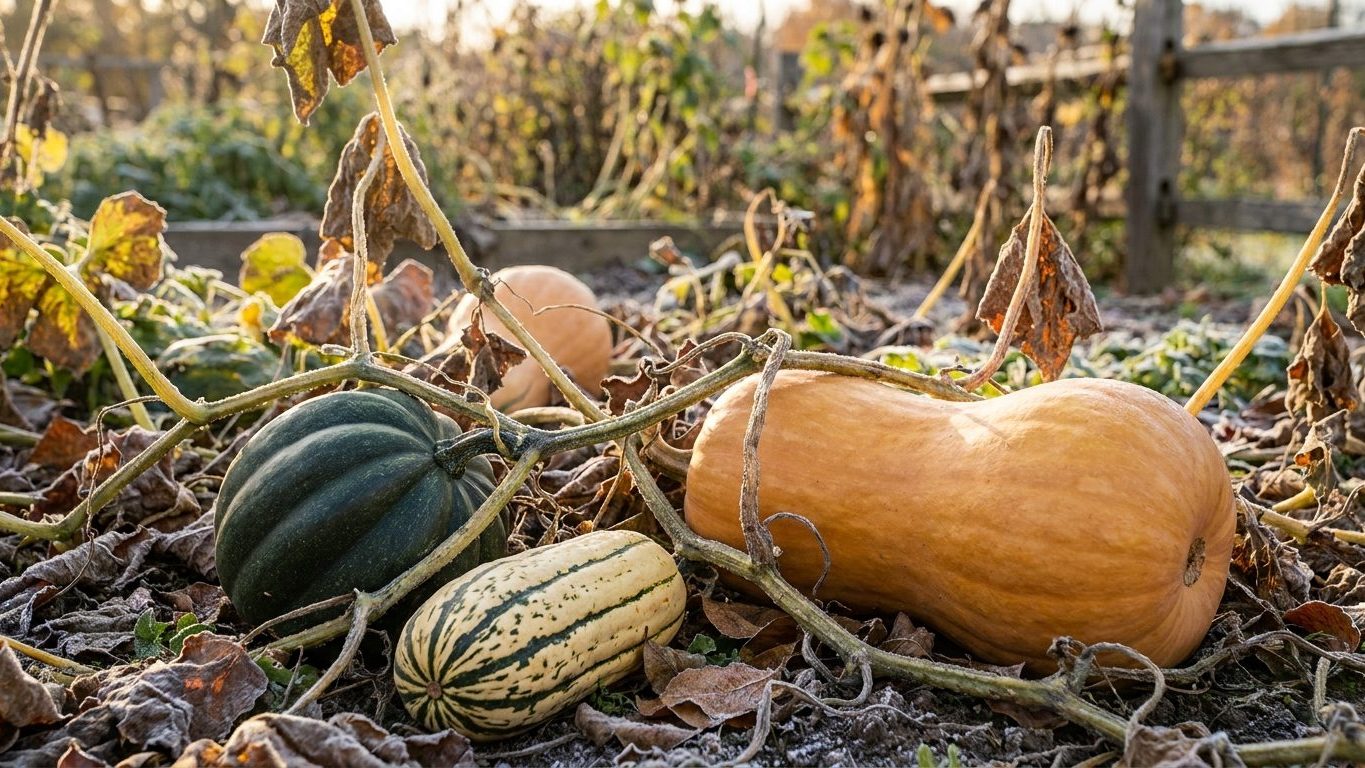

Most winter squash types need close to the full length of a frost-free growing season to reach true maturity, not just to produce fruit. That single fact separates winter squash from almost every other vegetable in the garden: a tomato picked green still ripens on the counter, but a Winter Squash pulled early never finishes the job it started on the vine.
What is actually going on

The thing to understand here is full maturity. A winter squash fruit has to ripen while still attached to the plant, drawing sugars and building the hard rind that will let it survive weeks or months in storage. Pull it too soon, whether by an early frost or an impatient hand, and no amount of curing afterward will fix what didn’t happen in the field. This is the mechanism that makes season length matter so much for this crop specifically: the plant isn’t just growing a fruit, it’s finishing one.
Winter squash also differs from summer squash in a way that trips up a lot of new gardeners. Summer squash (zucchini, yellow crookneck, and similar types) gets picked young and tender, often within a week of the flower opening. Winter squash types, by contrast, stay on the vine for the entire stretch of warm weather, slowly converting starches to sugars and thickening their skins. That long hang time is what gives winter squash its storage life. It’s also what makes a short growing season such a real obstacle rather than a minor inconvenience.
It’s worth being precise about another point of confusion. A carving pumpkin is grown mostly for its shell, its size, and its color, since the flesh is often an afterthought. Winter squash is grown for the opposite reason: the flesh is the point, and the skin exists mainly to protect it through storage. Some varieties sit in both categories, and where that overlap happens this site’s pumpkin guides cover the carving side in detail rather than repeating that ground here.
Curing adds another layer that’s easy to skip past. After harvest, most winter squash types benefit from a period of curing in a warm, airy spot, which hardens the rind further and helps heal small scratches picked up during harvest. But curing is not a fix for an immature fruit, and it’s not a guarantee against decay either. Before eating any stored squash, inspect it: a soft spot, a weeping patch, or a moldy stem area means that particular fruit is done, no matter how good the rest of the pile looks. Looking sound isn’t the same as being sound.
In the garden
Counting the season honestly starts with knowing two dates: the average last spring frost and the average first fall frost for the specific location, not the state or the region. Local extension services publish these averages, and they’re the only starting point that means anything, since a garden fifteen miles away can have a meaningfully different frost pattern because of elevation or nearby water.
Once that window is known, the gap between what the season offers and what a given winter squash type needs gets closed through a stack of techniques, not any single trick. The table below lays out the main ones, along with what tends to go wrong when each is skipped or mishandled.
| Technique | What it buys the gardener | What goes wrong if mishandled |
|---|---|---|
| Starting seed indoors instead of direct sowing | A head start of several weeks before the last frost date | Seedlings started too early get root-bound or leggy, and squash generally resents transplant shock more than tomatoes do |
| Black plastic or dark mulch over the planting bed | Warmer soil temperature early in the season, which speeds germination and root growth | Left down too long into summer, it can overheat roots and trap excess moisture against the stem |
| Row cover over young plants | Protection from late cold snaps and early pests without blocking light | Left on after flowering begins, it blocks the pollinators the plant needs to set fruit |
| Choosing a shorter-season type for the region | A better match between the plant’s needs and the actual frost-free window | Guessing at a type without checking regional trial data often means picking one bred for a much longer season |
| Protecting the last fruit from an early fall frost | A few extra days or weeks for borderline fruit to finish ripening | Covering the whole plant but leaving fruit exposed, or covering too late after damage has already occurred |
None of these techniques work in isolation the way a single fix might for a faster crop. A gardener who starts seed indoors but then plants into cold, wet soil loses most of that head start right back. One who mulches for warmth but skips row cover during a late cold snap can still lose the whole planting overnight. The stack matters more than any one piece of it.
Trial results vary too much by state, and a type that performs well in one region’s summer heat and rainfall pattern can underperform badly in another. The state extension service is the source that has actually run those trials locally, and it’s worth checking before buying seed.
What it depends on where you are
Season length is only one variable, and it’s the one most gardeners already know how to check. Summer heat and summer rainfall matter just as much, and they’re harder to summarize nationally because they don’t map neatly onto frost dates. A region can have a long frost-free window but cool, damp summers that slow fruit development anyway, or a shorter window paired with intense heat that pushes growth fast once the plant gets going.
Humidity patterns also affect how winter squash performs after the growing part of the job is done. Areas with high humidity late in the season can make curing harder, since the fruit needs airflow to dry and harden properly, while dry climates tend to make that stage more forgiving. None of this is something a national page can responsibly pin down to a specific number or date, because it changes county to county, sometimes yard to yard depending on drainage and airflow.
What this site can offer is a starting point rather than a final answer. The state-level guides in this garden cover regional patterns in more useful detail, and they’re built to be paired with, not a substitute for, the local extension service. Extension offices run actual field trials, track disease pressure specific to the area, and can say Which Winter Squash types have performed well in nearby test plots over multiple years. That kind of local, current data is something no general gardening page, including this one, can replace.
The practical move is to use the mechanism, regional context, and the extension office for the specific decision: which type to plant, when to start seed, and how much of a buffer to build in for an early frost. Combining all three gives a far more reliable answer than any single one alone.
The mistake that costs the most
The single most expensive mistake is planting a winter squash type without checking whether it actually matches the local season, and then treating the resulting immature harvest as though it will still store like a properly ripened one. This happens more often than it should, usually because seed packets and catalog descriptions get written for a national audience and don’t reflect what a specific region’s summer actually delivers.
The fix isn’t complicated, but it does take an extra step most gardeners skip. Before choosing seed, check the extension service’s trial data or regional variety recommendations for the area, and pick a type known to finish reliably within the local frost-free window rather than one that merely fits on paper. If the season runs short no matter what’s planted, lean harder on the techniques covered above, starting seed indoors, warming the soil, and protecting the last fruit from an early frost, rather than hoping an unripe squash will somehow catch up in storage.
It won’t. An immature winter squash has a thin, soft rind that hasn’t hardened, and that rind is the plant’s only real defense against rot once it’s off the vine. A fruit harvested before it finished ripening tends to break down in storage within weeks rather than months, no matter how carefully it’s cured or where it’s kept. That’s not a texture problem to work around at the stove; it’s a spoilage risk, and the inspection habit matters here too: any softening, weeping, or mold at the stem end means that fruit gets used or discarded now, not stored on the chance it holds.
Matching the type to the season before planting costs nothing but a little research. Discovering the mismatch in November, staring at a pile of squash that won’t keep, costs an entire season’s harvest.