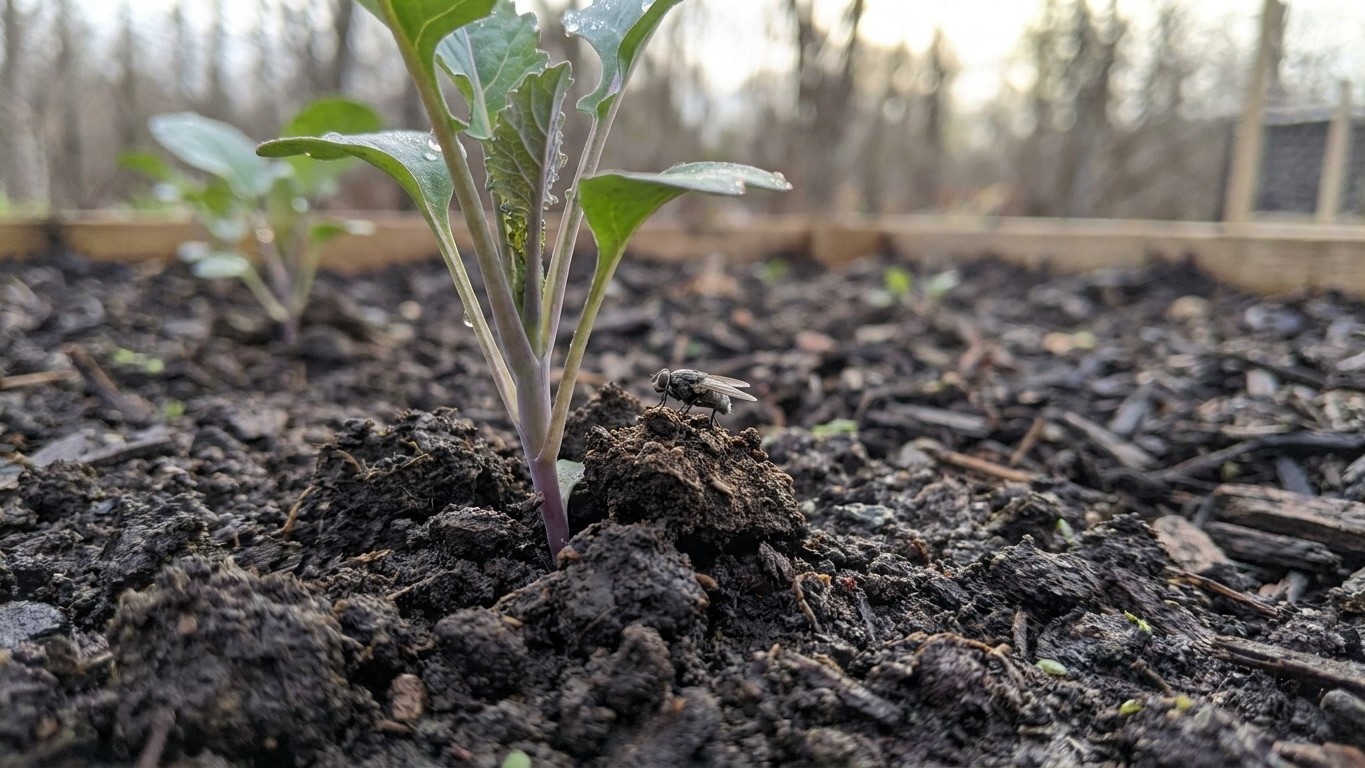

Cabbage maggot flies start moving in Quebec gardens as soon as soil temperatures climb past 43°F, which usually lands somewhere between late April and mid-May depending on the region. That first wave is the most damaging one of the season because it hits transplants right when their root systems are smallest and most vulnerable. Stopping it comes down to timing your plantings around that window, physically blocking the flies from reaching the soil, and rotating where you grow crucifers so the population never gets comfortable in one spot.
This isn’t a pest that sneaks up on you with dramatic overnight damage. It works underground, quietly, and by the time leaves start yellowing the roots are often already chewed through. Understanding the schedule this insect keeps in Quebec’s climate is the difference between losing a row of broccoli transplants and harvesting a full crop.
The Life Cycle Behind Quebec’s Cabbage Maggot Problem

Delia radicum, the fly responsible for cabbage maggot damage, spends winter as a pupa buried a few inches into the soil near where crucifers grew the previous year. Frozen ground doesn’t kill it. The insect simply waits, sometimes for years if conditions aren’t right, until spring soil temperatures trigger emergence.
Adults look like small, grayish houseflies, roughly a quarter-inch long, easy to mistake for a dozen other flying insects in the garden. Females seek out the base of cabbage-family plants, laying clusters of tiny white eggs right at the soil line where stem meets root. Within a week, the eggs hatch into legless white larvae that burrow straight into the root tissue and feed there for two to three weeks.
Southern Quebec, including the Montérégie and Estrie regions, typically sees three generations per growing season. Farther north toward Saguenay–Lac-Saint-Jean or the Abitibi region, shorter seasons often limit the insect to two generations. Each new generation adds pressure, but it’s that first spring flight that causes the most economic damage because young transplants haven’t developed the root mass to survive heavy feeding.
When Cabbage Maggot Shows Up: The Quebec Timing Window
Quebec agricultural researchers track cabbage maggot emergence using degree-day accumulation rather than calendar dates, because a warm April can push flies out two weeks earlier than a cold one. The base threshold sits at 43°F (6°C), and once accumulated soil degree-days cross roughly 300, the first generation is typically in full flight.
In practical terms, this usually plays out as follows across the province:
- Late April to mid-May: first generation flight begins in southern and central Quebec
- Mid-June to early July: second generation emerges
- Late August into September: a partial third generation appears in southern regions with longer seasons
Gardeners sometimes use a simpler shortcut tied to plant phenology: cabbage maggot flight often lines up closely with lilac bloom. When lilacs hit full bloom in your yard, that’s a reasonable signal the flies are active nearby, and any newly transplanted crucifers are at risk within days.
Home gardeners who transplant broccoli, cauliflower, or cabbage seedlings in early May in the Montreal or Quebec City areas are planting directly into that first flight window. Delaying transplants by two to three weeks, when practical, sidesteps a large chunk of the damage without any product application at all.
Spotting the Damage Before It’s Too Late
Above-ground symptoms lag behind the actual root damage, which is part of what makes this pest frustrating. Wilting during the heat of the day, a bluish or purplish tint to the leaves, and stunted growth compared to neighboring plants are the first visible clues. Pull one suspect plant and the roots tell the real story: tunnels, brown scarring, and sometimes small white larvae still feeding.
Radishes and turnips show damage differently since the maggots feed directly on the edible root, leaving tunnels and rot pockets that show up when you slice the vegetable open. A radish that looks fine on the outside but has brown streaks or soft spots inside is a classic sign of an earlier maggot infestation, even if the larvae have already moved on or died.
Young transplants under three weeks old are the most likely to die outright from root feeding. Established plants with four or five true leaves usually survive an infestation, though they’ll show reduced yield and slower growth compared to unaffected neighbors.
What Actually Stops Cabbage Maggot in Quebec Gardens
Physical barriers remain the most reliable defense, and they work because the fly needs direct soil access to lay eggs at the stem base. Floating row covers, installed immediately after transplanting and sealed at the edges with soil or stones, block adult flies completely as long as there are no gaps. The covers need to go on before the flies find the plants, not after symptoms appear.
Row covers do trap heat, though, which becomes a tradeoff during Quebec’s warmer June stretches. Removing covers once plants are past the vulnerable seedling stage, roughly four to five weeks after transplant, lets pollinators back in for crops like broccoli that eventually flower.
Collars, Barriers, and Timing Tricks That Work
A simpler, lower-cost option involves cutting cardboard or tar-paper collars, roughly 4 inches across with a slit to fit around the stem, and laying them flat on the soil surface at planting time. This stops females from reaching bare soil at the stem base without covering the whole plant. Some Quebec market gardeners report this method cutting egg-laying success by more than half when applied consistently across a planting.
Crop rotation matters more than most gardeners assume. Since pupae overwinter in the soil where crucifers grew, moving cabbage-family crops to a different bed each year, ideally with three to four years between crucifer plantings in the same spot, breaks the cycle by forcing emerging adults to travel farther to find host plants. Backyard gardens with limited space can still rotate within raised beds or containers rather than repeating the same patch.
Beneficial nematodes, specifically Steinernema feltiae, applied as a soil drench around transplants can reduce larval survival significantly when soil temperatures are above 55°F and moisture is adequate. This biological control works best as a preventive soil treatment rather than a rescue treatment once damage is already visible, since the nematodes need time and moist conditions to find and infect larvae before major root damage occurs.
Diatomaceous earth, worked into the soil surface around the stem base, creates an abrasive barrier that can deter egg-laying females, though rain washes it away quickly and reapplication after every significant rainfall is necessary for it to keep working.
Natural Predators Already Working in Your Favor
Rove beetles and ground beetles feed on cabbage maggot eggs and young larvae directly in the soil, and their populations tend to be higher in gardens that avoid broad-spectrum insecticides and maintain some undisturbed mulch or ground cover nearby. A parasitic wasp, Aleochara bilineata, also targets cabbage maggot pupae specifically and has been documented reducing overwintering populations in agricultural fields across eastern Canada.
Encouraging these predators means resisting the urge to till aggressively right after harvest, since that disturbance can destroy overwintering beetle populations along with the pest pupae you’re trying to eliminate. A lighter touch, leaving some soil structure intact between plantings, tends to favor the predators more than the pest over multiple seasons.
Interplanting isn’t a magic fix here, but some Quebec growers report fewer egg-laying females on crucifers planted near strong-smelling companions like onions or garlic, likely because the scent interferes with the flies’ ability to locate host plants by smell. The effect is modest and inconsistent enough that it shouldn’t replace row covers or rotation, but it costs nothing to try alongside proven methods.
One detail that surprises a lot of home gardeners: a single female cabbage maggot fly can lay upwards of 100 eggs over her lifespan, and she’ll often distribute them across several plants rather than dumping them all in one spot. That’s why a garden with even a handful of unprotected transplants during peak flight can end up with damage scattered across an entire crucifer bed rather than concentrated in one obvious trouble spot.
Related guides
- Cabbage maggot in Ontario: When It Shows Up and What Stops It
- Cabbage maggot in New Brunswick: When It Shows Up and What Stops It
- Cabbage maggot in Washington: When It Shows Up and What Stops It
- Cabbage maggot in Wisconsin: When It Shows Up and What Stops It
- Cabbage maggot in Oregon: When It Shows Up and What Stops It