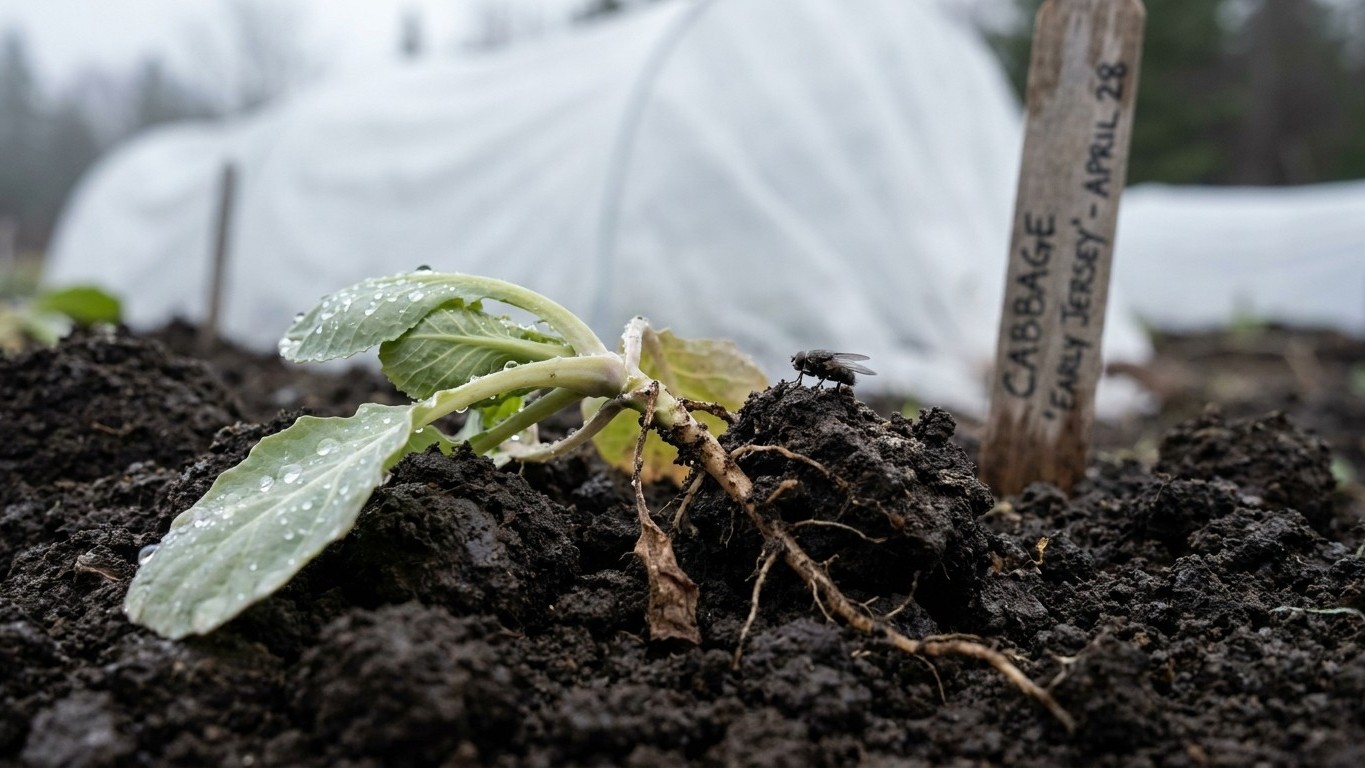

Cabbage maggot flies start laying eggs in New Brunswick soil as soon as it warms past about 50°F, which in the Maritimes usually lands somewhere between late April and mid-May. A second wave hits in July and August. Floating row covers sealed tight at planting, combined with crop rotation and quick removal of root debris after harvest, are what actually keep populations down. Everything else, sprays included, is a secondary tool at best.
When Cabbage Maggot Season Starts in New Brunswick

Delia radicum, the fly behind cabbage maggot damage, times its emergence to soil temperature rather than the calendar. Once soil hits roughly 50°F at a 2-inch depth for several consecutive days, adult flies start showing up around brassica plantings looking for a place to lay eggs. In a typical Fredericton or Moncton spring, that window opens in late April and runs through the third week of May, right when most home gardeners are setting out cabbage, broccoli, and cauliflower transplants.
That overlap is not a coincidence for the pest. Cool, damp Maritime springs happen to match the fly’s preferred conditions almost perfectly. Warm, dry years push emergence later and shrink the window; a wet, sluggish spring stretches it out and can let two overlapping egg-laying periods blur into one long threat.
New Brunswick typically sees two full generations of cabbage maggot per season, sometimes a partial third if fall stays mild. The first generation does the most visible damage to spring transplants. The second, active from mid-July into August, targets later plantings and root crops like rutabaga and turnip that are just starting to size up underground. Some growers in the province track degree-days (a running tally of accumulated warmth above a base temperature) to predict fly activity than a fixed date on a calendar ever could.
Crops and Signs to Watch For in Maritime Gardens
Any plant in the brassica family is fair game: cabbage, broccoli, cauliflower, kale, Brussels sprouts, radish, turnip, and rutabaga. Rutabaga deserves special mention here. New Brunswick, particularly the Waasis and Saint John River valley area, has grown rutabaga commercially for generations, and cabbage maggot is one of the reasons growers there watch spring emergence so closely. A backyard rutabaga bed sits in the exact same risk zone as a commercial field, just on a smaller scale.
The confusing part for a lot of gardeners is that the damage happens underground first. A young cabbage transplant might look fine one week, then wilt during the hottest part of the day the next, even though the soil is moist. Pull it and the roots often show ragged tunneling and small white maggots, sometimes a quarter-inch long, feeding right at the base of the stem. Seedlings can collapse outright. Older plants tend to survive but stay stunted, with leaves that yellow from the outside in.
It helps to rule out look-alikes before assuming cabbage maggot is the culprit:
- Flea beetles chew small round holes in leaves above ground, not in roots
- Cutworms sever stems at soil level but don’t tunnel into the root itself
- Clubroot causes swollen, distorted roots rather than tunneled ones, and is a soil disease, not an insect
If the damage is specifically inside the root or stem base, and it lines up with that late-April-through-May or mid-July window, cabbage maggot is the likely cause.
What Actually Stops Cabbage Maggot in New Brunswick Conditions
Row covers remain the single most reliable defense, and the detail that matters most is sealing the edges. Lightweight spun-bond fabric or insect netting laid over hoops, then buried or weighted down along every edge with soil or boards, physically blocks the adult fly from ever reaching the plant to lay eggs. Gaps as small as an inch let flies in, so this only works when it’s done properly at transplant time and left undisturbed through the first flight period.
Timing planting to dodge peak fly activity is the second lever growers pull. Setting out brassica transplants a week or two after the first big emergence, once that initial wave of egg-laying has passed, cuts exposure meaningfully. For fall crops meant to avoid the second generation, waiting until after early August tends to help, though it shortens the growing window, which matters more for slower crops like rutabaga than for quick-maturing radish.
Crop rotation matters because cabbage maggot pupae overwinter in the soil close to where the previous crop grew. Planting brassicas in the same bed year after year builds up a resident population right where next year’s transplants will go in. Moving brassica plantings to a different part of the garden, ideally with at least a two to three year gap before returning to the same spot, breaks that cycle.
Physical Barriers and Soil-Level Tactics
Simple collars cut from cardboard, tar paper, or heavy cloth and fitted around the base of each transplant stem block flies from laying eggs directly in the soil next to the stem, which is where most infestations start. A few inches of diameter is enough, and the material just needs to sit flush against the soil surface. Diatomaceous earth worked into the soil surface around the stem base can add a layer of protection against larvae that do hatch nearby, though it washes away with rain and needs reapplying.
Sanitation after harvest closes the loop. Cabbage maggot pupae ride out the winter in leftover root fragments and soil clumps left behind after brassicas are pulled. Clearing out roots and debris, rather than tilling them under and leaving them in place, removes a chunk of the population before it gets a chance to overwinter and re-emerge the following spring.
Natural predators, particularly ground beetles and rove beetles, already do some of this work for free in undisturbed soil. Reduced tillage and a light mulch layer give those predator populations more cover to build up over a season, which is one more reason heavy, repeated soil disturbance around brassica beds can backfire.
Where Raised Beds and Soil Drainage Fit In
New Brunswick’s clay-heavy soils in parts of the province hold moisture longer into spring, which keeps ground temperatures cooler for longer and extends the window where conditions favor the fly. Raised beds warm up faster and drain better, shrinking that window somewhat and giving transplants a head start before the peak of the first flight arrives. It’s not a fix on its own, but it stacks well with row covers and rotation rather than replacing either one.
Commercial rutabaga and cabbage growers in the province often rely on yellow sticky traps placed at ankle height near brassica plantings starting in mid-April, checking them every few days to catch the first flies and time their protective measures precisely rather than guessing from a fixed date. A home gardener can copy that trick with a couple of inexpensive yellow sticky cards from a garden center, giving a real, local read on when the flies actually show up in a given spring rather than relying on a provincial average that might be a week or two off from conditions in a specific backyard.
Related guides
- Cabbage maggot in Quebec: When It Shows Up and What Stops It
- Cabbage maggot in Nova Scotia: When It Shows Up and What Stops It
- Cabbage maggot in Newfoundland and Labrador: When It Shows Up and What Stops It
- Cabbage maggot in New York: When It Shows Up and What Stops It
- Cabbage maggot in Prince Edward Island: When It Shows Up and What Stops It