
Colorado potato beetles show up in Massachusetts gardens as soon as soil temperatures climb past 50°F, which typically happens between the last week of April and mid-May depending on how far inland you are. The Berkshires lag a week or two behind the Cape and Islands. Once the adults crawl out of the soil, they head straight for the nearest potato, tomato, or eggplant plant, and the real damage starts about two to three weeks later when the larvae hatch.
This isn’t a pest that sneaks up on you. It’s loud, orange, striped, and it eats leaves fast enough that you can watch the damage spread day to day. The tricky part in Massachusetts isn’t spotting it. It’s stopping it before it strips a plant bare, and doing that without relying on a chemical the beetle has probably already learned to shrug off.
When Colorado Potato Beetles Appear in Massachusetts

Adult beetles overwinter six to eight inches deep in garden soil, often at the edge of last year’s potato patch or under nearby leaf litter and windbreaks. They wait out the cold in a kind of forced hibernation, then dig upward once the ground warms. In central and eastern Massachusetts, that first emergence generally lands in the first half of May. Western Massachusetts, with its cooler spring soil, often sees beetles a week or so later.
Females start laying eggs almost immediately, gluing clusters of 10 to 30 bright yellow-orange eggs to the undersides of leaves. A single female can lay several hundred eggs over her lifetime, spread across weeks. Eggs hatch in four to nine days depending on temperature, and the larvae go through four growth stages over roughly three weeks before dropping to the soil to pupate.
Massachusetts growers typically deal with two full generations per season, sometimes a partial third in a long, warm fall. That means the first wave of adults in May sets up a second wave of eggs and larvae by mid-to-late July, and gardeners who only watch for the beetle in spring often get caught off guard by the midsummer repeat.
Why Timing Varies by County
Soil type and sun exposure matter as much as latitude. Sandy soils on Cape Cod warm faster than the heavier clay found in parts of the Connecticut River Valley, so beetle emergence can shift by five to ten days between neighboring towns. A raised bed with full southern exposure will produce beetles earlier than a shaded backyard plot a few miles away.
Identifying the Beetle at Every Stage
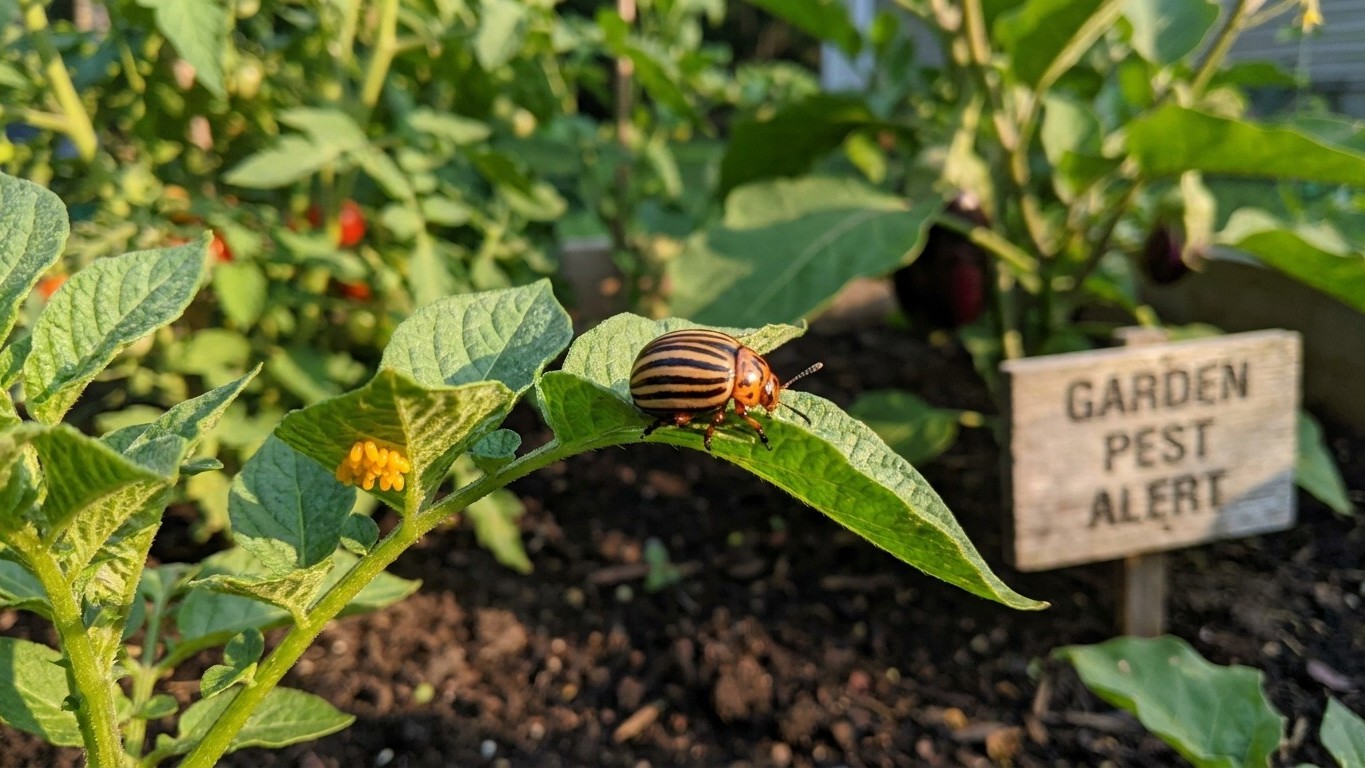
Adults are about three-eighths of an inch long, rounded, with a shell that’s yellowish-orange marked by ten black stripes running lengthwise, five on each wing cover. That stripe count is the giveaway. Several other beetles show up on garden plants with similar coloring, but none match that exact ten-stripe pattern.
Eggs are easy to miss unless you flip leaves over. They’re bright orange-yellow, laid in tight clusters, and stand out against the green underside of a potato leaf. Larvae start out dark red with black heads and grow into a softer orange-red hump-backed grub with two rows of black spots along each side. These larvae, not the adults, do the most damage, since they feed nonstop through four growth stages before dropping into the soil to pupate.
Damage itself is a reliable identifier even before you spot the insect. Leaves get skeletonized, meaning the soft tissue disappears and only the veins remain, starting at the edges and working inward. A heavily infested plant can go from full and green to bare stems in under a week once larvae reach their final growth stage.
Why This Beetle Is Hard to Kill
The Colorado potato beetle holds an unwanted distinction in pest management history: it was the first insect species documented to develop resistance to DDT, back in the 1950s. Since then it’s built up resistance to dozens of insecticide classes across different regions, including several organophosphates, carbamates, and pyrethroids used in past decades.
That resistance doesn’t spread evenly. A product that fails in one county might still work in another, because local beetle populations evolve independently based on what’s been sprayed on them season after season. This is exactly why extension programs across New England, including UMass Extension’s vegetable program, push growers toward rotating modes of action rather than leaning on one product year after year.
Practically, that means checking the active ingredient class on any product label and switching between different classes across a season, not just switching brand names. Using the same mode of action repeatedly, even from different-looking products, accelerates the exact resistance problem gardeners are trying to avoid.
What Actually Stops Colorado Potato Beetles
No single tactic handles this pest on its own. The most reliable results in Massachusetts gardens combine physical barriers, timing tricks, and targeted treatment rather than one heavy spray schedule.
Cultural and Physical Controls
Crop rotation works because overwintering adults emerge from the soil where last year’s potatoes grew and then walk, rather than fly long distances, to find food. Moving potatoes, tomatoes, and eggplant at least 200 feet from last year’s planting site can cut early infestation significantly, since many beetles simply can’t make the trek.
Straw mulch has shown a documented effect too. A thick layer around young plants makes it harder for emerging adults to navigate to the stems, and it also supports ground beetles and other predators that eat beetle eggs and larvae. Floating row covers installed right after planting block adults from reaching plants in the first place, though they need to come off once flowering starts so pollinators can reach the blossoms.
Hand-picking remains genuinely effective on small home plots. Adults are slow-moving and easy to knock into a bucket of soapy water in the early morning when they’re least active. Checking the undersides of leaves for egg clusters every few days during the May emergence window and crushing them stops an entire generation before it hatches.
- Rotate potato-family crops at least 200 feet from the prior year’s location
- Mulch heavily with straw around emergence time in May
- Hand-pick adults and crush egg clusters every 3 to 4 days
- Use floating row covers before flowering, then remove them
- Rotate insecticide modes of action rather than repeating the same product
Biological and Targeted Treatments
Certain biological insecticides based on the bacterium Bacillus thuringiensis subspecies tenebrionis target beetle larvae specifically while leaving most beneficial insects alone. These work best applied when larvae are small, in their first or second growth stage, since older larvae become tougher to kill with biological products.
Natural predators already present in most Massachusetts gardens help more than gardeners realize. Ground beetles, ladybird beetles, and certain predatory stink bugs feed on Colorado potato beetle eggs and young larvae. Avoiding broad-spectrum insecticide sprays that wipe out these predators alongside the target pest tends to reduce overall beetle pressure across a season, not just after a single application.
For gardeners who do reach for a chemical treatment, spinosad-based products and certain neonicotinoid alternatives labeled for home vegetable gardens remain effective against many Massachusetts beetle populations as of recent seasons, though local resistance can vary year to year. Reading the label for the active ingredient’s mode of action class, and switching classes between the spring and midsummer generations, keeps a single product from losing effectiveness within one growing season.
Planning for Next Season
Fall cleanup matters more than most gardeners assume. Adult beetles that fed on your plants this summer are the ones burrowing into that same soil to overwinter. Clearing plant debris and tilling the potato bed in October disturbs the ground enough to expose some overwintering adults to predators and cold before they settle in deep.
Massachusetts extension trials have also shown that staggering planting dates, putting in an early crop and a later crop rather than one large planting, spreads out the vulnerable seedling stage so a single beetle emergence wave doesn’t hit every plant at once. It’s a small adjustment, but on a bad beetle year it can mean the difference between losing a few plants and losing the whole bed.
Related guides
- Colorado potato beetle in Vermont: When It Shows Up and What Stops It
- Colorado potato beetle in New York: When It Shows Up and What Stops It
- Colorado potato beetle in Minnesota: When It Shows Up and What Stops It
- Colorado potato beetle in New Brunswick: When It Shows Up and What Stops It
- Mexican bean beetle in Massachusetts
- Winter moth in Massachusetts
- European corn borer in Massachusetts
- Colorado potato beetle in Illinois: When It Shows Up and What Stops It