
Colorado potato beetles wake up in Ontario as soon as soil temperatures climb past 50°F, which usually happens in the first half of May across the southern part of the province and pushes into late May or early June farther north. Adults that overwintered a few inches underground crawl out, head straight for the nearest potato, tomato, or eggplant patch, and start feeding within days. What actually stops them is a mix of timing your defenses before that emergence window, rotating crops so beetles can’t just walk from last year’s field, and accepting that most insecticide sprays alone will eventually fail because this species is notorious for outsmarting chemistry.
When Colorado Potato Beetles Show Up in Ontario

The trigger isn’t the calendar. It’s soil temperature. Once the top few inches of dirt hold steady above 50°F for several consecutive days, overwintered adults dig their way out and start moving toward host plants. In Essex and Kent counties, that threshold often gets hit by the first or second week of May. In eastern Ontario and the Ottawa Valley, where spring warms up more slowly, emergence can lag two to three weeks behind.
Once above ground, females don’t waste time. Mating happens almost immediately, and egg-laying starts within a week of emergence. A single female can lay 300 to 500 eggs over her lifetime, glued in clusters of a dozen or more on the undersides of leaves. Ontario’s growing season is long enough and warm enough to support two full generations most years, sometimes a partial third in an unusually hot stretch like the summers of 2020 and 2023.
The Degree-Day Shortcut
Provincial extension guidance built around growing degree days (base 50°F) gives growers a more reliable forecast than watching a thermometer. Roughly 100 accumulated degree days after the first adults are spotted, the first egg masses hatch. Another 300 or so, and you’re looking at the first wave of large, voracious fourth-instar larvae, the stage that does the most defoliation. Farmers and serious backyard growers who track this instead of guessing tend to time their first intervention far more effectively than those who just spray on a fixed date.
What the Beetle Actually Looks Like at Each Stage
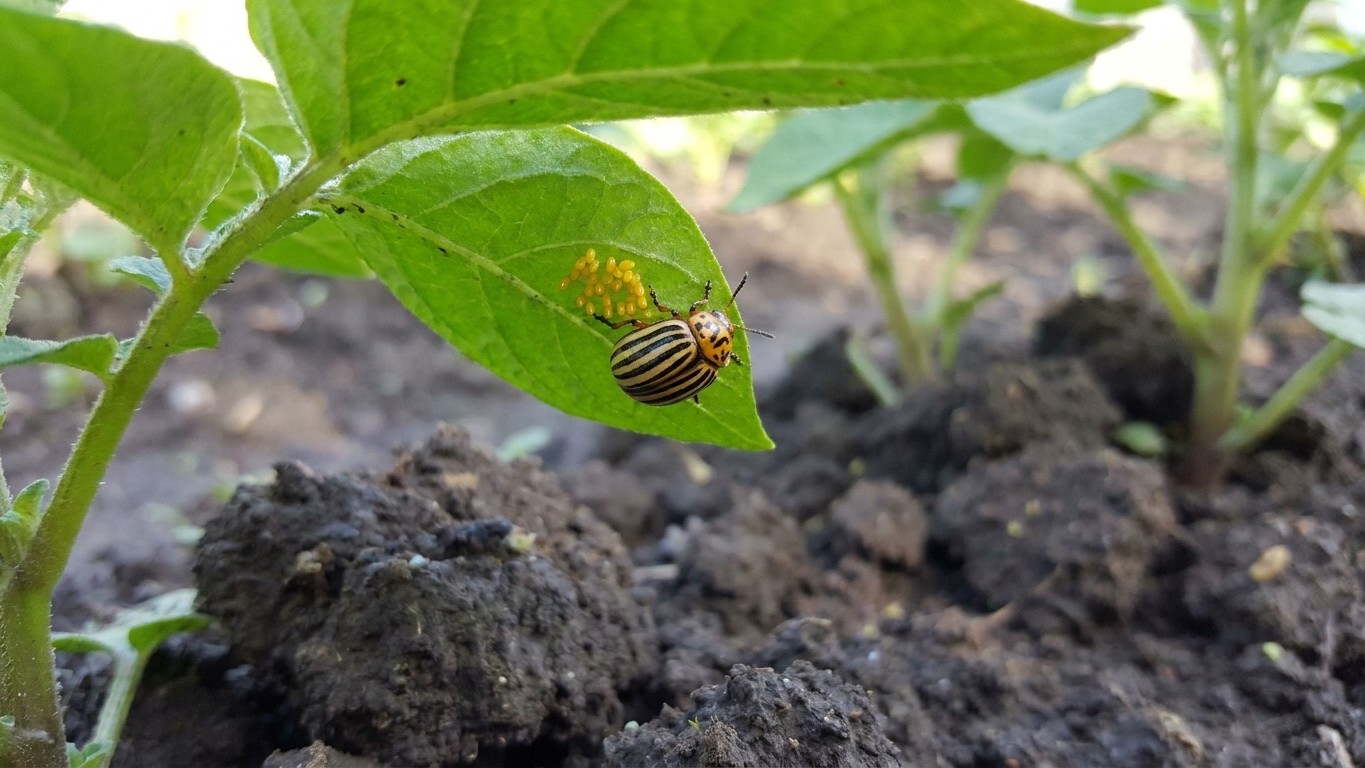
Confusing this beetle with a lookalike wastes precious response time. Adults are about 3/8 inch long, rounded, with ten black stripes running lengthwise down a yellow-orange back. Fresh eggs are bright orange-yellow, laid in tight clusters. The larvae are the real damage engine: soft, humpbacked, reddish-orange with two rows of black spots along each side, growing from pinhead size to almost half an inch before pupating in the soil.
A mature larva can eat through roughly 40 square inches of foliage in its lifetime. Multiply that by a few hundred larvae per plant in a bad outbreak, and a healthy potato row can go from green to skeletonized in under two weeks. That speed is exactly why waiting until damage is obvious usually means you’re already behind.
Cultural and Physical Controls That Actually Work
Crop rotation is the single most effective non-chemical tool, but it only works if the new potato bed is at least 200 to 300 feet from last year’s planting site. Overwintering adults have limited flight range early in the season and mostly walk to find host plants, so distance matters more than most gardeners assume. A rotation of 50 feet does almost nothing; beetles will find it within days.
Deep straw mulch, 4 to 6 inches thick, makes it physically harder for emerging adults to reach plants and also supports ground beetles and other predators that eat eggs and young larvae. Row covers work well early in the season before flowering, when pollinator access isn’t yet critical, but they need to come off once plants bloom.
Hand removal remains surprisingly effective on a garden scale. Checking the undersides of leaves twice a week starting in mid-May, crushing egg masses, and dropping adults into soapy water can keep small plantings under control without a single spray. Commercial growers obviously can’t scale that, which is where trap crops come in: planting an early, sacrificial row of potatoes a week or two before the main crop draws overwintered adults to a concentrated area where they’re easier to knock down.
Natural enemies already present in most Ontario landscapes help more than gardeners often realize. Two species worth encouraging:
- Ground beetles, which feed heavily on eggs and small larvae and thrive when soil is left undisturbed with some leaf litter nearby.
- Twelve-spotted lady beetles and lacewing larvae, both of which will eat Colorado potato beetle eggs when aphid prey is scarce.
Avoiding broad-spectrum insecticide use protects these predators, which is one more argument for reaching for chemical control only when cultural methods and thresholds justify it.
Why Insecticides Alone Keep Failing
This is the part that trips up a lot of Ontario growers who assume a spray will solve the problem the way it does for other pests. Colorado potato beetle populations across North America have developed resistance to more insecticide classes than almost any other agricultural pest on record, including early organochlorines, organophosphates, carbamates, pyrethroids, and neonicotinoids in various regions. Ontario populations aren’t immune to this pattern, and resistance tends to build fastest where the same product gets used season after season on the same ground.
The practical fix is rotation of chemical classes, not just rotation of fields. Using a product from one mode-of-action group for the first generation and switching to a genuinely different group for the second generation slows the pace at which local populations adapt. Spraying only when larval counts cross an economic threshold, rather than on a fixed calendar schedule, also reduces the selection pressure that drives resistance.
Targeting the right life stage matters just as much as the product choice. Newly hatched larvae are far more vulnerable than mature fourth-instars, which have thicker cuticles and can shrug off doses that would have killed them a week earlier. Scouting weekly through the emergence window and treating at the small-larva stage gets more value out of every application.
Regional Differences Worth Knowing
Southwestern Ontario, with its concentration of potato and processing tomato acreage around Norfolk, Elgin, and Middlesex counties, sees the earliest emergence and the most consistent second-generation pressure. Growers there generally need a two-pass management plan built around both spring and midsummer emergence peaks.
Farther north and east, single-generation years are more common, and a well-timed spring intervention combined with rotation often carries a garden or small plot through the whole season without a second round of treatment. Home gardeners in cottage country or the Ottawa Valley who’ve never seen a second wave shouldn’t assume that pattern holds if a warm summer stretches the season, since 2023’s above-average heat pushed a partial second generation further north than usual.
One detail that surprises a lot of gardeners: Colorado potato beetles didn’t originate anywhere near Colorado’s potato fields. They were first documented on wild nightshade plants in the Rocky Mountain region, then spread east alongside commercial potato cultivation in the 1800s, reaching Ontario well before the province had any dedicated potato industry to defend.
Related guides
- Colorado potato beetle in Manitoba: When It Shows Up and What Stops It
- Colorado potato beetle in Quebec: When It Shows Up and What Stops It
- Colorado potato beetle in Pennsylvania: When It Shows Up and What Stops It
- Colorado potato beetle in Prince Edward Island: When It Shows Up and What Stops It
- Colorado potato beetle in Maine: When It Shows Up and What Stops It
- Colorado potato beetle in Georgia: When It Shows Up and What Stops It