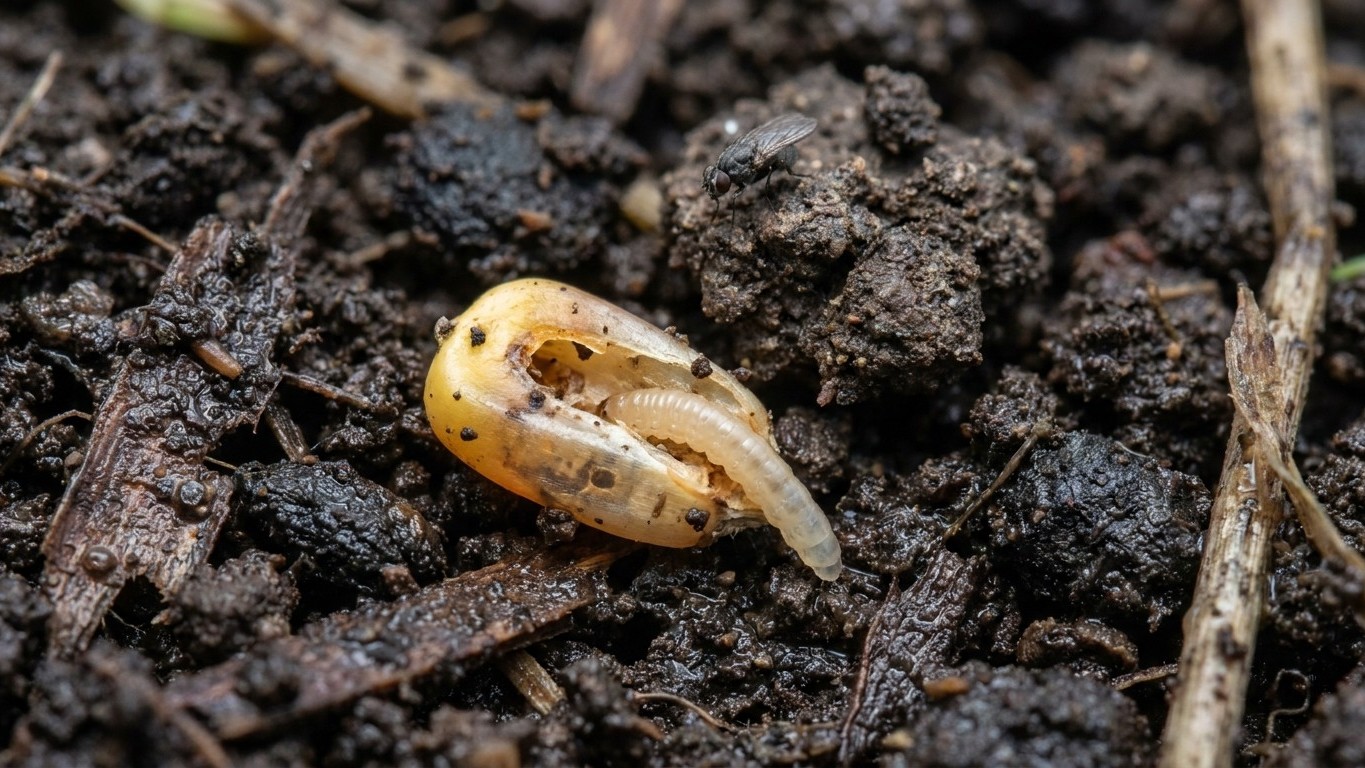

Seedcorn maggot shows up early, right when New Brunswick-area soils are still cold and wet, usually from late April through May, and it hits hardest in fields with fresh manure, cover crop residue, or any decaying organic matter turned into the soil right before planting. The fix isn’t a single spray. It’s timing: delaying planting until soil temperatures climb past the danger window, treating seed before it goes in the ground, and avoiding fresh organic inputs right before you plant corn, soybeans, or snap beans.
What Seedcorn Maggot Actually Is

Seedcorn maggot (Delia platura) is the larval stage of a small gray fly, barely a quarter-inch long, that looks unremarkable until you realize what it’s doing underground. The adult fly lays eggs in soil rich with decaying plant material or manure. Within days, cream-colored maggots hatch and tunnel straight into germinating seeds, hollowing out corn kernels and bean cotyledons before they ever push through the soil surface.
Unlike pests that chew visible leaves, seedcorn maggot damage happens where you can’t see it. A grower notices gaps in the row, digs up a seed, and finds a shriveled, tunneled mess instead of a sprout. By the time symptoms show above ground, the maggot has usually already moved on or pupated.
The fly overwinters as a pupa in the soil, which means the first generation of the season is tightly linked to how the ground warms up. That’s the piece that matters most for anyone farming or gardening in the New Brunswick region: this pest is a cold-soil specialist, and it front-loads its damage into the earliest planting window of the year.
When It Shows Up in New Brunswick
Seedcorn maggot activity tracks soil temperature more than the calendar. Extension programs across the Northeast and Mid-Atlantic, including research from Rutgers, use a degree-day accumulation model to predict fly emergence and egg-laying peaks. Degree days start accumulating from January 1 using a base temperature around 39°F, and the first generation of adult flies typically peaks once accumulated degree days land somewhere in the 200 to 300 range, roughly the same window many growers use for early corn and pea planting.
In practical terms for the New Brunswick area, that peak usually falls in late April to mid-May, depending on how cold the winter ran and how wet the spring turned out. A slow, wet spring stretches the risk window because seeds sit in cool soil longer, giving maggots more time to find and attack them before seedlings can outgrow the vulnerable stage.
A second, smaller generation can follow in early summer, but it rarely causes the same level of damage because soil has warmed enough that seeds germinate faster and spend less time exposed. The real danger is almost always tied to that first spring generation.
Conditions That Make an Outbreak Worse
Three factors consistently show up in the worst seedcorn maggot years: a cold, wet spring that delays germination; heavy organic matter freshly worked into the soil (manure, plowed-down cover crops, or crop residue); and no-till or reduced-till fields where decomposing plant material sits closer to the seed zone. Flies are drawn to the smell of decomposition, and they lay eggs directly in that organic material, which puts the next generation of larvae right next to your planted seed.
Fields that received manure applications within a few weeks of planting carry noticeably higher risk. The same goes for ground where a cover crop was terminated late and left to break down right as corn or beans went into the seedbed. It’s one of the few pest problems where doing the “sustainable” thing, working organic matter back into the soil, can backfire if the timing lines up wrong.
Crops at Risk
Seedcorn maggot isn’t picky, but it does have favorites. The crops most commonly hit in this region include:
- Field corn and sweet corn, especially early-planted fields
- Soybeans, particularly no-till or reduced-till ground
- Snap beans and lima beans
- Peas
- Cole crops like cabbage, broccoli, and cauliflower transplants
Home gardeners growing beans or peas from seed in cool, damp soil face the same risk as commercial growers, just on a smaller scale. A backyard row of beans planted into soil amended with fresh compost or manure in early spring is exactly the setup this pest looks for.
What Actually Stops It
Control for seedcorn maggot works best as prevention layered three or four ways, because once maggots are inside a seed, there’s no rescue treatment that brings it back.
Timing Is the Cheapest Tool
Delaying planting until soil temperatures reliably sit above the mid-50s speeds up germination enough that seeds spend less time vulnerable underground. This single adjustment, planting a week or so later than the earliest possible date, often does more than any product applied to the seed. Fast germination is the real defense; a seed that sprouts in four days instead of ten gives maggots far less opportunity.
Seed Treatments
Insecticide-treated seed remains the standard commercial defense, and most corn and soybean seed sold through major suppliers already comes pre-treated with a product labeled for seedcorn maggot suppression. For growers buying untreated seed, particularly for beans or peas, a labeled seed treatment applied before planting cuts risk substantially in fields with elevated risk factors like recent manure or heavy residue.
Manage Organic Matter Timing
Spread manure and terminate cover crops well ahead of planting, ideally three to four weeks out, rather than right before seeding. This gives decomposition time to progress past the stage that draws egg-laying flies, and it reduces the direct overlap between rotting material and germinating seed. If manure application close to planting can’t be avoided, shifting to a treated seed and a slightly later planting date becomes more important, not less.
Tillage and Residue Management
Fields with heavy surface residue, especially from a terminated cover crop or old crop stubble, tend to run higher risk in no-till systems. Where seedcorn maggot pressure has been a repeat problem, light incorporation of residue rather than leaving it fully on the surface can reduce the attractant effect, though this has to be weighed against the soil conservation benefits of no-till. It’s a genuine trade-off, and there’s no universal right answer, it depends on how much history a given field has with this pest.
Monitoring With Degree Days
Tracking accumulated degree days from January 1 gives a practical heads-up window rather than a guess. Growers who plant right around the 200 to 300 degree-day mark, the peak fly activity period, take on more risk than those who wait until accumulation pushes past that range and soil has warmed enough for quick germination. This kind of tracking is standard practice in extension-supported IPM programs across the Northeast and is worth checking against local weather station data rather than relying on the calendar alone.
What Doesn’t Work
Foliar insecticide sprays after planting do almost nothing for seedcorn maggot, because the damage happens below the soil surface before plants emerge. By the time a stand failure is visible, the maggots have typically already pupated or moved to a new food source. Spraying at that point treats a symptom that’s already finished happening.
Replanting into the same conditions without changing anything, same seed source, same planting date, same recently manured ground, tends to produce the same result. If a field failed once to seedcorn maggot, the fix has to change at least one variable: later planting, treated seed, or a longer gap since the last organic matter application.
Replanting After Damage
When stand loss from seedcorn maggot hits 30 percent or more, replanting is usually the better economic call over trying to fill gaps. Because the pest’s damage window is tied to a specific degree-day range, replanting even a week or two later often lands outside peak fly activity, which gives the second seeding a real advantage over the first. Pairing that later date with treated seed closes most of the remaining gap.
Soil sampling isn’t necessary to confirm this pest the way it might be for soil-borne disease. Digging up a handful of failed seeds and checking for tunneling or hollowed-out kernels is usually enough to identify seedcorn maggot as the cause, distinguishing it from simple cold-soil rot or bird damage, which tend to leave seeds intact but missing rather than tunneled through.
Related guides
- Seedcorn maggot in Quebec: When It Shows Up and What Stops It
- Seedcorn maggot in Nova Scotia: When It Shows Up and What Stops It
- Seedcorn maggot in Newfoundland and Labrador: When It Shows Up and What Stops It
- Seedcorn maggot in Ontario: When It Shows Up and What Stops It
- Seedcorn maggot in Prince Edward Island: When It Shows Up and What Stops It