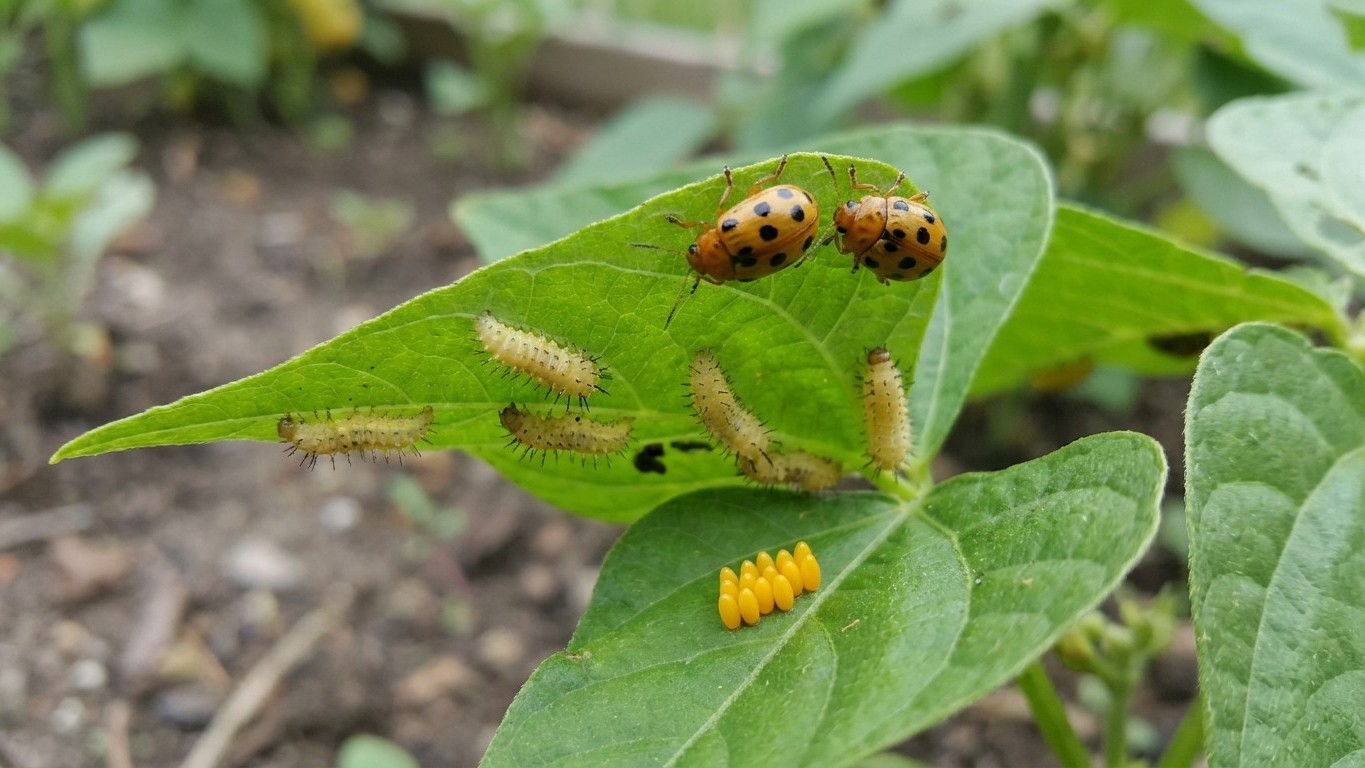

Mexican bean beetles reach Indiana gardens in two distinct waves each growing season: a first generation that emerges from winter shelter in late May to early June, and a second, usually heavier, generation that builds through late July into August. The insect that actually stops them isn’t a single product but a combination of early scouting, egg removal, and one parasitic wasp that Purdue entomologists have used for decades to knock populations down without spraying.
What the Mexican Bean Beetle Looks Like on Indiana Bean Plants

Adults are easy to mistake for a beneficial ladybug at first glance. They’re about a quarter inch long, copper to yellow-orange, with 16 black spots arranged in three rows across the wing covers. That spot count matters: the look-alike convergent lady beetle, which actually eats aphids and helps your garden, has far fewer, less orderly spots and a more rounded shape. If you’re not sure which one you’re looking at, flip the leaf over. Mexican bean beetles feed in groups on bean foliage; predatory lady beetles don’t.
The larvae are the stage most gardeners never learn to recognize, and that’s a problem because they cause more damage than the adults. They’re pale yellow, soft-bodied, and covered in branching black-tipped spines that give them a fuzzy, almost intimidating look under a hand lens. Eggs are laid in tidy clusters of 40 to 60 on the undersides of bean leaves, bright yellow-orange and oval, standing upright like tiny bowling pins. A single female can lay 500 to 600 eggs over her lifetime, which is why one missed cluster in June can turn into a full-blown infestation by August.
When Mexican Bean Beetles Show Up in Indiana Gardens
Adults overwinter in Indiana, not by migrating south but by tucking into leaf litter, hedgerows, and the edges of woodlots close to last year’s bean patch. They wait out the cold in a state of dormancy and start moving as soil temperatures climb in spring, generally emerging between mid-May and early June across most of the state. Southern Indiana counties tend to see activity about one to two weeks ahead of the northern tier, which lines up with the general lag in spring soil warming across the state.
That first wave of adults feeds briefly, then lays eggs, and the resulting larvae hit their peak feeding window in June. A second generation of adults emerges from those larvae and lays another round of eggs in July, so by late summer you can have overlapping adults, eggs, and larvae all feeding on the same plants at once. This is the point where damage accelerates fast, and it’s also why a garden that looked fine in early July can look shredded by mid-August. Snap beans, lima beans, and soybeans are all fair game, and in years with a mild, dry spring, populations tend to run higher because more overwintering adults survive.
Degree Days and Why Timing Shifts Year to Year
Emergence isn’t tied to a calendar date so much as accumulated warmth. Entomologists track this pest using degree-day models, and a warm April can push activity earlier by a week or more, while a cold, wet spring delays it. Practically, that means the safest approach is to start checking the undersides of bean leaves as soon as plants have their first true leaves, rather than waiting for a specific week on the calendar.
How to Spot Damage Before It Spreads
Feeding damage has a distinct signature. Both larvae and adults scrape the leaf tissue between the veins on the underside, leaving the upper surface intact but paper-thin and translucent, almost like lace. Heavy feeding turns whole leaves brown and skeletal, and in bad infestations the beetles move on to pods and stems once foliage runs out. This is different from bean leaf beetle damage, which shows up as round or irregular holes punched clean through the leaf, and different from Japanese beetle feeding, which tends to skeletonize from the top down rather than leaving that characteristic lacy underside pattern.
Early detection comes down to a habit, not a tool: turning over a handful of leaves on ten or so plants once a week starting in late May. Look specifically for the yellow-orange egg clusters and for the spiny larvae clustered near leaf veins. Squashing a single egg mass at this stage removes 40 to 60 future beetles before they ever start feeding, which is a far better return on five minutes of effort than any spray applied later in the season.
What Actually Stops Mexican Bean Beetles
No single tactic wipes this pest out on its own. What works is layering a few low-effort habits with one or two targeted interventions timed to the life cycle.
Cultural Controls That Reduce the Starting Population
Fall cleanup matters more than most gardeners realize, since adults overwinter in exactly the kind of debris left behind after harvest. Pulling and composting or removing spent bean plants, and clearing leaf litter along garden edges, cuts down on the local overwintering population that shows up again the following May. Crop rotation helps too: moving beans to a different part of the yard or garden each year forces emerging adults to travel farther to find a host, and some don’t make it.
Row covers put on at planting and left in place until bloom keep the first wave of adults off young seedlings entirely, which matters because early-season damage on small plants sets back yield more than the same damage on mature plants later. Staggering plantings so all your beans aren’t at the same vulnerable seedling stage at once also spreads out the risk.
Biological Control: The One Wasp Worth Knowing
Pediobius foveolatus is a tiny parasitic wasp that specifically targets Mexican bean beetle larvae, and it’s been used in the eastern and midwestern United States, including Indiana, as a targeted biological control since the 1980s. The wasp lays its own eggs inside beetle larvae; the parasitized larvae stop feeding, turn into hardened brown mummies, and release a new generation of wasps roughly three weeks later. Because the wasp doesn’t survive Indiana winters on its own, it’s typically released fresh each season, timed to when the first-generation larvae appear, usually mid to late June. Home gardeners can order it through university or commercial suppliers that ship small quantities for backyard-scale releases, and it pairs well with hand-removal since it targets the stage that’s hardest to spot and squash individually.
Encouraging general predators helps as a secondary layer. Ground beetles, spined soldier bugs, and some lacewing species will feed opportunistically on eggs and small larvae, and avoiding broad-spectrum insecticide use preserves that background pressure.
Least-Toxic and Chemical Options, Used at the Right Moment
When populations get ahead of hand-picking, insecticidal soap and neem oil applied directly to the undersides of leaves work best against young larvae, before they’ve built up the tougher spines and cuticle of later instars. Spinosad, an organic-approved option derived from soil bacteria, has good activity against both larvae and adults but should be applied in the evening to limit exposure to bees still working the blossoms during the day. Pyrethrin-based sprays offer faster knockdown but break down quickly in sunlight, so timing and repeat applications matter more than with longer-residual synthetic products.
Whatever product you choose, coverage on the leaf underside is what determines success or failure, since that’s where eggs, larvae, and most feeding adults are found. A quick spot check a few days after treatment, looking for surviving larvae or fresh egg clusters, tells you whether a second application is needed before damage compounds.
Planning for Next Season Starts Now
Because this pest overwinters locally rather than reinvading from elsewhere, the population you deal with next May is largely a direct result of how much habitat and food source you leave behind this fall. Gardeners who combine fall sanitation, a rotation plan, and early-season scouting typically see noticeably lighter pressure by their second or third year of consistent effort, compared to gardens where beans go in the same spot annually with no cleanup.
One detail worth knowing if you’re deciding whether to bother with any of this: soybeans planted as a field crop near a home garden can act as a reservoir, since the beetle isn’t picky about which legume it feeds on. If a neighboring field or a large soybean planting sits within a few hundred feet of your bean patch, expect pressure to run higher regardless of how clean your own garden habits are, and factor that into how aggressively you scout in years when nearby fields are in soybeans rather than corn.