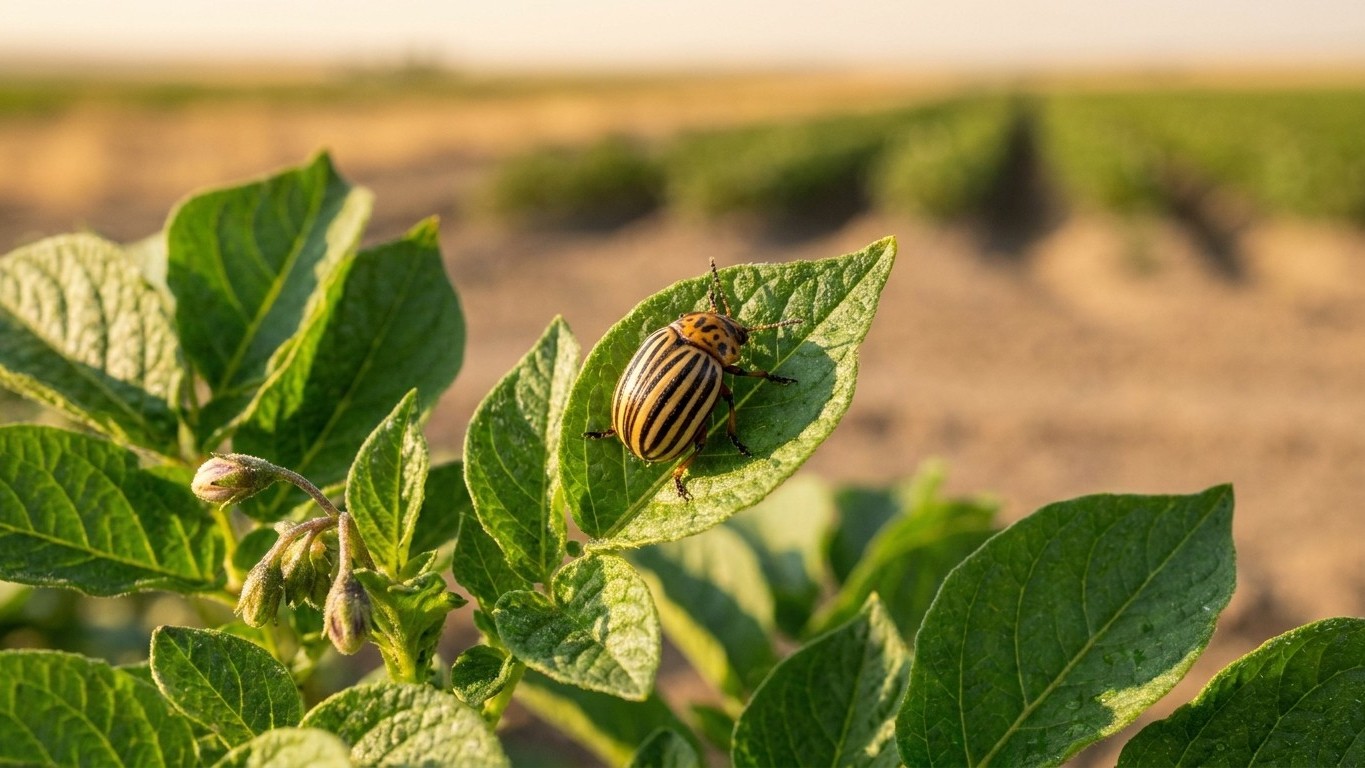

Colorado potato beetle shows up in Washington as soon as soil temperatures climb past 50°F, which usually happens in mid-to-late April across the Columbia Basin and a bit later, often early May, in the cooler Puget Sound lowlands. What stops it isn’t one product or one trick. It’s a mix of crop rotation, timed monitoring, and rotating between biological and chemical controls before the beetle’s well-documented resistance kicks in.
Where Colorado potato beetle causes the most trouble in Washington

Washington ranks among the top potato-producing states in the country, and nearly all of that acreage sits in the irrigated flatlands of Grant, Franklin, Adams, and Benton counties, the heart of the Columbia Basin. That concentration of host plants, potatoes mostly, but also tomatoes and eggplant in smaller plots, gives Colorado potato beetle exactly what it wants: dense, predictable food and warm, dry summers that speed up its life cycle.
West of the Cascades, the beetle exists too, mostly in backyard vegetable gardens around Seattle, Tacoma, and the Olympia area. But the marine climate slows everything down. Cooler nights and more cloud cover mean development from egg to adult takes longer, and most western Washington gardeners deal with a single generation per season instead of the two that can occur east of the mountains in a hot year.
That geographic split matters for timing your defenses. A grower in Othello is watching soil temperature in April. A gardener in Bellingham can usually wait a couple of weeks longer before checking leaf undersides.
The Washington timeline: from soil thaw to second-generation adults
Adult Colorado potato beetles overwinter four to six inches deep in the soil, often right at the edge of last year’s potato patch. They wait out the cold in a dormant state and start moving once the ground warms to roughly 50°F. In the Columbia Basin, that threshold typically arrives between mid-April and early May, depending on the year’s snowpack and spring temperatures.
Once they emerge, adults crawl or fly short distances to the nearest host plant. They feed for a few days, then females start laying eggs in tight clusters of 20 to 40 on the undersides of leaves. The eggs are a distinctive bright orange-yellow, easy to spot if you flip a leaf over in early May.
From egg to adult takes anywhere from three to five weeks, with warmer temperatures shortening that window. The larvae go through four growth stages, starting as tiny reddish grubs and ending as plump, humpbacked orange-red larvae with rows of black spots along their sides. This larval stage does the real damage, stripping leaves down to the veins in a matter of days when populations build up.
East side versus west side: why the calendar shifts
In the Columbia Basin, a hot June and July can push a second generation of adults out by late summer, usually August. Those beetles feed briefly before digging back into the soil to overwinter, setting up next year’s cycle. In western Washington, the cooler summer usually caps development at one generation, with adults from that single cycle burrowing down by September.
That difference explains why commercial growers in eastern Washington track calendar-day accumulations and soil temperature almost obsessively, while home gardeners on the west side can often get by with a couple of visual checks a month during the growing season.
What actually stops Colorado potato beetle in Washington gardens and fields
No single method wipes out this beetle for good. It’s survived every major insecticide class introduced since the 1950s, developing resistance faster than almost any other agricultural pest tracked in North America. That history is exactly why the most reliable Washington approach layers several tactics instead of leaning on one.
Cultural tactics that work before you spray anything
Crop rotation is the cheapest and most effective first line of defense. Overwintering adults emerge near where they last fed, so moving potatoes, tomatoes, and eggplant to a different part of the yard or field each year forces beetles to travel farther to find food, and many simply don’t survive the trip. Commercial operations in the Columbia Basin often aim for a half-mile separation between this year’s and last year’s potato ground when rotation space allows it.
Straw mulch laid thickly around young plants makes it harder for emerging adults to reach the foliage, and it also encourages ground beetles that prey on beetle eggs and larvae. Row covers give newly planted potatoes a head start, but they need to come off once plants flower so pollinators can do their job, and by then the covers stop offering protection anyway.
For home gardeners, handpicking remains genuinely effective on a small scale. Checking leaf undersides once a week starting in early May, and squashing egg clusters and young larvae on sight, can keep a backyard patch under control without a single spray.
Biological and chemical options, and why rotation matters
Several natural enemies already patrol Washington gardens and fields. Spined soldier bugs, lacewing larvae, and certain ladybeetle species feed on Colorado potato beetle eggs and small larvae. Encouraging these predators, mainly by avoiding broad-spectrum insecticides that kill beneficial insects along with pests, gives them room to do their work.
When populations exceed what handpicking or predators can manage, Bacillus thuringiensis var. tenebrionis, sold under several trade names as a Bt product, targets young larvae specifically and leaves most other insects untouched. It works best on the smaller larval stages, so timing the spray to coincide with egg hatch, roughly one to two weeks after you first spot egg clusters, makes a real difference in results.
Spinosad and neem-based products (azadirachtin) offer additional organic-approved options, each with a different mode of action than Bt. That variety matters because Colorado potato beetle populations can develop resistance to a single active ingredient within just a few seasons of repeated use. Rotating between different chemical classes, rather than reaching for the same product every time, slows that resistance buildup and keeps each tool useful longer.
Commercial growers in eastern Washington typically follow threshold-based spraying, treating only when scouting turns up a set number of egg masses or larvae per plant, rather than spraying on a fixed calendar. That threshold approach, developed through university extension research, cuts down on unnecessary applications and preserves beneficial insect populations in the field.
A practical starting point for the season ahead
Anyone growing potatoes, tomatoes, or eggplant in Washington gets the most value from starting inspections the moment soil temperatures hit that 50°F mark, roughly mid-April in the Columbia Basin and into early May west of the Cascades. Flip a few leaves weekly, look for the orange egg clusters and the humpbacked larvae, and rotate host crops to a new spot each year whenever space allows.
One detail that surprises a lot of first-time potato growers in Washington: adult beetles can fly several miles when conditions turn hot and dry, particularly in the open Columbia Basin landscape where wind carries them across field borders. That means even a perfectly rotated home garden isn’t fully isolated from a beetle population building up in a neighboring lot or nearby commercial field, which is one more reason scouting early and often beats waiting until the damage is already visible on the leaves.
Related guides
- Colorado potato beetle in Idaho: When It Shows Up and What Stops It
- Colorado potato beetle in West Virginia: When It Shows Up and What Stops It
- Colorado potato beetle in Wisconsin: When It Shows Up and What Stops It
- Colorado potato beetle in Newfoundland and Labrador: When It Shows Up and What Stops It
- Colorado potato beetle in Minnesota: When It Shows Up and What Stops It