
Adult squash vine borer moths typically emerge in South Dakota gardens between late June and mid-July, once soil temperatures near the base of squash plants climb into the mid-60s Fahrenheit. Unlike gardeners in warmer states dealing with two generations a season, South Dakota growers usually face just one wave of moths per year. That single-generation pattern is actually good news: it means a tight window of vigilance in early summer can prevent most of the damage that shows up as sudden, mysterious wilting in August.
Squash Vine Borer Timing in South Dakota Gardens

The moth (Melittia cucurbitae) overwinters as a pupa buried two to six inches deep in the soil, right where last year’s squash or pumpkin vines grew. It doesn’t wake up on a calendar date. It wakes up based on accumulated warmth, what entomologists call growing degree days. In practice, that means the eastern part of the state, around Sioux Falls and Brookings, tends to see moth activity a week or two earlier than western counties near Rapid City, where cooler spring soils delay emergence.
Most South Dakota gardeners can expect the first moths flying by the last week of June, with activity peaking through July. Egg-laying continues for several weeks after that, which is why a plant that looked perfectly healthy on the Fourth of July can be collapsing by early August. The larvae that hatch from those eggs are the actual problem. They tunnel straight into the stem near the soil line and feed there for four to six weeks, hollowing out the vine from the inside while the leaves above slowly lose their water supply.
Zucchini, yellow summer squash, and pumpkins are the hardest hit across the state. Winter squash varieties with thick, ridged stems, particularly butternut, hold up noticeably better because the vine tissue is denser and harder for young larvae to penetrate.
How to Spot an Infestation Before Your Plants Collapse
The moth itself is easy to misidentify. It flies during the day, which is unusual for a moth, and its orange-red hind body with black spots makes it look more like a wasp than anything you’d expect to find fluttering around your garden. Gardeners who spot it resting on a leaf often assume it’s a beneficial insect and leave it alone. That’s exactly the wrong move.
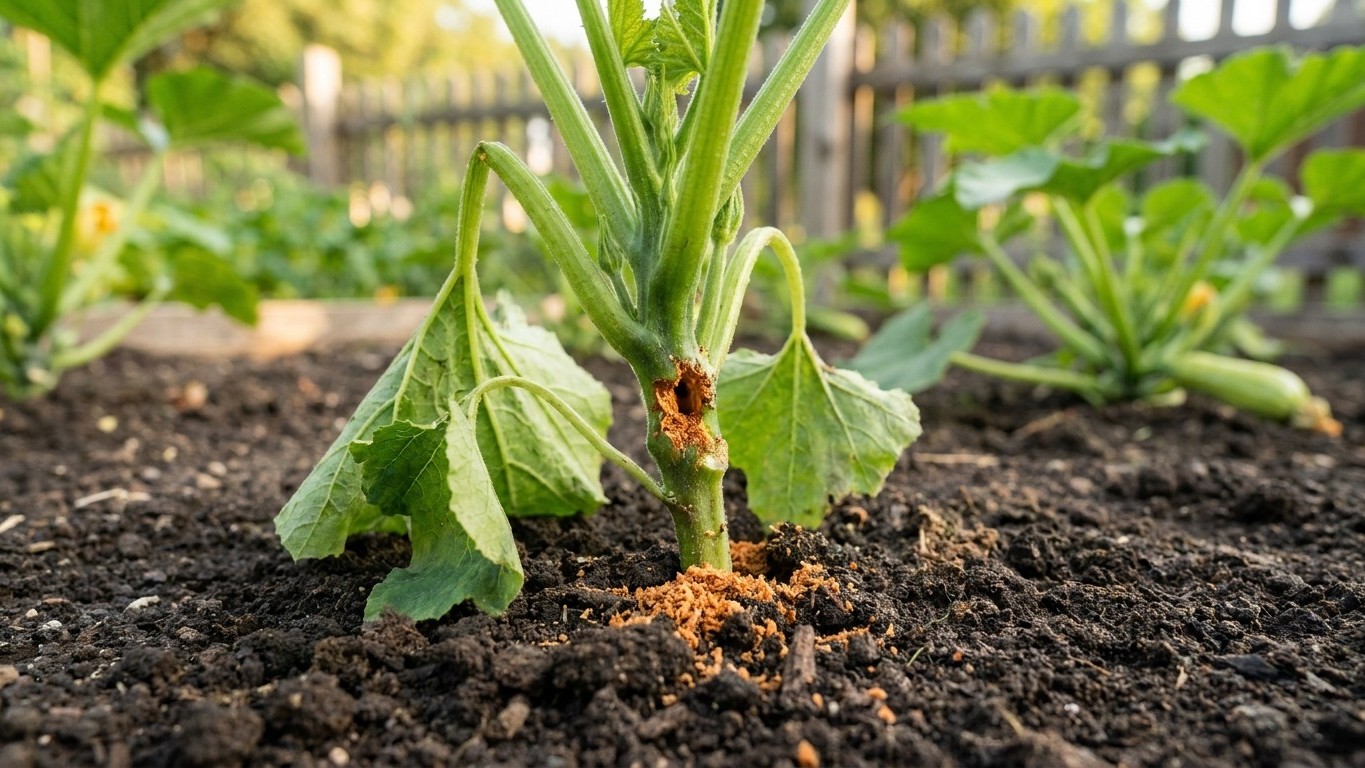
The real giveaway comes later, and it’s on the ground, not on the moth. Look at the base of the stem for small holes surrounded by a wet, greenish-yellow material that resembles coarse sawdust. That’s frass, the borer’s excrement, and it’s the single most reliable early sign of infestation. By the time you notice whole leaves wilting even after a good watering, the larva has usually been feeding for a week or more.
A useful habit: check the crown of every squash plant once a week starting in late June, running a finger along the stem where it meets the soil. Healthy stems feel firm. An infested one often feels slightly soft or spongy just above ground level, even before any external frass appears.
What Actually Stops Squash Vine Borer
No single tactic wipes out this pest completely. What works in South Dakota gardens is layering a few methods together, timed to the state’s specific emergence window.
Cultural and Mechanical Controls
Floating row covers are one of the most effective tools available, but timing matters more than the product itself. Covers need to go on before moths start flying, ideally by mid-June in eastern South Dakota and closer to late June farther west, and they need to come off once female flowers appear so pollinators can reach the blossoms. Leaving covers on too long defeats the purpose since squash relies on bees for fruit set.
Staggering plantings helps too. A second sowing of squash seeds three to four weeks after the first gives you a backup crop that’s still young and less attractive when the main wave of egg-laying happens. Crop rotation matters as well: moving squash beds at least 30 feet from where they grew the previous year reduces the odds that emerging moths find your plants immediately.
Physical removal is unglamorous but works. If you find an entry hole with frass, a gardener can often slit the stem lengthwise with a sharp knife, extract the larva, and then mound moist soil over the wound. Plants frequently root at that damaged node and recover, especially if caught within the first couple weeks of feeding.
Biological and Targeted Chemical Options
Bacillus thuringiensis (Bt), specifically the variety kurstaki, can be injected directly into the stem with a syringe or applied as a weekly spray to the base of the plant during the egg-laying period. Because Bt only affects caterpillars that ingest it, it’s far gentler on bees and other pollinators than broad-spectrum insecticides, which matters since squash flowers depend entirely on insect visits for pollination.
Spinosad, another lower-impact option, works similarly when applied to stem bases in the evening after bees have finished foraging for the day. Spraying at dusk rather than midday cuts pollinator exposure significantly. According to the EPA’s guidance on protecting pollinators when using pesticides, timing applications to avoid peak bee activity is one of the simplest ways home gardeners can limit unintended harm.
Broad insecticides labeled for borers can work, but they need to be applied to the stem, not the whole plant, and repeated weekly through the egg-laying window since they don’t reach larvae already inside the vine. Once a larva has tunneled in, no spray reaches it. Prevention beats treatment here, every time.
Season-End and Next-Year Prevention
What happens in October matters almost as much as what happens in June. After harvest, pulling and destroying infested vines rather than composting them removes larvae that would otherwise pupate in the soil and emerge next summer. Tilling the garden bed in fall, turning soil over to a depth of at least six inches, exposes overwintering pupae to freezing temperatures and hungry birds. South Dakota’s cold winters actually work in gardeners’ favor here: exposed pupae rarely survive a hard freeze on bare, tilled soil.
Some gardeners set up simple yellow bucket traps filled with soapy water near squash beds starting in mid-June. The moths are drawn to yellow and will fly into the water and drown. It’s not a complete solution, but it gives an early warning that moths are active in your specific yard, which helps time the first Bt application than relying on a generic calendar date.
Resistant variety selection remains one of the most overlooked strategies. Butternut, cushaw, and other thick-stemmed squash types consistently show lower infestation rates in university trials across the Midwest, and swapping even half a garden bed to these varieties can cut overall losses substantially without adding any extra labor.
One detail that surprises a lot of first-time squash growers: a plant that wilts from vine borer damage can sometimes still produce a partial harvest if secondary roots have formed along the vine where it touches soil. Squash vines root opportunistically at leaf nodes, so a damaged main stem doesn’t always mean a total loss, particularly on sprawling varieties left unstaked and allowed to run along the ground.
Related guides
- Squash vine borer in Minnesota: When It Shows Up and What Stops It
- Squash vine borer in Iowa: When It Shows Up and What Stops It
- Squash vine borer in Tennessee: When It Shows Up and What Stops It
- Squash vine borer in Texas: When It Shows Up and What Stops It
- Squash vine borer in Maine: When It Shows Up and What Stops It
- Squash vine borer in Maryland: When It Shows Up and What Stops It