
Squash vine borer adults typically emerge in Illinois between mid-June and late July, with southern counties seeing activity about two weeks ahead of the Chicago area. The window to act runs short: once a larva tunnels into a stem, insecticides stop working, and the plant usually wilts within days. Timing your defense to that emergence window, not to when you first notice damage, is what actually separates a saved squash patch from a dead one.
This pest hits home gardens across the entire state, but the calendar shifts depending on where you’re planting. Understanding that shift, plus a handful of physical and cultural tactics, is the difference between losing your zucchini every August and actually harvesting some.
The weeks to watch

Illinois runs through USDA hardiness zones 5b in the north down to 7a along the southern tip near Cairo, and that temperature gradient controls when the moths take flight. In far southern Illinois, adult moths often start emerging in late May to early June. Central Illinois, including the Springfield and Peoria corridor, usually sees the first flights in mid-June. Up around Chicago and the northern counties, emergence tends to hold off until late June, sometimes stretching into the first week of July.
Most of Illinois gets a single generation per year. That’s actually good news compared to states farther south, where two generations can overlap and make control nearly impossible. But a single generation still means a broad window of vulnerability, because moths don’t all emerge on the same day. Egg-laying activity in a given region can stretch across four to six weeks, so a garden can face pressure from late June clear through August.
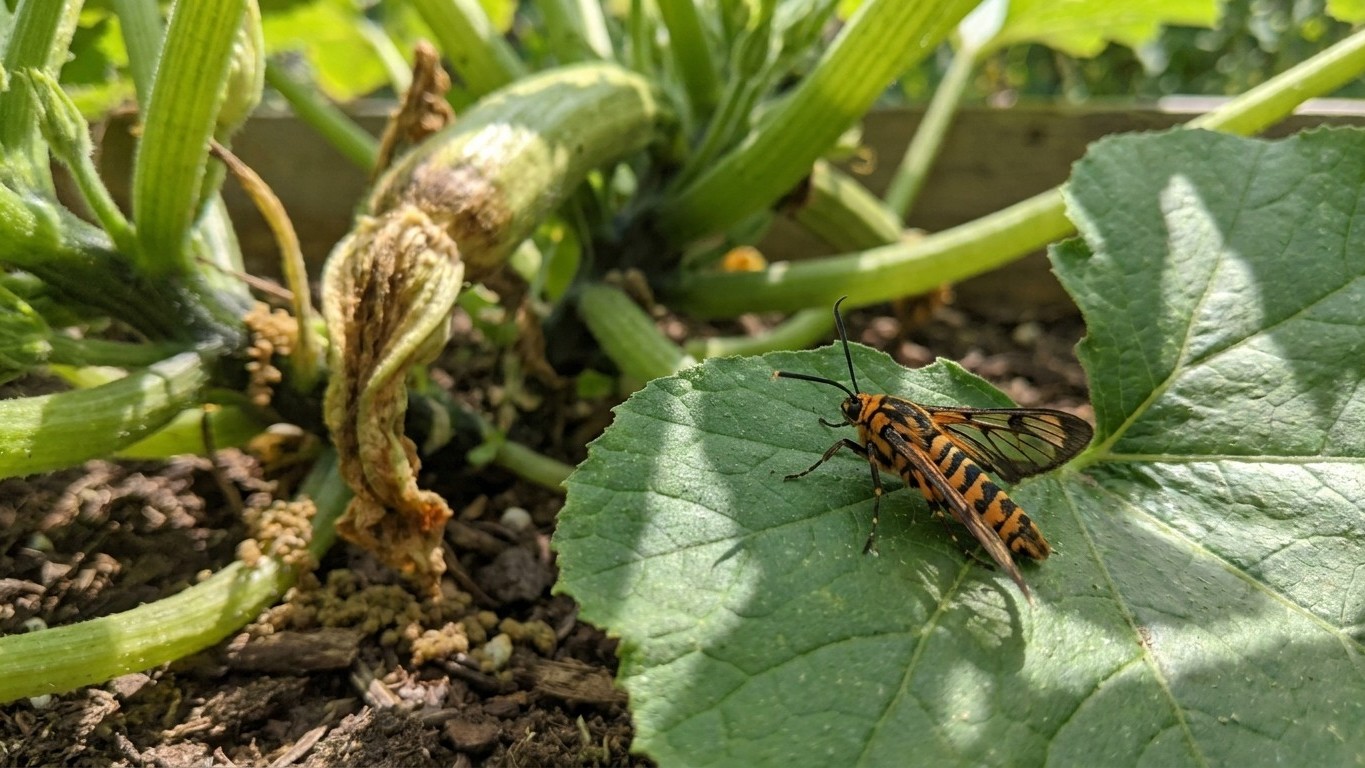
The moth itself looks nothing like the fuzzy gray creature most gardeners picture when they hear “moth.” It’s a day-flying insect with a bright orange abdomen dotted in black, clear-ish wings, and a wingspan around an inch and a half. Gardeners often mistake it for a wasp on first glance, which is part of why it goes unnoticed until the damage is already underway.
Spotting the Damage Before the Plant Collapses
The giveaway most people catch first is sudden, dramatic wilting of a single vine while the rest of the plant looks fine. That’s a stem already compromised. Squash vine borer larvae tunnel into the base of the stem, usually within the first foot or so from the soil line, and feed inside for four to six weeks before dropping into the soil to pupate.
Before wilting starts, there are earlier clues worth checking for on a weekly basis starting in June:
- Small holes near the base of the stem with sawdust-like frass pushed out, often looking like fine wet sawdust
- Tiny reddish-brown eggs, laid singly, on the lower stem and leaf stalks near the base of the plant
- Soft, mushy spots on the stem when squeezed gently between two fingers
- Yellowing of individual leaves before the whole vine collapses
Winter squash and pumpkins tend to take the worst hits because their long vines give larvae more stem to work with and more opportunity to root at secondary nodes along the way. Zucchini and yellow summer squash, with their compact bush habit, often show damage faster because there’s less stem mass to absorb the injury before the whole plant wilts.
Cucumbers and melons get attacked far less often. Butternut squash, interestingly, shows some natural tolerance thanks to a solid, less hollow stem structure that’s harder for larvae to tunnel through effectively.
What Actually Stops Squash Vine Borer
Once larvae are inside the stem, spraying the leaves does nothing. Control has to target either the adult moths before they lay eggs, or the eggs and newly hatched larvae before they burrow in. That narrow biology is why timing matters more with this pest than almost any other vegetable garden insect.
Row Covers Timed to Local Emergence
Floating row covers placed over young plants before local moth emergence, then removed once flowering starts so pollinators can reach the blossoms, block egg-laying almost entirely during the vulnerable early weeks. For northern Illinois gardeners, that means covers should go on by early June and stay put until late June or early July. Central Illinois gardeners should aim for covers in place by late May. This method works best on bush-type summer squash, since vining winter squash eventually outgrows the cover and needs the fabric removed anyway.
Stem Wrapping and Barrier Methods
Wrapping the lower 6 to 10 inches of stem in aluminum foil or a strip of nylon stocking at transplant time physically blocks the female moth from reaching the tissue where she’d normally lay eggs. It’s a low-cost trick that home gardeners in Illinois have relied on for generations, and it remains one of the more reliable non-chemical options because it doesn’t depend on catching a spray window exactly right.
Scouting and Mechanical Removal
For gardeners who missed the prevention window, weekly stem checks starting in mid-June give a shot at catching larvae early. If frass and a soft spot show up, a vertical slit made with a sharp knife along the stem, right where the entry hole sits, lets a gardener dig the larva out with a toothpick or tweezers. Mounding moist soil over the slit afterward often lets the plant root at that node and recover, particularly in vining squash varieties that can send down new roots along buried stem sections.
Insecticide Timing
For gardeners who want to use an insecticide, the product has to hit the stem base and lower leaf stalks before larvae tunnel in, which means applications need to start at first adult emergence and repeat on a schedule through the egg-laying period. Products containing Bacillus thuringiensis subsp. kurstaki can be injected directly into stems in some cases, but they work only against larvae that haven’t yet done deep tunneling. Spinosad-based products applied to stem bases on a weekly schedule during peak flight offer another option favored by gardeners trying to avoid broader-spectrum chemicals. None of these products help once a vine has already wilted from established tunneling.
Reducing Pressure Season to Season
Squash vine borer overwinters as a pupa in the top few inches of soil, which means the insect doesn’t travel far between generations. Tilling the garden bed in fall or early spring, after squash plants are pulled, exposes overwintering pupae to freezing temperatures and predators, cutting down on the population that emerges the following June. Illinois State University and regional extension entomologists have long recommended this fall cleanup as one of the higher-value, lowest-effort steps available to home gardeners.
Crop rotation helps too, though its effect is more modest than fall tillage since adult moths can fly a fair distance to find new host plants. Moving squash to a different section of the yard each year, rather than replanting in the same bed, at least removes the advantage of pupae emerging right next to a fresh host plant.
Staggered planting dates spread risk in a useful way. Planting a portion of the squash crop two to three weeks later than usual, timed to emerge after peak moth flight has passed in your region, can produce a second crop that dodges the worst of the pressure. This works particularly well in central and southern Illinois, where the growing season is long enough to support a delayed planting without running out of warm weather before harvest.
Choosing resistant varieties adds another layer. Butternut squash and other Cucurbita moschata varieties consistently show less damage than Cucurbita pepo types like zucchini, acorn squash, and most pumpkins, largely due to stem structure that makes tunneling more difficult. Gardeners who’ve struggled year after year with a particular variety sometimes get better results simply by switching species rather than fighting the same losing battle with more spray.
None of these methods work in isolation as well as they do combined. A gardener who wraps stems at planting, covers young plants until bloom, scouts weekly through July, and tills the bed in fall stacks four separate points of interruption into the borer’s life cycle. That layered approach, more than any single product or trick, is what Illinois gardeners with long-running vegetable patches tend to credit for finally getting a full season out of their squash.
Related guides
- Squash vine borer in Wisconsin: When It Shows Up and What Stops It
- Squash vine borer in Iowa: When It Shows Up and What Stops It
- Squash vine borer in Indiana: When It Shows Up and What Stops It
- Squash vine borer in Kansas: When It Shows Up and What Stops It
- Spotted lanternfly in Illinois
- Squash vine borer in Michigan: When It Shows Up and What Stops It
- Squash vine borer in New York: When It Shows Up and What Stops It