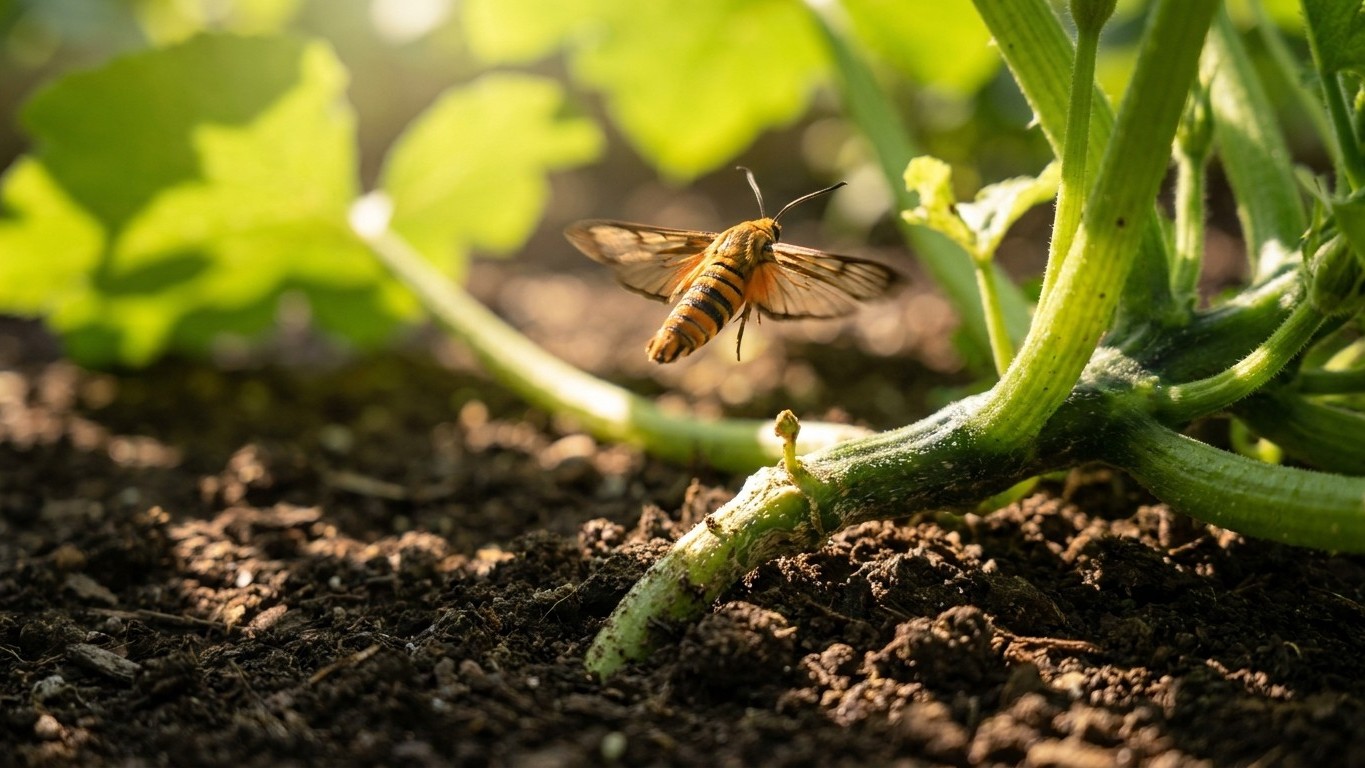

In Massachusetts, squash vine borer moths typically emerge and start laying eggs from late June through mid-July, with a second smaller wave of activity sometimes stretching into early August. There’s only one generation per year in this region, which is actually good news: once you get past that window with your plants intact, the threat mostly passes until next season. The real fix is a combination of timing your defenses to that emergence period, physically blocking egg-laying with row covers, and catching larvae early enough to remove them before they hollow out the stem.
When Squash Vine Borer Moths Are Active in Massachusetts

The squash vine borer (Melittia cucurbitae) overwinters as a pupa buried a few inches deep in the soil, right where an infested plant grew the year before. As soil temperatures warm through late spring, the pupa develops into an adult moth. In Massachusetts, that transformation lines up with accumulated heat units in the soil, which is why the moth’s first flight can vary by a week or two depending on how cold the spring was and where in the state you’re gardening. Coastal and southeastern areas tend to see activity a few days earlier than the Berkshires or the northern tier near the New Hampshire border.
The adult itself throws people off because it doesn’t look like a typical moth. It flies during the day, has a wasp-like orange and black (sometimes olive-green) body, and moves in quick, darting bursts around the base of squash and pumpkin plants. Homeowners often mistake it for a wasp and swat it away without realizing it’s the pest responsible for the collapsed zucchini plant three weeks later.
Females lay eggs individually at the base of stems, on leaf stalks, or even on the soil near the crown of the plant. A single female can lay 150 to 200 eggs over her lifespan, spreading them across multiple plants. Eggs hatch in about a week to ten days, and the newly hatched larva wastes no time. It bores directly into the stem within hours, which is why spotting an egg before it hatches is one of the few reliable ways to stop damage before it starts.
Reading the Signs Before Plants Wilt
Sudden wilting, especially on a hot afternoon after the plant looked fine that morning, is usually the first sign homeowners notice, but by then the larva has already been feeding inside the stem for one to three weeks. Look for a small hole near the base of the main stem with a pile of moist, greenish-yellow frass around it, similar in texture to wet sawdust. That frass pile is the giveaway. Squeezing the stem gently near the hole sometimes reveals a soft, hollowed section where the larva has been tunneling.
Which Squash Plants Take the Worst Hit
Not every plant in the cucurbit family is equally vulnerable, and that distinction matters when deciding what to plant and what to watch closely. Zucchini and other summer squash (Cucurbita pepo) along with most pumpkins and acorn squash are highly attractive to egg-laying females because of their thick, hollow stems, which give larvae plenty of room to tunnel and feed. Butternut squash and other varieties in the Cucurbita moschata group have solid, less hollow stems and tend to be far less appealing to the moths. Gardeners in Massachusetts who’ve lost zucchini to borers repeatedly often switch a portion of their planting to butternut for that reason alone.
Winter squash varieties that vine extensively, like some pumpkin cultivars grown for fall displays, also have an advantage the compact bush varieties lack: they root at multiple points along the vine where it touches soil. Even if one section gets bored through and collapses, the plant can sometimes survive because other rooted sections keep feeding it.
What Actually Stops It
Timing is everything with this pest, because once a larva is inside a thick stem, insecticide sprays applied to the leaf surface do essentially nothing. Control has to happen either before the eggs are laid, right as they hatch, or through direct physical intervention afterward.
Floating row covers are the most dependable barrier method available to home gardeners. Installed at planting time and sealed at the edges with soil or landscape staples, they physically block the moth from reaching the stem to lay eggs. The catch is that squash needs pollinators to set fruit, so covers have to come off once flowering starts, right around the time moth activity in Massachusetts is peaking. Some gardeners split the difference by keeping covers on until the first female flowers appear, then removing them and switching to inspection-based monitoring instead.
Aluminum foil or a section of nylon stocking wrapped loosely around the base of the stem, from the soil line up a few inches, blocks egg-laying at the single most targeted spot without interfering with pollination higher up on the plant. It’s a low-cost trick that a lot of longtime vegetable growers swear by, and it takes about thirty seconds per plant.
Applying an insecticide containing spinosad or a Bacillus thuringiensis (Bt) formulation labeled for vine borers directly to the base of the stem and surrounding soil, timed to when local extension reports or personal trap counts show adult moths flying, catches newly hatched larvae before they tunnel deep. Bt products work by disrupting the larva’s digestive system after ingestion, but they only work if applied before the larva burrows past the outer stem tissue, which can happen within a day of hatching. That narrow window is why monitoring adult activity, rather than waiting for wilting symptoms, produces better results.
Yellow sticky traps or a simple visual check of plant bases every few days during late June and July catches both adult moths and egg clusters before larvae get established. Eggs are small, reddish-brown, and flattened, usually stuck singly to the stem or leaf stalk near the crown. Squishing them between two fingers takes seconds and eliminates the problem before it starts.
Rescuing a Plant That’s Already Infested
A wilting plant isn’t necessarily a dead one. If the frass hole and hollow section are located, a longtime and surprisingly effective home remedy involves slitting the stem lengthwise with a small, sharp knife right above the entry hole, extracting the larva by hand, and then mounding moist soil over the wounded section of stem. Squash stems root readily when buried, so the damaged area often heals and the plant continues producing, especially if the surgery happens early, before extensive tunneling has occurred further up the vine.
Multiple larvae can occupy a single stem, so it’s worth checking the full length of the vine for additional frass piles rather than stopping after finding one. Vining types (as opposed to compact bush zucchini) tend to survive this kind of surgery better simply because they have more stem length and more rooting points to fall back on.
Breaking the Cycle Season to Season
Because the pest overwinters in soil, tilling the garden bed in fall after harvest, or in early spring before planting, exposes buried pupae to birds and freezing temperatures, reducing the population that emerges the following summer. Crop rotation helps too. Moving squash and pumpkin plantings to a different section of the yard each year, even a modest 15 to 20 feet away, means emerging adults have to search farther to find host plants, and some portion of them fail to find suitable egg-laying sites in time.
Staggering planting dates offers another angle of attack. A second, later planting of summer squash put in the ground in early July, after the first wave of egg-laying has passed, sometimes escapes damage entirely and produces a fall harvest right as the first planting is dying back from borer damage or natural senescence. Massachusetts gardeners in USDA hardiness zones 5b and 6a and 6b, which cover most of the state outside the immediate coast, generally have enough growing season left in July for a second planting to mature before frost.
Removing and destroying (not composting) infested vines at the end of the season matters more than most gardeners realize. Larvae that finish feeding in a dying vine will still drop into the soil to pupate even if the plant itself looks finished, so pulling and disposing of spent squash plants promptly, rather than leaving them to decompose in place through fall, cuts down on next year’s overwintering population directly in that bed.
Related guides
- Squash vine borer in New Hampshire: When It Shows Up and What Stops It
- Squash vine borer in New York: When It Shows Up and What Stops It
- Squash vine borer in Michigan: When It Shows Up and What Stops It
- Squash vine borer in Minnesota: When It Shows Up and What Stops It
- Mexican bean beetle in Massachusetts
- Winter moth in Massachusetts
- European corn borer in Massachusetts
- Squash vine borer in Tennessee: When It Shows Up and What Stops It