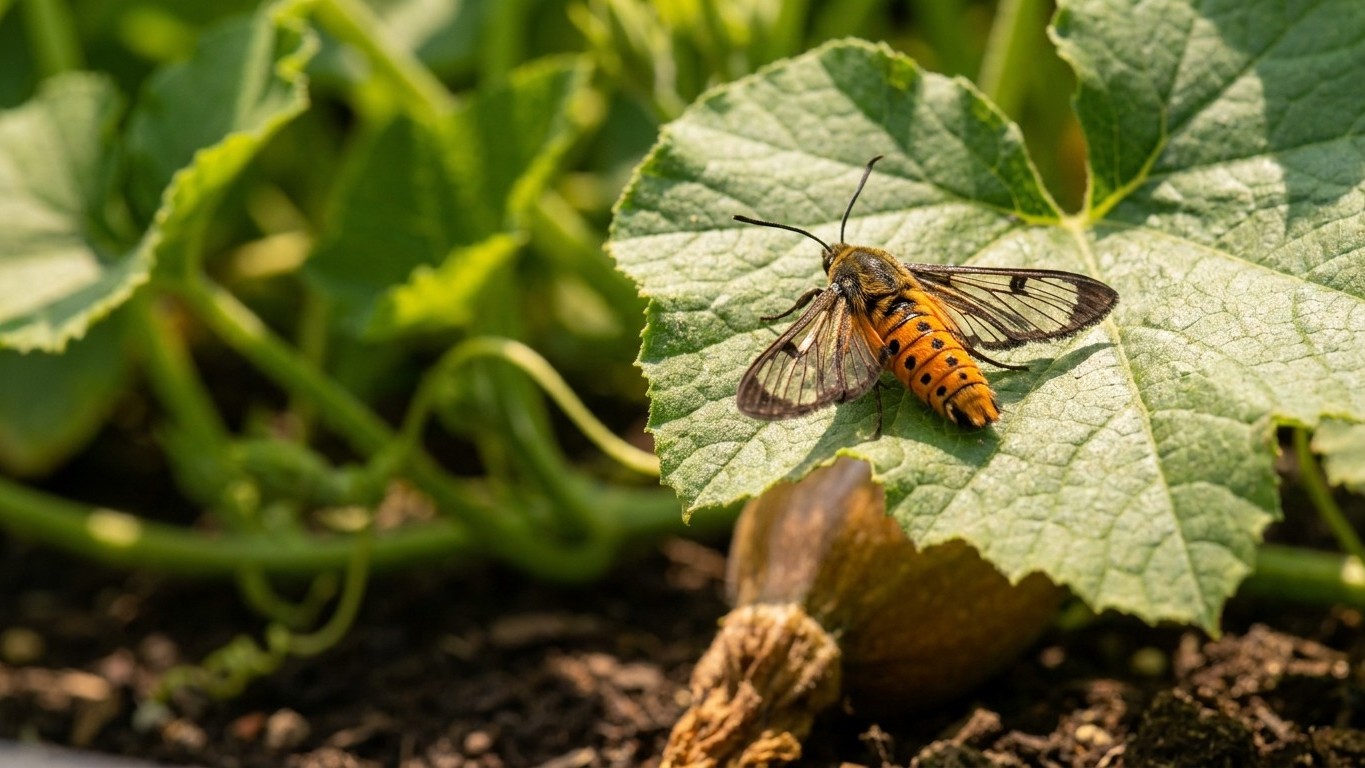

Squash vine borer moths start emerging in Ohio around late June, with egg-laying activity peaking through mid-July into early August. If your squash plants collapse seemingly overnight in midsummer despite looking healthy the week before, this pest is the most likely culprit, and the window for stopping it without losing the plant is narrower than most gardeners realize.
Ohio’s Squash Vine Borer Timeline

Ohio State University Extension entomologists track this pest closely because its timing shifts year to year based on spring temperatures. The moths overwinter as pupae in the soil, roughly one to two inches down, and emerge as adults once soil temperatures warm consistently. In a typical year across central and southern Ohio, that means late June. Northern counties near Lake Erie often see emergence run a week or two later.
The adult moth looks nothing like the fuzzy gray moths people expect. It flies during the day, has a wingspan close to an inch and a half, and sports an orange abdomen with black dots, more resembling a wasp than a typical moth. That daytime activity means gardeners actually have a decent chance of spotting the adults if they know what to look for, unlike many nocturnal pests.
Females lay eggs individually at the base of squash plants, usually within a few inches of the soil line, along stems and sometimes on leaf stalks. A single female can lay 150 to 200 eggs over her lifetime, spreading them across multiple plants. Eggs hatch in seven to ten days, and that’s when the real damage begins. The newly hatched larva bores directly into the stem, and from that point forward it’s feeding inside the plant, invisible and essentially untouchable by most surface treatments.
Ohio typically sees one generation per year, though southern parts of the state occasionally get a partial second generation in years with an early, warm spring. That single-generation pattern is actually good news: once the main egg-laying window closes in early-to-mid August, the pressure for the season largely ends.
Which Squash Are Most at Risk
Not all cucurbits are equal targets. Summer squash and zucchini, along with pumpkins and other Cucurbita pepo varieties, suffer the heaviest infestations because their stems are relatively soft and hollow, which is exactly the structure the larvae need to tunnel through easily. Winter squash varieties like butternut, which belong to Cucurbita moschata, show noticeably more resistance thanks to their solid, less hollow stems. That resistance isn’t complete protection, but Ohio gardeners who’ve lost zucchini year after year often report better luck switching part of their planting to butternut types.
Cucumbers and melons occasionally get hit but far less often than pumpkins and zucchini. If a garden has limited space and vine borer has been a recurring problem, shifting the ratio toward moschata types is one of the simplest structural changes a gardener can make.
Early Warning Signs Before the Plant Collapses
The frustrating part of squash vine borer is that the plant often looks completely normal until it isn’t. Wilting during the hottest part of the afternoon, even with adequate soil moisture, is frequently the first visible clue, especially if the plant perks back up overnight. That kind of intermittent wilting is different from drought stress, which tends to be more consistent across the whole plant and across neighboring plants too.
A closer look at the base of the stem often reveals small holes with a sawdust-like material called frass pushed out, sometimes described as looking like wet, orange-tinged sawdust. That frass is the larva’s excrement, and its presence at the stem base is close to a confirmed diagnosis. Cutting into the stem near that spot, carefully, with a sharp knife, will often reveal one or more cream-colored larvae up to an inch long actively feeding on the interior tissue.
Checking plants twice a week starting in late June gives Ohio gardeners the best shot at catching an infestation before the vine is girdled and the plant beyond saving. By the time a whole plant wilts and doesn’t recover, the internal damage is usually too extensive to reverse.
What Actually Stops Squash Vine Borer
Control strategies split into prevention, during-season intervention, and physical extraction, and Ohio’s climate makes timing the single most important factor across all three.
Prevention Before Eggs Are Laid
Floating row covers placed over young plants at transplant or seedling stage block adult moths from reaching the stems to lay eggs in the first place. The covers need to come off once flowers appear, though, since squash relies on pollinators to set fruit, and that timing gap is exactly when moths are most active in Ohio. Some gardeners hand-pollinate flowers each morning to keep row covers on longer, extending the protected window by a couple of extra weeks during peak moth activity.
Wrapping the base of each stem in aluminum foil or a strip of nylon stocking, extending a few inches up from the soil, physically blocks females from accessing the spot where they typically lay eggs. It’s a low-cost, low-tech method that Ohio State University Extension and other university extension programs have documented as effective when applied before egg-laying begins in late June.
Delayed planting is another approach some Ohio growers use deliberately. Since the main generation of moths is active from late June through early August, squash transplanted in early July, after the peak emergence, sometimes escapes the worst of the pressure and still has time to produce a fall harvest before frost.
Treating During the Egg and Early Larval Stage
Once eggs are visible at the stem base, scraping them off by hand with a fingernail or the edge of a knife is a direct, if tedious, control method. Checking plants every three to four days during peak season from late June through July catches most eggs before they hatch.
Bacillus thuringiensis subspecies kurstaki, commonly sold as Bt, can be injected into the stem or applied to the base where larvae are entering, and it works during the brief window after hatching but before the larva has tunneled deep into the stem. Once a larva is well established inside the plant, Bt applied to the surface has little effect since it needs to be ingested by the larva directly.
Insecticides containing spinosad or permethrin, applied to the stem base weekly starting in late June through early August, target newly hatched larvae before they burrow in. Timing these applications around Ohio’s egg-laying window matters more than the specific product chosen, since spraying too early or too late misses the vulnerable stage entirely.
Physical Removal After Infestation
For plants already showing frass and wilting, a careful vertical slit along the stem with a sharp blade, following the tunnel and removing the larva by hand, can save a plant that would otherwise die. After extraction, mounding moist soil over the wounded section of stem encourages new root growth from that point, which helps the plant recover even with the damaged section still present. This works best when caught early, while only one or two larvae are present and the tunnel damage is localized rather than running the length of the stem.
Reducing Ohio’s Squash Vine Borer Pressure Long Term
Because the pupae overwinter in soil at a shallow depth, tilling the garden bed in fall after harvest, or again in early spring before planting, exposes pupae to freezing temperatures and predators, cutting down on the population that emerges the following June. Ohio’s winter freeze-thaw cycles make this more effective than in milder climates, since exposed pupae face repeated cold stress rather than a single hard freeze.
Rotating cucurbit plantings to a different part of the garden each year, ideally with at least 100 feet of separation from the previous year’s squash bed, reduces the odds that emerging moths find host plants immediately. Since adult moths don’t fly indefinitely searching for hosts, distance and rotation genuinely lower localized pressure, even in a modest backyard garden.
Removing and destroying infested vines at the end of the season, rather than composting them, prevents any surviving larvae or pupae from completing their lifecycle in a compost pile that might not reach lethal temperatures. Backyard compost systems often run cooler than the internal heat needed to kill overwintering pupae, so this step matters more than it might seem for a pest that only produces one generation a year in Ohio.
Related guides
- Squash vine borer in Michigan: When It Shows Up and What Stops It
- Squash vine borer in Pennsylvania: When It Shows Up and What Stops It
- Squash vine borer in Ontario: When It Shows Up and What Stops It
- Squash vine borer in Prince Edward Island: When It Shows Up and What Stops It
- Squash vine borer in Iowa: When It Shows Up and What Stops It