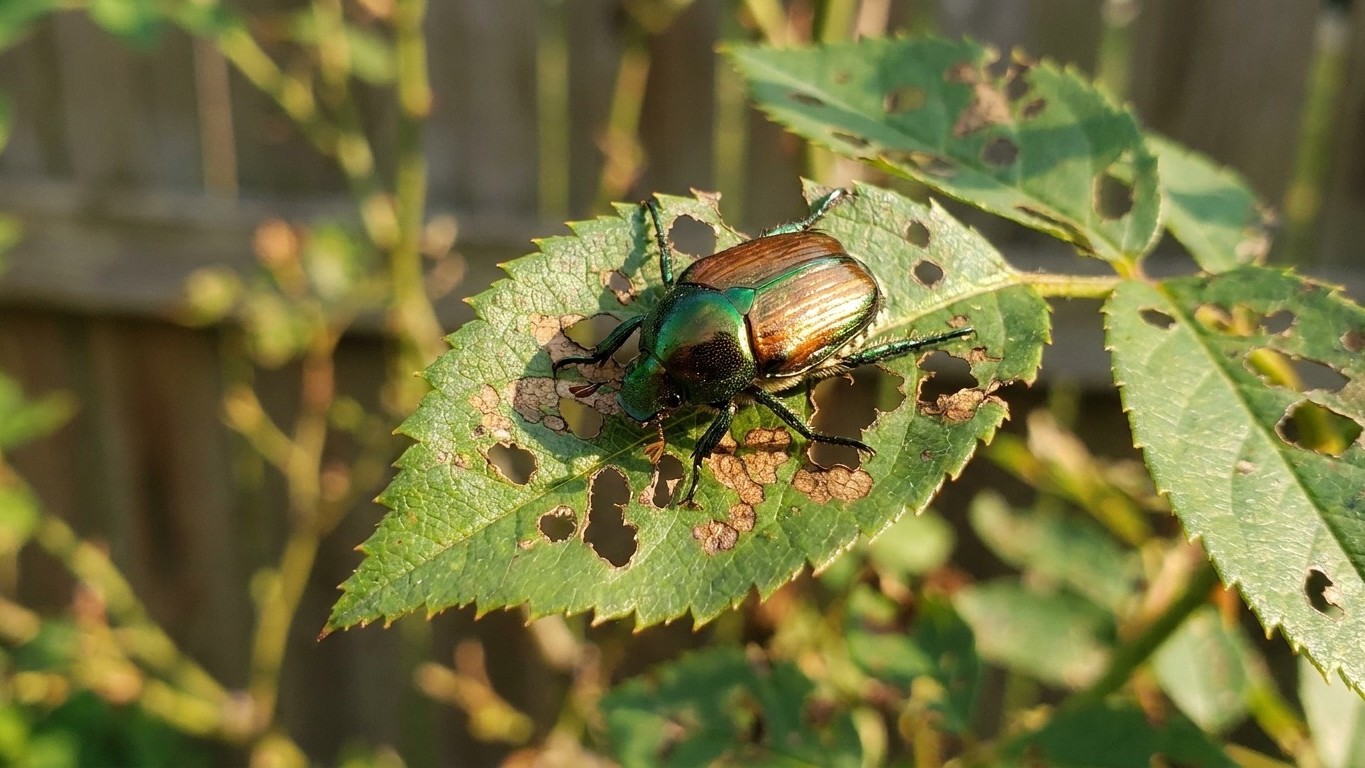

Missouri’s Japanese beetle season runs roughly from mid-June through early August, with the heaviest feeding pressure hitting in the first three weeks of July. There’s no single product that ends an infestation for good. What actually works is a layered approach: skip the pheromone traps, hit adults directly on the plants they’re chewing, and go after the grubs in the soil before they become next year’s problem.
When Japanese Beetles Show Up in Missouri

Adult beetles crawl out of the ground once soil temperature at a two-inch depth holds near 70°F for several consecutive days. In Missouri, that usually happens somewhere between the first and third week of June, a bit earlier in the Bootheel and southern counties, a bit later up around the Iowa border. Emergence isn’t a single event. It staggers across a few weeks, which is why the “active season” stretches longer than any one beetle’s lifespan.
An individual adult only lives about 30 to 45 days, but because new beetles keep emerging behind the first wave, yards can see fresh damage from mid-June clear through the first days of August. Missouri produces one generation per year. That’s a bit of good news compared to warmer climates that see more cycles, but it also means the grub stage sitting underground right now (feeding on turf roots into the fall and again briefly in spring before pupating) is setting up next summer’s adult population.
What Japanese Beetles Target in Missouri Yards
Adults feed on foliage and flowers, skeletonizing leaves so only the veins remain, a pattern that’s hard to mistake once you’ve seen it. They favor sun-exposed, upper-canopy leaves first, which is why damage often shows up at the top of a shrub or tree before anyone notices it lower down. Missouri landscapes give them plenty to work with:
- Roses, especially light-colored and fragrant varieties
- Linden and littleleaf linden trees, common street and shade trees across the state
- Grapevines, a real concern for the state’s wine-growing regions in the Ozarks and along the Missouri River
- Crape myrtle and Japanese maple, both widely planted ornamentals
- Raspberry canes and other bramble fruit
Below ground, it’s a different kind of damage. Female beetles lay eggs in turf during July, favoring lawns that are moist and well-irrigated over dry, unwatered ones. The larvae that hatch feed on grass roots through late summer and fall, then again for a short stretch in early spring once soil warms. Heavily infested lawns develop irregular brown patches that peel back like carpet because the root system underneath has been eaten away. Raccoons and skunks tearing up turf at night looking for grubs is often the first sign a homeowner notices, before they ever see an adult beetle.
What Actually Stops Japanese Beetles
Start with what doesn’t work: the yellow-and-green pheromone traps sold at hardware stores. University extension entomologists have tested them repeatedly, and the finding holds up. The floral and pheromone lures pull in beetles from well beyond a single yard, and most of those beetles land on nearby plants rather than making it into the bag. Set a trap near your roses and you’ll likely end up with more damage, not less, because you’ve turned your yard into the neighborhood’s beetle magnet.
Hand removal is unglamorous but reliable on a small scale. Beetles are sluggish in the early morning and easy to knock into a bucket of soapy water, where they drown within minutes. Doing this daily during peak weeks in late June and July measurably cuts down the population feeding on a specific rose bed or grapevine row, especially since beetles release an aggregation scent that draws more beetles to plants already under attack. Removing the first arrivals early breaks that cycle.
For adult beetles on ornamentals, contact insecticides containing pyrethrin or products labeled for Japanese beetle give quick knockdown but need reapplication after rain or every week or so during heavy pressure. Neem oil works as a repellent and feeding deterrent rather than an instant kill, useful on plants you’re not ready to spray with something stronger. Systemic insecticides such as those containing imidacloprid can protect a plant for weeks, but timing matters: applying them while plants are in bloom risks harming pollinators visiting the same flowers, so treatment should happen after bloom or be limited to non-flowering ornamentals like linden trees.
Going After the Grubs
Adult control only addresses what’s already flying. Breaking the cycle means treating the grub stage in the soil. Preventive grub control products, applied to turf in late May or June before eggs hatch, target young larvae while they’re most vulnerable and give season-long protection. Curative treatments applied in September can knock back grubs already established, though they’re less effective once larvae have grown large. Beneficial nematodes, applied to moist soil in late summer, offer a biological option that some homeowners prefer over synthetic grub killers, though results tend to be less consistent than chemical controls. Milky spore disease, often marketed as a long-term grub solution, has a track record built mostly in the warmer, more consistently humid soils of the Northeast and Mid-Atlantic. Missouri’s colder winters and drier stretches make it a less dependable bet here than the label promises.
Reducing Pressure Season After Season
Lawn watering habits matter more than most people realize. Female beetles seek out moist soil to lay eggs, which means a lush, frequently irrigated lawn in July is more attractive to egg-laying females than a lawn allowed to go a bit dry during that specific window. Cutting back on irrigation for a few weeks in midsummer, especially in years without heavy rain, can reduce the number of eggs laid in your turf without sacrificing the lawn for the whole season.
Plant choice plays a role too. Swapping out the most beetle-favored ornamentals for less attractive alternatives, native shrubs, boxwood, hollies, dogwood, doesn’t eliminate beetles from a property but does reduce the concentration of damage on any one plant. Because adults fly readily between yards, a single household’s efforts only go so far. Beetle pressure in a subdivision tends to reflect what the whole block is doing about lawn moisture and grub control, not just one yard’s choices.
Beetle numbers also swing with weather from year to year. A dry July, when egg and young-larva survival drops because the soil crusts and dries out, can mean a noticeably lighter beetle season the following summer, no spraying required. Missouri’s swings between wet springs and dry midsummers make that kind of natural population dip a real, if unpredictable, part of managing this pest.
Related guides
- Japanese beetle in Iowa: When It Shows Up and What Stops It
- Japanese beetle in Illinois: When It Shows Up and What Stops It
- Japanese beetle in Nebraska: When It Shows Up and What Stops It
- Japanese beetle in Nevada: When It Shows Up and What Stops It
- Japanese beetle in Pennsylvania: When It Shows Up and What Stops It
- Japanese beetle in Quebec: When It Shows Up and What Stops It