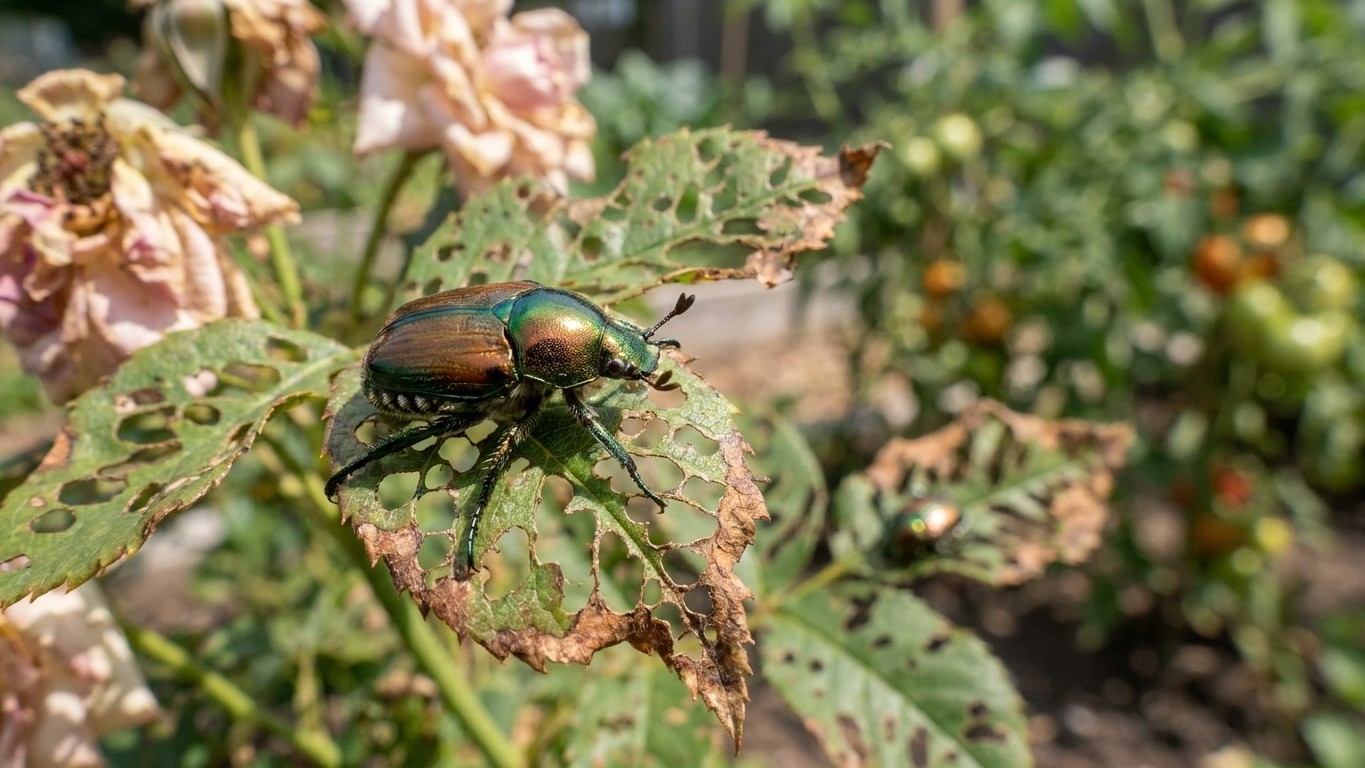

Japanese beetles start showing up in Illinois in late June, with populations peaking through July and tapering off by mid-to-late August. Adults are already active as you read this in late summer, feeding on roses, linden trees, and garden vegetables across the state. The real damage, though, happens twice: once above ground when adults skeletonize leaves, and once below ground when their grubs chew through lawn roots from late summer into fall.
Stopping them takes a mix of timing and tactics, not a single silver bullet. Traps often make things worse. Milky spore, a popular organic treatment sold nationally, struggles in Illinois soil temperatures. What actually works is a combination of hand removal, targeted insecticide timing, and grub-stage lawn treatments applied before damage sets in, not after.
When Japanese Beetles Arrive in Illinois

The beetle (Popillia japonica) is not native to North America. It arrived from Japan and was first detected in New Jersey back in 1916, tucked inside iris bulbs shipped for nursery stock. It reached Illinois decades later and has since become a predictable summer visitor across the northern two-thirds of the state, with populations somewhat lighter in far southern counties where soil and climate conditions differ slightly.
Adults emerge from the soil when ground temperatures warm consistently, typically the last week of June in central Illinois and the first week of July farther north. Emergence isn’t a single event. Beetles trickle out over four to six weeks, which is why gardeners see a slow buildup rather than a sudden invasion. Peak feeding activity lands squarely in July, when Illinois summer heat and humidity match the beetle’s preferred conditions. By late August, most adults have died off, though a few stragglers can linger into early September in warmer years.
Here’s the part most homeowners miss: the adults you’re swatting off your roses in July are laying eggs in your lawn at the same time. Females burrow into moist soil, often turf grass, and deposit eggs a few inches down. Those eggs hatch into grubs by August, and the grubs spend the rest of the growing season feeding on grass roots before digging deeper to overwinter below the frost line. Come next spring, they migrate back up, feed briefly, then pupate into the next generation of adults. One generation per year, like clockwork, but with damage on two separate calendars.
What Japanese Beetles Actually Damage
Adult beetles are generalists. They feed on more than 300 plant species, but in Illinois yards a shorter list takes the brunt of it: roses, linden and crabapple trees, grapevines, raspberries, Virginia creeper, and Japanese maple. They feed from the top of the plant downward and from the outside of the leaf inward, leaving a lace-like skeleton of veins behind. On a rose bush, that means chewed petals and holes punched clean through leaves within days. On a linden tree, entire canopies can look bronzed and tattered by late July.
Grubs cause a different kind of trouble. They feed on turf grass roots from below, which weakens the grass’s ability to pull up water and nutrients. Lawns show irregular brown patches, usually in sunny, well-irrigated areas since egg-laying females prefer moist soil over dry patches. A telltale sign: damaged turf pulls up like loose carpet because the root system has been chewed away. Skunks and raccoons digging up your yard at night in September is often a secondary clue, since they’re hunting the grubs themselves.
Distinguishing Beetle Damage From Other Pests
Skeletonized leaves with intact veins point almost exclusively to Japanese beetles rather than caterpillars, which tend to chew irregular holes or eat entire leaf sections. On lawns, grub damage differs from chinch bug damage (which shows up as yellowing in dry, sunny strips rather than patchy brown areas) and from drought stress (which affects the whole lawn evenly rather than in scattered patches). Pulling up a suspect patch of turf and checking for C-shaped white grubs, usually a half-inch to an inch long, confirms the diagnosis quickly.
What Actually Stops Japanese Beetles in Illinois
Pheromone traps sold at garden centers are probably the most misunderstood tool on the market. Research from land-grant universities across the Midwest has repeatedly found that these traps attract more beetles to a property than they actually capture, essentially turning your yard into a beetle magnet for the whole neighborhood. Skip them unless you’re placing them far from the plants you actually want to protect, at least 30 feet away and downwind.
Hand removal remains one of the most reliable low-cost methods for small infestations. Beetles are sluggish in early morning temperatures, which makes dawn the best time to knock them into a bucket of soapy water. A single vigorous shake of an infested branch over a wide container can remove dozens of beetles in seconds. This works especially well on roses and small ornamental trees where the population is concentrated and manageable.
For heavier infestations, insecticides containing carbaryl or pyrethrin-based products offer knockdown control on adults, though timing matters more than the product itself. Spraying during peak midday feeding, when beetles are most active and exposed, gets better results than spraying at dawn or dusk when fewer beetles are on the plant. Systemic insecticides applied earlier in the season, before beetles arrive, can also protect high-value ornamentals like roses through the whole feeding window, though homeowners should always check current label restrictions, since some systemic products carry pollinator-protection rules that limit their use on flowering plants.
Neem oil and insecticidal soaps offer a gentler option for edible gardens like grapes and raspberries, though they require more frequent reapplication and work better as a deterrent than a knockout treatment. Beneficial nematodes applied to lawn soil in late summer can target grubs directly, offering an organic alternative to chemical grub control, though results vary depending on soil moisture and application timing.
Why Milky Spore Underperforms in Illinois
Milky spore disease, a bacterial treatment (Bacillus popillae) marketed nationally as a long-term grub solution, has a track record problem in colder Midwest states. The bacteria need warm soil temperatures to establish and spread effectively, conditions more common in the Southeast than in Illinois. University turf researchers in the region have found inconsistent results here compared to warmer climates, so homeowners expecting a one-time application to solve grub problems for a decade often end up disappointed. It’s not useless, just unreliable enough that Illinois homeowners shouldn’t rely on it as a sole strategy.
Lawn Grub Control Runs on a Different Clock
Treating adult beetles on your rose bushes does nothing to stop next year’s grub population, and vice versa. Grub-targeted insecticides work best when applied in late July through August, right as eggs are hatching and young grubs are feeding near the surface where they’re most vulnerable. Waiting until you see brown lawn patches in September means the grubs have already done their damage and are burrowing deeper for winter, making treatment far less effective.
Preventive grub control products, often labeled for grub prevention rather than curative treatment, work on a similar late-summer schedule and need to go down before egg-laying peaks. Homeowners who’ve had recurring grub damage in past summers get the best return by treating proactively each July rather than reacting each fall. Healthy, deep-watered lawns also recover from moderate grub feeding better than stressed, shallow-rooted turf, so basic lawn care (mowing height, watering depth, aeration) plays a bigger supporting role in grub resistance than most people assume.
One detail that surprises a lot of Illinois homeowners: irrigated lawns during dry Julys are more attractive to egg-laying females than unwatered, drought-stressed turf nearby. That green, well-watered yard everyone’s proud of during a dry summer is quietly sending out a welcome sign to beetles looking for moist soil to lay eggs in.
Related guides
- Japanese beetle in Iowa: When It Shows Up and What Stops It
- Japanese beetle in Missouri: When It Shows Up and What Stops It
- Japanese beetle in Kentucky: When It Shows Up and What Stops It
- Japanese beetle in Manitoba: When It Shows Up and What Stops It
- Japanese beetle in New Hampshire: When It Shows Up and What Stops It