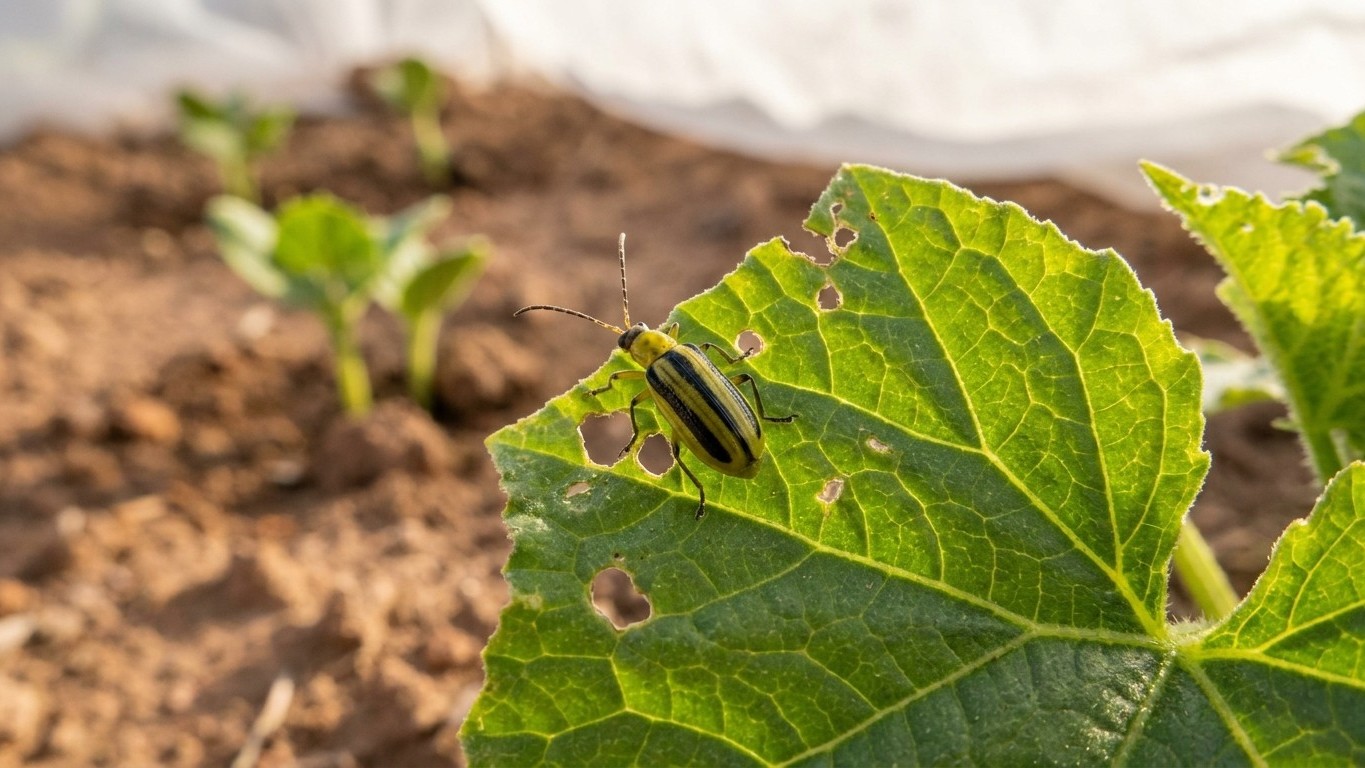

Striped cucumber beetles typically appear in New Mexico gardens between late April and early May in the southern valleys, and closer to late May at higher elevations like Santa Fe or Taos. The trigger isn’t the calendar date but soil temperature: once soil hits the mid-50s Fahrenheit and cucurbit seedlings break ground, overwintering adults come out of hiding and head straight for the nearest squash or cucumber leaf. Row covers timed to that emergence window, combined with a few smart planting choices, block most of the damage before it starts.
Why New Mexico’s Dry Climate Changes the Threat

The striped cucumber beetle (Acalymma vittatum) causes two kinds of trouble everywhere it lives: direct feeding damage on leaves, stems, and blossoms, and disease transmission. In the humid Midwest and Southeast, that second problem often matters more than the first. Bacterial wilt, caused by Erwinia tracheiphila, spreads through beetle feeding wounds and can collapse a healthy squash plant within a week.
New Mexico’s arid air works in gardeners’ favor here. Bacterial wilt needs moisture to move efficiently through plant tissue and survive between feeding events, so infection rates in low-humidity regions like Albuquerque, Las Cruces, or the eastern plains run noticeably lower than in wetter climates. That doesn’t mean the disease is absent, wilt shows up in irrigated fields and well-watered home gardens every season, but the dry background humidity slows its spread. The bigger practical concern in most New Mexico gardens is straightforward defoliation and stem damage, plus a secondary role in spreading cucumber mosaic virus.
Elevation adds another layer. A garden in the Mesilla Valley near 3,900 feet warms up weeks earlier than one in the Sangre de Cristo foothills above 7,000 feet. Beetle emergence follows that same gradient, which means there’s no single “beetle season” for the whole state. Gardeners need to track local soil warming rather than lean on a fixed date.
The New Mexico Emergence Calendar, Region by Region
Southern Valleys and the Rio Grande Corridor
Around Las Cruces, Deming, and the lower Rio Grande, soil warms fast once spring arrives. Overwintering beetles typically emerge from late April through mid-May, right as gardeners are setting out squash and melon transplants or direct-seeding cucumbers. This region also tends to get a second, smaller population bump in July and August as a new generation matures, so vigilance doesn’t end after the first wave.
Central New Mexico and the Albuquerque Metro
In the middle Rio Grande valley, expect activity to start roughly two to three weeks later than the south, usually early to mid-May. Cool nights that persist into late April slow beetle activity even when daytime temperatures feel warm enough for planting.
Higher Elevations and Northern Counties
Santa Fe, Taos, and mountain valleys above 6,500 feet see the shortest, most compressed pest window. Beetles emerge later, often late May into June, but because the growing season itself is shorter, seedlings spend a larger share of their vulnerable early weeks exposed to feeding pressure. Gardeners here get less runway to protect plants before beetle numbers peak.
One practical takeaway across all three zones: the first two to three weeks after cucurbit seedlings emerge or transplants go in the ground is the highest-risk window, no matter which region you’re gardening in. That’s when stems are thin, cotyledons are tender, and a handful of beetles can do damage disproportionate to their numbers.
What Actually Stops Them
No single tactic eliminates striped cucumber beetles completely, but layering a few methods cuts damage dramatically. The most effective approaches target the vulnerable seedling stage, since mature plants tolerate beetle feeding far better.
Row Covers, Timed Correctly
Floating row covers remain the single most reliable physical barrier. The catch is timing: covers need to go on immediately at planting, before beetles find the seedlings, and they need to come off once flowers open so pollinators can reach the blossoms. Left on too long, they trap heat and block bees, which cucurbits depend on for fruit set. In New Mexico’s intense spring sun, lightweight covers work better than heavier fabric that can cook young plants on unusually warm afternoon.
Trap Cropping
Planting a small sacrificial patch of a highly attractive cucurbit variety, blue hubbard squash is a commonly used trap crop in beetle research, a week or two before the main crop draws beetles away from the plants you actually want to harvest. This works because striped cucumber beetles are drawn strongly to cucurbitacins, the bitter compounds that give some squash varieties their attractiveness to the pest. Concentrating beetles on a small border planting makes targeted treatment (or hand removal) far more efficient than spraying an entire garden bed.
Delayed Planting and Transplants Over Direct Seeding
Starting cucurbits indoors and transplanting larger, sturdier seedlings gives plants a head start that reduces the window of maximum vulnerability. A four-inch-tall squash plant survives beetle feeding that would kill a two-leaf seedling outright. In regions with a compressed season, like the northern mountain valleys, this approach also buys back some of the growing time lost to a later frost-free date.
Targeted Insecticide Use
When beetle numbers overwhelm physical and cultural controls, spinosad and pyrethrin-based products labeled for cucurbits offer effective knockdown with a shorter environmental persistence than older broad-spectrum chemicals. Kaolin clay, applied as a fine particle film on leaves, disrupts beetle feeding and egg-laying without killing pollinators, which makes it a reasonable option for gardens near active bee activity. Whatever product is chosen, applying it in the early morning or evening, when bees aren’t foraging, protects pollination while still targeting the beetles.
Yellow Sticky Traps for Monitoring
Cucumber beetles are strongly drawn to yellow, which is why yellow sticky cards placed near cucurbit beds double as an early warning system. Checking traps every few days during the emergence window tells gardeners exactly when local beetle pressure is climbing, which takes the guesswork out of deciding when to deploy row covers or start scouting more intensively.
Reading the Damage Correctly
Striped cucumber beetles chew irregular holes in leaves and can strip cotyledons down to bare stems on young seedlings. They also feed on blossoms and the surface of developing fruit, leaving shallow scarring that, while cosmetic on tougher squash varieties, can make thinner-skinned cucumbers less marketable. Larvae live in the soil and feed on roots, which can weaken plants in ways that aren’t obvious above ground until a plant wilts under heat stress that a healthy root system would have handled fine.
Distinguishing beetle damage from squash bug or squash vine borer damage matters because control tactics differ. Striped cucumber beetles leave visible chewing holes and the beetles themselves are easy to spot, roughly a quarter-inch long with three bold black stripes down a yellow body. Squash bugs, by contrast, cause yellow speckling and eventual wilting without the same obvious leaf perforation, and squash vine borer damage shows up as a wilting vine with a small entry hole and sawdust-like frass near the base of the plant.
A Practical Season Checklist
- Track soil temperature rather than the calendar date, beetle emergence follows warming soil, not a fixed week.
- Install row covers at transplant or seeding time, and remove them once flowering begins.
- Consider a small trap crop planted slightly ahead of the main cucurbit bed.
- Check yellow sticky traps every few days during early spring to catch emergence early.
- Reserve insecticide applications for evening hours to protect pollinators.
New Mexico’s dry climate means the worst-case scenario, a bacterial wilt outbreak wiping out a squash patch overnight, happens less often here than in humid growing regions. But that lower disease risk doesn’t erase the beetle problem itself. A garden left unprotected during those first vulnerable weeks after planting can still lose young cucumbers and melons to straightforward feeding damage, wilt or no wilt, which is exactly why timing the defense to local soil warming matters more than following a generic pest calendar built for a different climate.
Related guides
- Striped cucumber beetle in New York: When It Shows Up and What Stops It
- Striped cucumber beetle in North Carolina: When It Shows Up and What Stops It
- Corn earworm in New Mexico
- Beet leafhopper in New Mexico
- Spotted cucumber beetle in New Mexico
- Striped cucumber beetle in Iowa: When It Shows Up and What Stops It