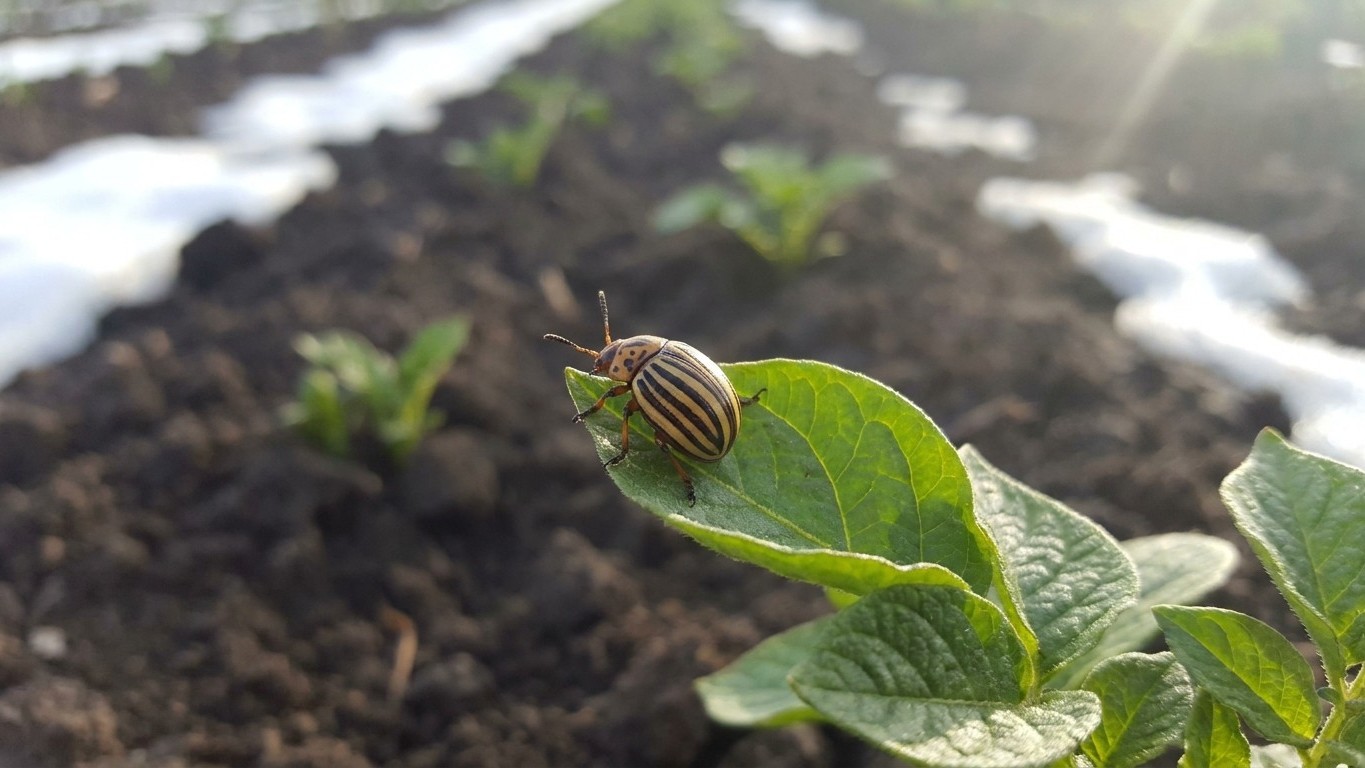

Overwintered Colorado potato beetle adults start crawling out of the soil in North Dakota once ground temperatures hit roughly 50 to 55 degrees Fahrenheit, which typically lands somewhere between late April and mid-May depending on where you farm or garden in the state. Fields in the Red River Valley tend to see activity a week or two earlier than plots out west near Williston, simply because the eastern part of the state warms up faster in spring. Stopping the beetle once it arrives comes down to three things working together: rotating where you plant potatoes, catching the first wave of adults before they lay eggs, and rotating insecticide classes so the beetle doesn’t build resistance faster than it already has.
The weeks to watch

The beetle spends winter as an adult, buried six to eight inches down at the edge of last year’s potato field or in nearby windbreaks and grassy margins. It doesn’t fly south, doesn’t migrate in any dramatic way. It just waits underground through the North Dakota winter, sometimes with snow cover offering an odd kind of insulation. Once soil temperature warms past that 50-degree mark, adults dig out, feed briefly on whatever green potato foliage or nearby volunteer plants they can find, then start looking for mates and egg-laying sites.
Egg-laying usually begins within a week or two of emergence. Females lay clusters of 20 to 40 bright yellow-orange eggs on the undersides of leaves, and a single female can produce several hundred eggs over her lifetime. Those eggs hatch in about a week under warm conditions, releasing the reddish, humped larvae that do the real damage to a potato crop. Larvae go through four growth stages over roughly three weeks, feeding nonstop, before dropping to the soil to pupate.
How Many Generations Per Year
North Dakota’s growing season is short enough that most of the state sees one full generation per year, with a partial second generation in warmer years or in the southeastern counties where the frost-free period runs longer. Compare that to states like Iowa or Nebraska, where two full generations are routine. That single-generation pattern matters for timing control: missing the first wave of adults in May means dealing with a much bigger larval population in June, but there usually isn’t a second full-blown outbreak to worry about later in the summer the way growers further south experience.
Recognizing the Beetle and Its Damage
Adult Colorado potato beetles are hard to mistake for much else in a potato patch. They run about three-eighths of an inch long, rounded like a ladybug but bigger, with alternating black and cream-colored stripes running down the wing covers. The larvae look completely different, plump and reddish-orange with two rows of black spots along each side, and they’re the ones doing most of the eating.
Damage shows up as ragged holes in leaves that expand into full defoliation if the population goes unchecked. A heavy infestation can strip a potato plant down to bare stems in a matter of days, and since potatoes need healthy foliage to bulk up tubers, that kind of defoliation translates directly into smaller yields at harvest. Research from land-grant universities across the Midwest has consistently shown that losing more than 20 percent of leaf area during tuber bulking can cut yield noticeably, which is why scouting early matters more than reacting late.
What Actually Stops Colorado Potato Beetle
Crop rotation remains the single most effective tool against this pest, and it works because overwintering adults don’t travel far when they emerge in spring. If last year’s potato field is planted to potatoes again, or sits close enough for beetles to walk to it, the population picks up right where it left off. Moving potatoes at least a third of a mile from the previous year’s field, ideally farther, forces emerging adults to walk a distance many of them simply can’t manage before running out of energy or falling prey to something else along the way.
Trap cropping takes that same emergence behavior and turns it into a targeted kill zone. Planting an early strip of potatoes around the perimeter of the main field, or along the edge closest to last year’s potato ground, lures the first emerging adults into a concentrated area. Growers then treat just that border strip with an insecticide rather than spraying the whole field, cutting chemical use substantially while still knocking down the population before it spreads.
Biological Control Options
Several natural enemies help keep beetle numbers in check, though none of them eliminate the need for other tactics on their own. Lady beetles and spined soldier bugs feed on eggs and small larvae. Parasitic wasps in the genus Edovum attack eggs directly, and tachinid flies parasitize larvae and adults. None of these predators or parasites reliably prevent economic damage by themselves in commercial potato production, but preserving them by avoiding broad-spectrum insecticide applications when populations are still low gives them a fighting chance to contribute.
Insecticide Resistance Is the Real Complication
Colorado potato beetle has a well-documented history of developing resistance to insecticides faster than almost any other agricultural pest in North America. Populations in various states have shown reduced sensitivity to organophosphates, carbamates, pyrethroids, and more recently to neonicotinoids, the class that includes many of the seed treatments and soil-applied products growers leaned on heavily through the 2000s and 2010s. Once a population develops resistance to one product in a chemical class, it often carries partial resistance to related products in that same class, which is why rotating between different modes of action, not just different product names, is the only way to keep any single tool useful for more than a few seasons.
Extension entomologists generally recommend using the Insecticide Resistance Action Committee (IRAC) group numbers printed on product labels to track this rotation properly. Using two products with different brand names but the same IRAC number offers no resistance management benefit at all, since the beetle’s resistance mechanism doesn’t care what the label says. Growers who scout fields, treat only when thresholds are crossed, and alternate between at least two or three different IRAC groups within a season tend to keep populations manageable for far longer than those who spray on a fixed calendar schedule regardless of actual beetle counts.
Scouting and Treatment Thresholds
Checking fields twice a week starting right around soil temperatures hitting that 50-degree mark gives growers enough lead time to catch the first adults before egg masses appear in large numbers. Walking the field edges closest to last year’s potato ground first makes sense, since that’s where emerging adults show up in the highest concentration.
Common threshold guidance used across northern Plains potato-growing regions suggests treating when counts reach roughly one adult beetle per plant during early season scouting, or when small larvae appear on more than 10 percent of plants before tuber bulking begins. These numbers shift somewhat depending on plant growth stage and overall field health, but the underlying logic stays the same: act before defoliation reaches the point where yield is already compromised, not after.
Home gardeners in North Dakota dealing with a handful of plants have an advantage commercial growers don’t: hand-picking adults and squishing egg clusters remains genuinely effective at that scale, especially if done consistently every few days starting in May. It’s tedious, but for a backyard plot it avoids chemical use entirely and sidesteps the resistance problem altogether.
Regional Notes for North Dakota Growers
The Red River Valley, with its heavier clay soils and earlier spring warm-up, tends to see beetle pressure build a bit sooner and sometimes more intensely than the drier, sandier ground further west. Irrigated potato fields in central North Dakota, where soil moisture stays more consistent through the season, can also support somewhat larger beetle populations simply because the potato foliage stays lush and attractive longer into the summer compared to dryland fields that may stress and yellow earlier.
Windbreaks and shelterbelts common across North Dakota farmland double as overwintering habitat for adult beetles, since the loose soil and leaf litter at the base of tree rows offer better insulation than open field ground. Fields bordered by these windbreaks sometimes show beetle activity concentrated along that edge first, which is worth factoring into where scouting starts each spring.
One detail that surprises a lot of growers new to potato production: a single overwintering female beetle, if she survives to lay her full complement of eggs undisturbed, can theoretically be responsible for several hundred larvae within a single generation. That’s the math that makes early-season control so disproportionately valuable compared to trying to catch up once larvae are already established across a field.