
Squash vine borer adults start flying in Iowa from mid-June through early August, with the heaviest activity typically landing between the last week of June and the third week of July. That single generation is the whole ballgame here. Unlike the Deep South, where a second wave can hit in late summer, Iowa gardeners deal with one shot of egg-laying moths per season. Miss that window with prevention, and you’re often stuck cutting open stems to save what’s left of the crop.
The weeks to watch

The moth (Melittia cucurbitae) overwinters as a larva tucked inside a tough cocoon, usually one to two inches down in the soil right where last year’s squash plants stood. Pupation happens in spring once soil temperatures climb, and the adult moths emerge once accumulated warmth hits a threshold entomologists track as growing degree days. Extension programs across the Corn Belt generally place first emergence somewhere in the 900 to 1,000 growing degree day range (base 50°F), which in Iowa lines up with mid-to-late June in most years.
There’s a real north-south split within the state. Southern Iowa counties, where soil warms up faster in spring, tend to see moths flying a week to ten days ahead of northern counties along the Minnesota border. A gardener in Lee County might spot the first adult in the second week of June, while someone in Winnebago County doesn’t see one until closer to July 1st. Weather swings matter too, a cool, wet May pushes everything later, and a hot early spring pulls the whole calendar forward.
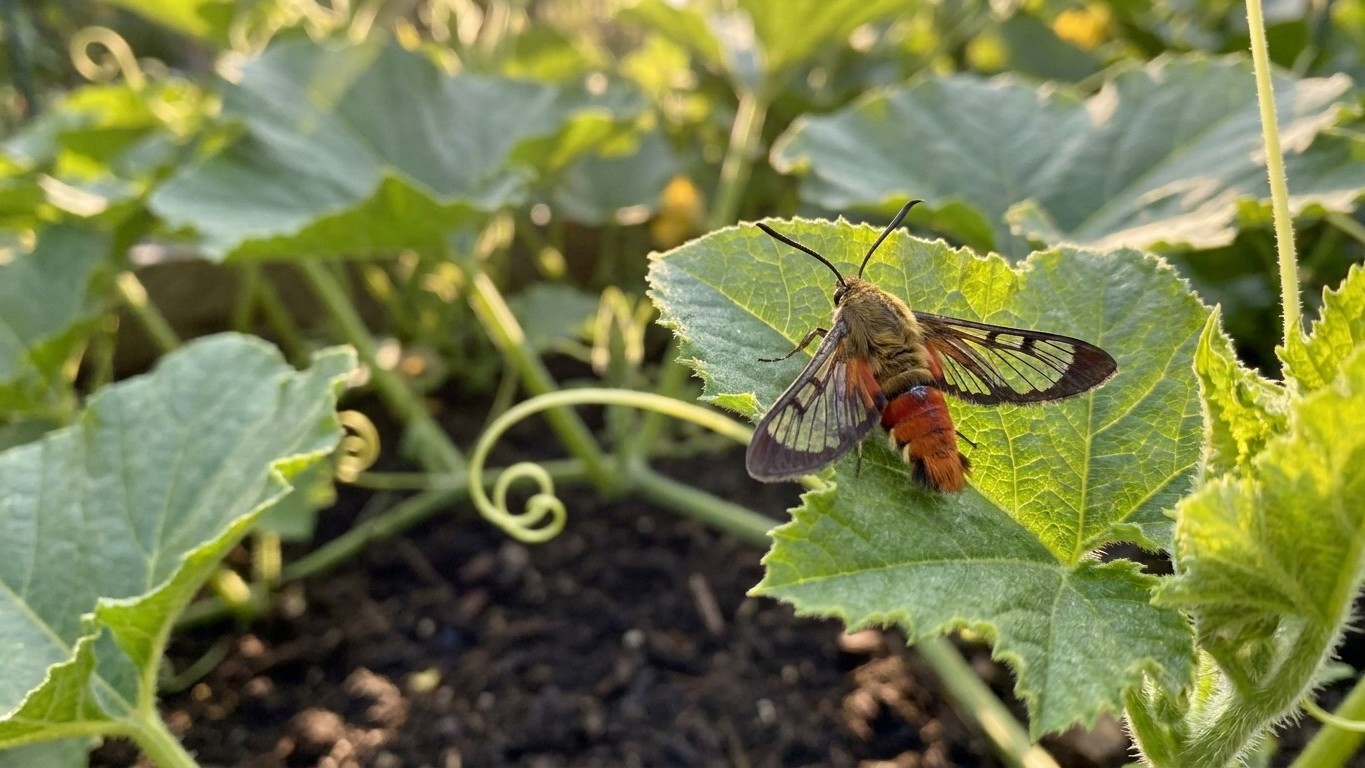
The adult itself throws people off because it doesn’t look like a typical moth. It flies during the day, has clear-ish wings with a wingspan around an inch and a half, and sports an orange-red abdomen with black dots, plus noticeably fuzzy orange-red hind legs. Gardeners mistake it for a wasp constantly. That daytime flight pattern means you can actually watch for it in the garden rather than relying only on nighttime moth traps.
Spotting the Damage Before the Whole Vine Collapses
Here’s the frustrating part. By the time most gardeners notice a problem, the larva has already been feeding inside the stem for one to two weeks. The female moth lays flat, reddish-brown eggs singly at the base of the plant, near the soil line or on the lower stem, sometimes on leaf stalks too. A single female can lay 150 to 200 eggs over her lifetime, scattering them across multiple plants.
Eggs hatch in seven to ten days, and the newly emerged larva bores directly into the stem within hours. From that point, it’s tunneling and feeding on the inside of the vine, which cuts off water and nutrient flow to everything downstream of the entry point.
Three signs give it away, usually all at once:
- Sudden wilting of one vine or an entire plant, especially during the heat of the day, even when soil moisture looks fine
- Small holes near the base of the stem with piles of moist, sawdust-like frass pushed out (this greenish-yellow debris is the single most reliable diagnostic clue)
- A stem that feels soft, hollow, or collapses when you press on it near the crown
Split a wilting stem open lengthwise near the frass, and you’ll usually find a cream-colored, wrinkled caterpillar up to an inch long, sometimes more than one per plant. That’s your confirmation. Wilting from squash vine borer often gets confused with bacterial wilt or simple drought stress, so the frass at the base is what separates a borer problem from everything else.
Which Squash Are on the Menu
Not every plant in the cucurbit family gets hit equally, and this matters a lot for what you plant next season if borers have been a recurring headache. Summer squash and zucchini (Cucurbita pepo) rank among the most vulnerable, along with most pumpkins, which share that same species classification. Their stems are relatively soft and hollow, easy pickings for a tunneling larva.
Butternut squash and other Cucurbita moschata varieties fare much better. Their stems are denser and more solid, which the borer larvae seem to find harder going. Gardeners across the Midwest who’ve struggled year after year with zucchini losses often report noticeably less damage when they switch part of their garden over to butternut types. It’s not full immunity, just a meaningfully lower hit rate.
Cucumbers and melons sit at the low end of the risk spectrum. They’re technically in the same broader plant family but aren’t a preferred host, so infestations there are uncommon. If your garden layout allows it, grouping the vulnerable squash and pumpkin plants away from where you had heavy borer pressure last year, combined with genuine crop rotation, reduces the odds that emerging moths find their target crop sitting right where the overwintering cocoons are.
What Actually Stops It
Prevention works far better than rescue here, mostly because once a larva is inside the stem, insecticide sprays on the leaf surface do nothing to reach it. Timing is everything, and it has to start before the moths ever lay eggs.
Row covers and the pollination trade-off
Lightweight floating row cover, secured tightly at the soil edges so no moth can sneak underneath, is one of the most dependable barriers available to home gardeners. The catch is that squash needs pollinators to set fruit, so the cover has to come off once flowering begins, right around the time moth activity is often peaking. Some gardeners split the difference by keeping covers on through the vulnerable early growth stage, then removing them at flowering and hand-pollinating each morning with a small brush to skip the exposure window without losing yield.
Watching for the moths themselves
Because squash vine borer moths fly during daylight, a homemade trap using a yellow plastic pan filled with soapy water, set near the base of the plants starting in mid-June, gives an early warning. Once moths start showing up in the trap, that’s the cue to start twice-weekly stem checks and, if desired, apply an insecticide labeled for squash vine borer directly to the base of the stems and soil surface where eggs get laid, following label instructions for timing and reapplication.
Stem surgery when it’s already inside
If wilting shows up and frass confirms a borer’s already tunneling, a narrow slit made lengthwise along the stem with a sharp knife, right where the frass sits, lets a gardener physically remove the larva with tweezers. Afterward, mound moist soil over the wounded section of stem to encourage new root growth from that point, and keep the area consistently watered for a couple weeks while it recovers. Plenty of squash plants survive this minor surgery and keep producing through the season, especially if it’s caught while only one vine on a sprawling plant is affected rather than the main crown.
Cleaning up the overwintering site
Since the larvae spend winter in the top couple inches of soil, tilling the garden bed in fall after harvest, or turning it over again in early spring before planting, exposes those cocoons to freezing temperatures and hungry birds. Iowa’s winters do a lot of the work here, but only if the cocoons are disturbed and brought closer to the surface rather than left undisturbed under a layer of old mulch or plant debris. Pulling and destroying spent squash vines at the end of the season, rather than composting them in place, removes another wintering site.
Growing squash in the same exact bed every year gives each new generation of moths a shorter flight to a guaranteed food source. Rotating cucurbits to a different part of the yard, even by twenty or thirty feet, combined with the fall tillage habit, tends to knock down pressure noticeably by the second or third season of doing it consistently.
Related guides
- Squash vine borer in Minnesota: When It Shows Up and What Stops It
- Squash vine borer in Wisconsin: When It Shows Up and What Stops It
- Squash vine borer in Kansas: When It Shows Up and What Stops It
- Squash vine borer in Kentucky: When It Shows Up and What Stops It
- Squash vine borer in Nebraska: When It Shows Up and What Stops It
- Squash vine borer in Ohio: When It Shows Up and What Stops It