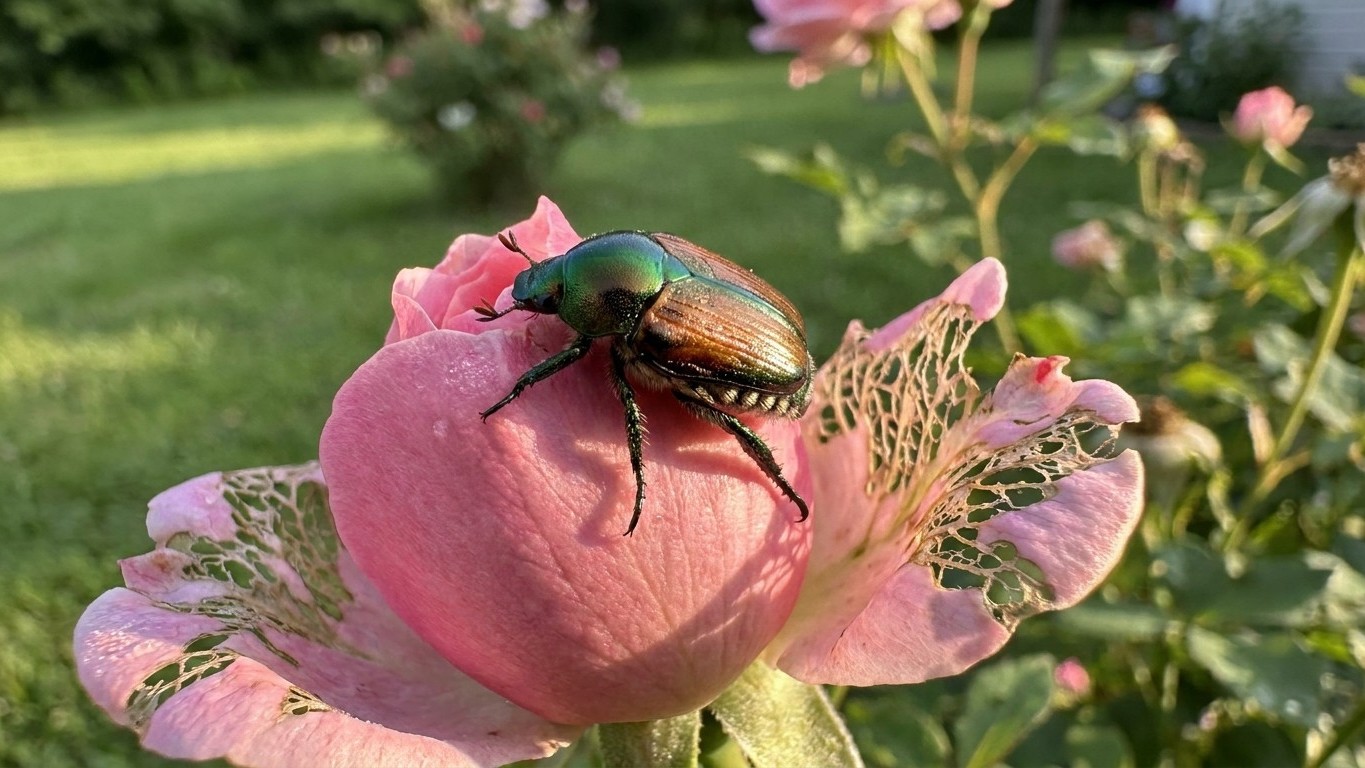

Japanese beetles typically appear in West Virginia between mid-June and early July, with populations peaking through late July and tapering off by mid-to-late August. Lower elevations like the Eastern Panhandle and Ohio Valley see them first; mountain counties such as Pocahontas, Randolph, and Tucker often lag two to three weeks behind because cooler soil temperatures slow the beetle’s development underground. Stopping them means targeting two very different stages: the adult beetles skeletonizing your rose bushes right now, and the grubs chewing through lawn roots that will become next year’s problem.
The West Virginia Timeline: From Grub to Adult

A Japanese beetle spends roughly ten months of its year underground and only four to six weeks as the flying, leaf-eating adult most homeowners recognize. Adult females lay eggs in soil through July and August, favoring irrigated lawns and moist turf over dry, unwatered ground. Eggs hatch within two weeks, and the resulting grubs feed on grass roots through September and October before burrowing deeper as temperatures drop.
Here’s the part that catches people off guard: those grubs don’t die over winter. They simply move down eight to ten inches below the surface, wait out the cold, then migrate back up toward the root zone in April as soil warms past roughly 50 degrees Fahrenheit. Feeding resumes for a few weeks, pupation happens in May, and adults start emerging by early June in the state’s warmer valleys.
Elevation changes this math significantly. A yard in Martinsburg or Charles Town might see adult beetles a full three weeks before a property near Marlinton or Elkins. West Virginia’s terrain, ranging from around 250 feet along the Ohio River to over 4,800 feet at Spruce Knob, creates a patchwork of microclimates that stretch the statewide beetle season across nearly ten weeks rather than a tight window.
What Japanese Beetles Damage in West Virginia
Adult beetles feed in groups, which is why damage often looks sudden and severe rather than gradual. They skeletonize leaves, eating the tissue between veins and leaving a lacy, brown skeleton behind. Roses rank among their favorite targets statewide, along with grapevines, a real concern for the growing number of small vineyards in the Eastern Panhandle and Potomac Highlands. Linden trees, crape myrtle, birch, and Virginia creeper also draw heavy feeding pressure.
Fruit growers feel this pest particularly hard. West Virginia’s apple orchards, concentrated in Berkeley and Jefferson counties, deal with beetles feeding directly on fruit surfaces in addition to foliage, which can affect marketability even when the tree itself survives fine. Soybean and corn growers in the state’s agricultural pockets also report defoliation, though West Virginia’s crop acreage is small enough that residential and orchard damage tends to dominate local complaints.
Below ground, grub damage shows up as irregular brown patches in lawns that pull up like loose carpet, since the roots have been eaten away. A simple way to check: cut a one-square-foot section of turf about two inches deep and fold it back. Finding more than five to ten C-shaped white grubs suggests a population dense enough to justify treatment.
Effective Control Methods That Actually Work
Hand-picking remains one of the most underrated tools available, especially for smaller yards or prized plants like roses. Beetles are sluggish in early morning and evening, making those the best times to knock them into a bucket of soapy water. Do this daily during peak season and populations on individual plants drop noticeably within a week or two, since beetle feeding also releases scent compounds that attract more beetles to already-damaged foliage.
Pheromone traps deserve a word of caution here. Research from land-grant universities has repeatedly shown that these traps attract far more beetles than they capture, often pulling in insects from well beyond your property line and depositing them right in your garden. If you use one, place it at least 30 feet from the plants you’re trying to protect, not next to them.
For chemical options, products containing carbaryl, permethrin, or pyrethrin provide the fastest knockdown on visible adult beetles, though they need reapplication every seven to ten days during peak activity since new beetles keep arriving from neighboring properties. Neem oil and insecticidal soap offer a gentler approach with less impact on pollinators, but they require more frequent application and work best as a deterrent on plants that aren’t already under heavy attack.
Timing Your Defense
Spraying before beetles arrive accomplishes nothing and wastes product. The better strategy is watching for the first beetles in your specific part of the state, then starting treatment within the first week of noticeable feeding. Eastern Panhandle residents should start scouting by mid-June; those in the higher elevations of the Potomac Highlands or Allegheny Mountains can usually wait until early July.
Preventing Grub Damage in Lawns
Grub control works on an entirely different calendar than adult beetle control, and this is where most homeowners go wrong. Treating for grubs in July, when adult beetles are swarming overhead, misses the window. Grub populations are easiest to knock down in late July through August, right after eggs hatch and before the young grubs grow large and burrow deep.
Products containing imidacloprid or chlorantraniliprole applied during that late-summer window and watered in thoroughly reach the grubs while they’re small and near the surface, feeding actively on roots. Beneficial nematodes, specifically the species Heterorhabditis bacteriophora, offer a biological alternative that performs well in West Virginia’s clay and loam soils when applied to moist ground and irrigated afterward. Milky spore disease, a bacterial treatment marketed for grub control, has a mixed track record in cooler climates and tends to take two to three years to build up enough soil bacteria to matter, making it a slower long-term option rather than a quick fix.
Keeping lawns on the drier side during egg-laying season (late June through August) also reduces how attractive your yard is to egg-laying females in the first place. Beetles strongly prefer moist soil for depositing eggs, so a lawn that isn’t watered daily during that stretch becomes a less appealing nursery, even if it looks a little less green for a few weeks.
Living With an Established Pest
Japanese beetles have been present in West Virginia for decades now, and the state isn’t under any active quarantine or eradication program the way some newly invaded regions are. That shifts the practical goal from elimination to management. Combining early hand-removal, well-timed grub treatments in late summer, and smarter watering habits keeps damage to a level most gardens and lawns can tolerate without turning the whole season into a chemical battle. Neighborhoods that coordinate grub treatment across several adjoining yards tend to see better results than any single property acting alone, since adult beetles fly freely between properties regardless of who treated their lawn.
Related guides
- Japanese beetle in Pennsylvania: When It Shows Up and What Stops It
- Japanese beetle in Virginia: When It Shows Up and What Stops It
- Japanese beetle in Connecticut: When It Shows Up and What Stops It
- Japanese beetle in Illinois: When It Shows Up and What Stops It
- Japanese beetle in Kentucky: When It Shows Up and What Stops It
- Japanese beetle in Nebraska: When It Shows Up and What Stops It