
Squash bugs show up in Texas gardens as soon as soil temperatures climb into the mid-60s, which in most of the state means late March in the south and late April to May farther north. They stick around until the first hard freeze, cycling through two to four generations depending on region, and they don’t leave quietly. A vine that looked healthy on Monday can be wilted and collapsing by Friday, and once populations build, no single treatment fixes the problem overnight.
Texas AgriLife Extension entomologists list Anasa tristis as one of the top three cucurbit pests statewide, alongside squash vine borer and cucumber beetles. Unlike some seasonal nuisances, this one is tied directly to what homeowners plant: pumpkins, yellow squash, zucchini, and to a lesser extent cucumbers and melons. If you grow any of those, the question isn’t whether squash bugs will find your garden. It’s when, and how fast you notice.
When Squash Bugs Show Up Across Texas

Adult squash bugs overwinter under leaf litter, mulch, dead vines, and even stacked firewood or garden boards. They don’t migrate long distances. The same bugs that hid in your compost pile in December are often the ones walking to your squash plants in April. This matters because sanitation in fall directly affects pressure the following spring, a connection a lot of gardeners miss.
Timing shifts noticeably by region:
- Rio Grande Valley and South Texas: Adults emerge as early as mid-March, with up to four generations possible by November because the growing season barely pauses.
- Central Texas and the Gulf Coast (Austin, Houston, San Antonio): Activity typically starts in April and runs through October, with two to three overlapping generations.
- North Texas and the Panhandle: Emergence lags to late April or May, and cooler falls usually limit the cycle to one or two generations.
The overlap between generations is what makes late-season infestations so brutal. By August, a Central Texas garden can have eggs, nymphs, and breeding adults all present on the same plant at once. That’s not a coincidence of bad luck. It’s the natural math of a bug that lays 20 eggs per cluster and reaches adulthood in five to six weeks under Texas heat.
Identifying Squash Bugs Before They Spread
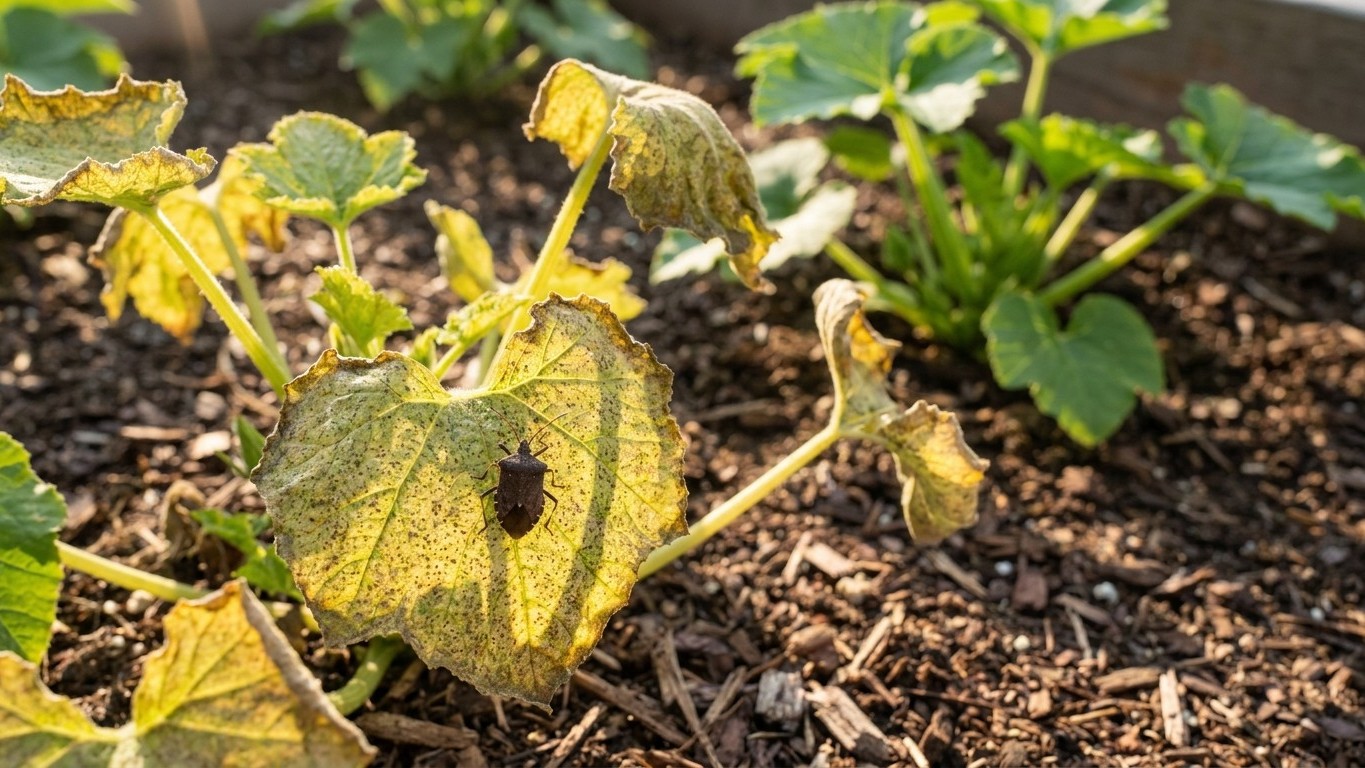
Adult squash bugs measure about five-eighths of an inch, flattened, and grayish-brown with faint orange or yellow striping along the edges of the abdomen. They’re often mistaken for stink bugs at first glance, but squash bugs are more elongated and move faster when disturbed, dropping to the soil or scattering rather than freezing in place.
The Eggs Are the Giveaway
Before you see the bugs themselves, look for the eggs. Squash bug eggs are bronze to copper-colored, oval, and laid in tight, geometric clusters, almost always on the underside of leaves in the V formed by two veins. A single cluster can hold 15 to 40 eggs, and one female may lay several clusters over her lifetime. Checking leaf undersides once a week starting in late spring is the single most effective early-warning habit a Texas gardener can build.
Nymphs hatch pale green to gray, cluster tightly together, and darken as they molt through five stages before reaching adulthood. Groups of nymphs feeding side by side on a single leaf are a strong sign that a cluster hatched recently and that action now will prevent a much bigger problem in two weeks.
The Damage: Wilt, Yellowing, and a Bacterial Disease
Both nymphs and adults feed by piercing leaves and stems with needle-like mouthparts, injecting saliva that breaks down plant tissue and then sucking out the resulting fluid. The visible result is a mottled, yellow-speckled leaf that eventually turns brown and crisp, a symptom growers often call “anasa wilt.” Unlike drought stress, this wilting doesn’t recover overnight watering.
Research from Texas A&M has also linked squash bug feeding to the spread of cucurbit yellow vine disease, caused by the bacterium Serratia marcescens. Squash bugs can carry and transmit the bacteria while feeding, and infected plants show sudden vine collapse even when soil moisture looks adequate. This disease connection is a big reason Texas extension programs treat squash bug management as disease prevention, not just insect control.
Young plants are the most vulnerable. A heavy nymph infestation on a seedling can kill it within days, while established, mature vines can often tolerate moderate feeding without total collapse, at least for a while.
What Actually Stops Squash Bugs in Texas Gardens
No single method eliminates squash bugs completely once they’ve established. Effective control in Texas combines timing, sanitation, and targeted intervention, layered together rather than relying on one tactic.
Cultural Practices That Reduce Pressure
Removing garden debris, old vines, and mulch piles in fall eliminates overwintering sites, which directly reduces spring populations, since these bugs don’t travel far to find new host plants. Crop rotation helps too: moving cucurbits to a different bed each year, even 20 or 30 feet away, forces overwintering adults to search harder before finding a host.
Planting timing also matters more in Texas than in cooler states. Getting squash in the ground early, before the first major generation peaks in May or June, lets plants establish a strong root system before bug pressure builds. Some Texas growers also stagger plantings two to three weeks apart, accepting some loss on the first planting while the second escapes peak pressure.
Certain varieties show more tolerance. Butternut and other vining winter squash tend to hold up better than yellow squash and zucchini, which are consistently among the most heavily attacked cucurbits in Texas trial data. Planting a small “trap crop” of a highly attractive variety like blue hubbard squash a short distance from the main planting can also pull bugs away from the crop you actually want to harvest.
Mechanical Control: Hand-Picking and Trap Boards
Checking leaf undersides weekly and scraping off egg clusters with a fingernail or piece of tape remains one of the most reliable, zero-cost methods available. Crushing clusters directly on the leaf works too, as long as you’re thorough, since even a few surviving eggs can restart an infestation.
A classic trick still recommended by extension offices: lay a flat board or piece of cardboard on the ground near squash plants in the evening. Adult squash bugs seek shelter overnight and will cluster underneath. Flip the board each morning and drop the bugs into soapy water. It’s low-tech, but it works especially well in home gardens where plant counts are manageable.
Biological and Natural Predators
A tachinid fly, Trichopoda pennipes, parasitizes adult squash bugs by laying a single white egg on the bug’s body. The larva burrows in and eventually kills its host. Gardeners sometimes notice this fly’s egg (a tiny white dot near the bug’s head or thorax) and mistake it for damage, but it’s actually a sign of natural biological control working in your favor. Avoiding broad-spectrum insecticide sprays helps preserve these parasitoids along with other beneficial insects like spiders and predatory stink bugs that also feed on squash bug eggs and nymphs.
When Chemical Treatment Makes Sense
Insecticidal soap and neem oil can knock back young nymphs when sprayed directly on contact, but they have little effect on hardened adults and no residual action, so timing sprays for early morning or evening, when bugs are less active and more exposed, improves results. Spinosad-based products offer another option with lower toxicity to bees when applied to foliage rather than open blooms.
For heavier infestations, pyrethroid insecticides labeled for cucurbits provide faster knockdown, but they’re non-selective and will also kill the beneficial insects mentioned above. Texas extension guidance generally recommends reserving these for situations where nymph populations have already overwhelmed hand-removal efforts, and applying in the evening to reduce harm to pollinators visiting squash blossoms during the day.
None of these controls work in isolation as well as they do combined. A Texas garden that rotates crops, clears fall debris, checks leaves weekly for egg clusters, and reserves sprays for genuine outbreaks will consistently see less damage than one relying on a single method, no matter how aggressive that method is.