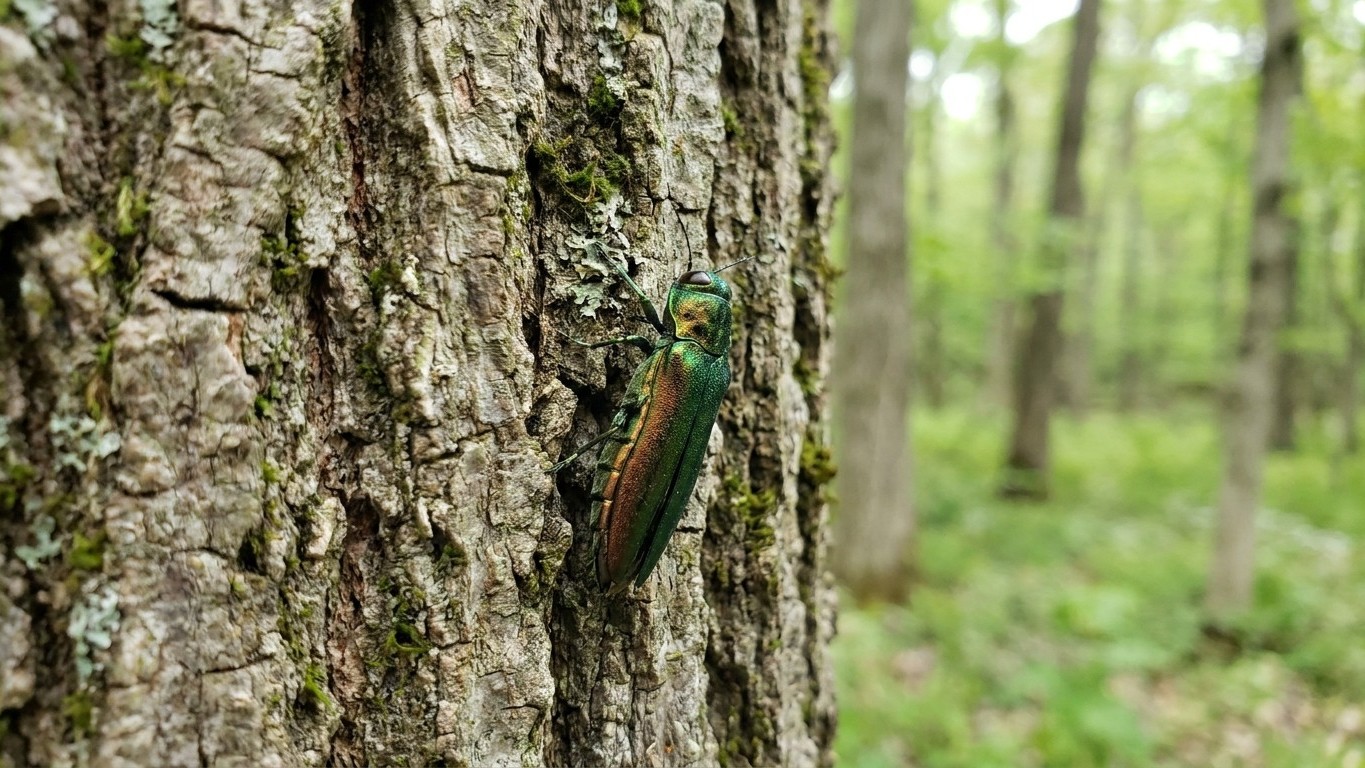

As of the most recent monitoring updates from provincial and federal forestry officials, emerald ash borer has not been confirmed as an established population on Prince Edward Island. That’s the good news. The less comforting part: the beetle is already established less than 200 miles away in parts of Nova Scotia and New Brunswick, and the Northumberland Strait won’t stop it if someone tosses a load of infested firewood on a ferry or in the back of a truck heading over the Confederation Bridge.
PEI sits in an unusual position. It’s one of the last corners of Atlantic Canada where ash trees still stand mostly untouched by this beetle, but it’s also downwind, so to speak, of every campground, cottage, and backyard woodpile within driving distance of a confirmed infestation zone. Understanding how the insect actually spreads, and what stops it, matters more here than in places where the damage is already done.
Where Emerald Ash Borer Stands in Atlantic Canada

Emerald ash borer arrived in North America from Asia in the early 2000s, first detected in Michigan in 2002 before hitchhiking, quite literally, across the continent inside firewood, nursery stock, and shipping pallets. Since then it has killed hundreds of millions of ash trees from the Great Lakes to the Atlantic coast. The Canadian Food Inspection Agency regulates its movement through quarantine zones, and those zones now cover parts of Ontario, Quebec, and both Nova Scotia and New Brunswick.
Nova Scotia’s confirmed infestation, first identified in the Halifax area, has expanded over the years to cover a growing chunk of the mainland. New Brunswick has its own confirmed pockets. PEI, connected to the mainland by bridge and by regular ferry traffic, watches these neighboring infestations the way a homeowner watches wildfire smoke on the horizon: not an immediate threat, but not something to ignore either.
Provincial forestry staff and the CFIA run detection surveys on the island, including purple prism traps hung in ash trees along roadsides and in wooded areas, designed to catch adult beetles during their summer flight period. No confirmed island population has turned up through that monitoring so far. That status can change with a single infested log.
Why the Island Isn’t as Protected as It Looks
Adult emerald ash borer beetles are weak fliers on their own. Left to natural dispersal, a population might creep outward half a mile to a mile a year. At that pace, water crossings like the Northumberland Strait would function as a real barrier for decades.
Human transport erases that math entirely. Firewood is the single biggest reason this insect has jumped hundreds of miles in a season instead of crawling a few hundred yards. Larvae live under the bark, invisible from the outside, riding along in split logs that look completely normal. A camper hauling firewood from a Nova Scotia campground to a PEI provincial park, a cottage owner moving old cordwood between properties, a landscaper transporting ash mulch or chips: any of these can move the insect faster than any natural spread pattern would allow.
This is exactly why “don’t move firewood” campaigns exist across every province and state dealing with this pest, and why PEI’s own biosecurity messaging leans so heavily on that single behavior. It’s the cheapest, most effective control measure available, and it costs nothing beyond buying firewood where you plan to burn it.
Signs an Ash Tree Is Under Attack
Ash trees don’t announce an infestation right away. Larvae feed under the bark for one to two years before adults emerge, which means visible symptoms often show up well after the tree is already compromised. Homeowners with ash trees on their property, and PEI does have a notable share of green and white ash in its urban and rural tree cover, should know what early damage actually looks like.
- D-shaped exit holes in the bark, roughly the width of a grain of rice, where adult beetles chewed their way out
- Canopy dieback starting at the top of the tree and working downward over one to three years
- Bark splitting vertically, exposing S-shaped larval tunnels called galleries underneath
- Epicormic sprouting, meaning clusters of small shoots growing from the trunk or lower branches as the tree tries to compensate for lost canopy
- Increased woodpecker activity, sometimes called “blonding,” where birds strip patches of bark chasing larvae underneath
Any single symptom on its own could mean something else entirely, drought stress or a different borer species. Two or more of these showing up together on an ash tree, especially the D-shaped holes combined with canopy thinning, is worth reporting rather than waiting out.
What Actually Stops It
There’s no way to eradicate emerald ash borer once it establishes in a region. Every jurisdiction that’s dealt with it, from Michigan to Nova Scotia, has shifted from “prevent arrival” thinking to “slow the spread and protect high-value trees” thinking the moment a population gets confirmed. PEI’s current advantage is that it still has the option to focus almost entirely on prevention.
Firewood Rules and Reporting
Regulated areas under CFIA quarantine restrict moving firewood, ash nursery stock, and ash logs out of infested zones. Practically, this means firewood purchased in a quarantine area in Nova Scotia or New Brunswick shouldn’t be transported across provincial lines, including onto the island. Campgrounds and provincial parks across Atlantic Canada increasingly post signage reminding visitors to buy firewood locally and burn it on site rather than hauling it home or to the next stop on a road trip.
Reporting suspected sightings matters just as much as compliance. Anyone who spots the metallic green beetle itself (about half an inch long, roughly the size of a grain of cooked rice with a jewel-like sheen) or the exit holes and canopy symptoms described above can report it to provincial forestry officials or the CFIA. Early detection on an island this size, with a limited and identifiable ash population, is the difference between a manageable response and losing street trees the way Bedford, Nova Scotia did.
Treatment Options for High-Value Trees
Where the beetle has established, arborists rely on systemic insecticide treatments, most commonly emamectin benzoate injected directly into the trunk, to protect individual high-value ash trees such as mature street trees or specimen trees in a yard. These treatments run on a two- to three-year cycle and work best when applied before infestation takes hold, not after a tree is already declining. They’re not practical or affordable for forest-scale ash populations, which is why municipal and provincial responses in infested areas have generally focused on removing dead and dying ash for safety while treating only a select number of trees worth preserving.
For PEI specifically, this kind of preventive treatment isn’t yet a widespread recommendation, since no established population has been confirmed. Property owners with particularly valuable or sentimental ash trees sometimes start treatment proactively once an infestation is confirmed within a certain radius, a decision best made with a certified arborist familiar with current provincial guidance rather than a blanket rule.
Diversifying new plantings is the other long game. Municipalities that lost large percentages of their street trees to this pest, some Midwestern towns saw ash make up 30 to 40 percent of their urban canopy before the beetle arrived, learned the hard way that planting one species along an entire street creates exactly the kind of monoculture this insect exploits. PEI communities doing new street tree plantings are increasingly mixing species rather than leaning on ash the way older neighborhoods once did, which won’t stop the beetle from arriving but limits how much damage it could do if it ever does.
Anyone with ash trees on the island, whether a handful in a backyard or a windbreak row along a farm field, can check trunks and canopies each summer during the beetle’s flight period, typically June through August, since that’s when adults are active and new exit holes tend to appear. It’s a five-minute walk around the yard that costs nothing and, for now, is the closest thing PEI has to an early warning system of its own.
Related guides
- Emerald ash borer in Nova Scotia: When It Shows Up and What Stops It
- Emerald ash borer in Quebec: When It Shows Up and What Stops It
- Emerald ash borer in Saskatchewan: When It Shows Up and What Stops It
- Seedcorn maggot in Prince Edward Island
- Winter moth in Prince Edward Island
- Striped cucumber beetle in Prince Edward Island
- Emerald ash borer in Michigan: When It Shows Up and What Stops It