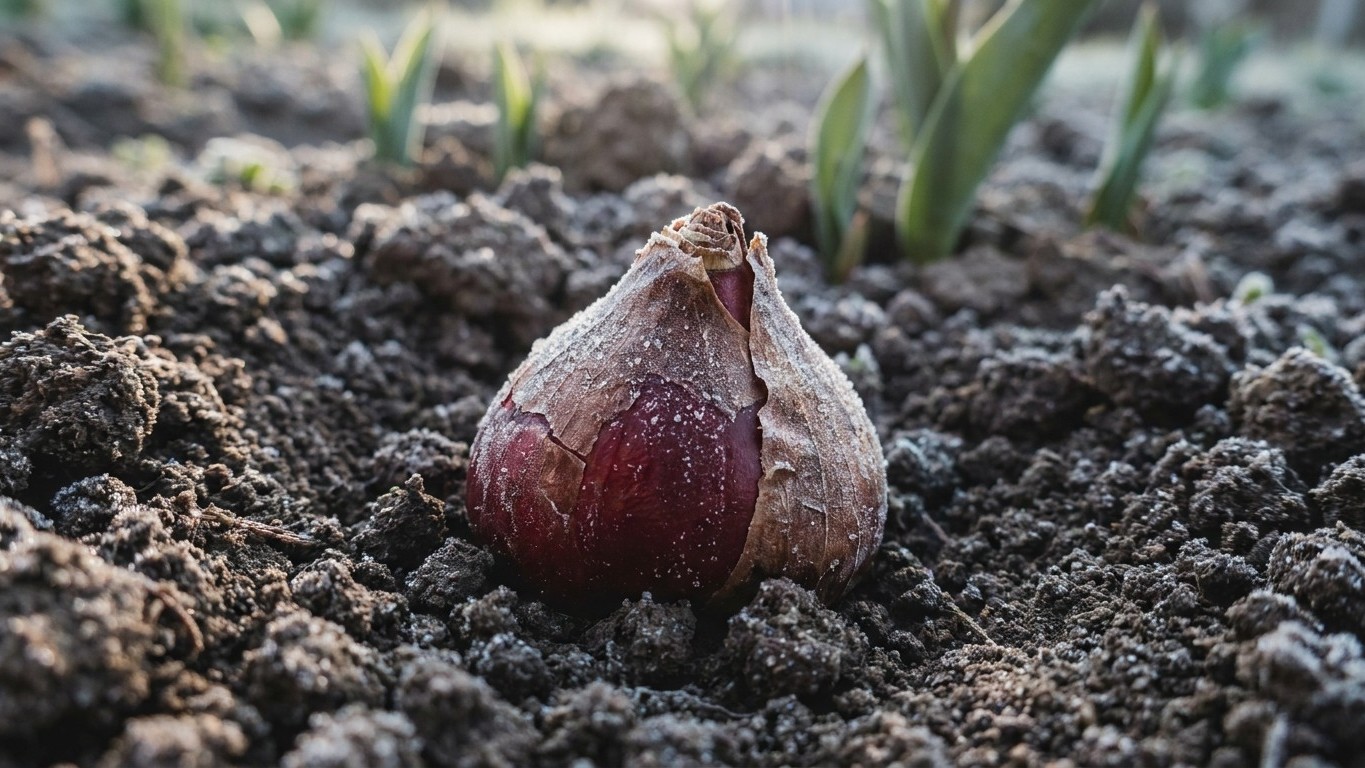

Garlic in Maryland gets eaten at three points: voles, slugs and digging squirrels around planting, allium leafminer and thrips in spring, and mites or soil-borne rot as the bulbs mature and cure. Most of the damage traces back to one decision, when you plant relative to frost. Get the planting window right and the garlic goes into winter with roots but little top growth to attract trouble.
The short answer for Maryland
The first fall freeze in Maryland arrives between October 26 and November 5, according to NOAA NCEI’s 1991-2020 Climate Normals (the band where the chance of a 32°F freeze sits between 30 and 70 percent). That window is the anchor for the garlic pest calendar. Garlic goes in a few weeks ahead of it, spends the winter as roots and a short shoot, and gets lifted the following summer. Every pest below shows up at a predictable stage of that cycle.
Treat that date as a midpoint, not a deadline you can count on. In one year out of two the frost falls later than the figure, and in the other it falls earlier. A gardener who plants “at frost” because the calendar says so is gambling on a coin flip, and the rooting time comes out of the garlic’s side of the bet.
Here is how the pest year lines up against that anchor. In fall, planted cloves attract rodents and squirrels that dig, and wet soil favors rot organisms and slugs. Through winter, voles tunnel under thick mulch where it is warm and protected. In spring, adult allium leafminers lay eggs in the leaves, thrips build up as the weather warms, and the damage becomes visible. By early summer, as leaves yellow and the bulbs size up, stem and bulb problems appear, then storage mites and molds during curing.
The frost date moves because it describes a long-run average across a state with mountains, a big bay and an ocean coast. The pest dates move with it, since both depend on how cold the ground and air get and how quickly.
Working it out for your own garden
The arithmetic
Start with the midpoint of NOAA’s band. October 26 to November 5 centers on October 31. A state is not one climate, though, and elevation, the Chesapeake and the Atlantic coast can push your real date about two weeks either way. That puts the plausible range for a given garden at roughly October 17 to November 14.
Next, look up your own county’s figure (the extension service in the last section is the place to start) and see where it sits against October 31. If you garden in a cold pocket and your frost runs two weeks early, your planting window moves up by the same amount. If you are on warm, bay-moderated ground, it moves back. The method for turning a frost date into a planting date is laid out in When to Plant Garlic in Maryland: Counting Back From the First Frost, so this page only needs the pest side of it.
The reason pests belong in this arithmetic is that planting date controls what the pests find. Plant too early and the cloves send up a tall green shoot that the cold bruises and rodents browse. Plant too late and the cloves sit in cold soil with no roots to anchor them, which makes them easy for voles to pull out. A modest shoot and a decent root system by the time the ground freezes is the target.
Where each pest falls on the calendar
| Pest or problem | When it hits | What you see |
|---|---|---|
| Squirrels and other diggers | Right after planting, fall | Disturbed soil, cloves lying on the surface |
| Voles | Winter, under mulch | Missing cloves, small runways and holes |
| Slugs | Fall and wet spring | Ragged leaves, slime trails |
| Allium leafminer | Spring, with a smaller fall flight reported in the Mid-Atlantic | Rows of small white punctures on leaves, then tunnels and larvae in the leaf bases |
| Thrips | Late spring into early summer | Silvery streaks on leaves, stunted plants |
| Bulb and stem nematodes, bulb mites | Soil and seed stock, visible in spring and at harvest | Twisted, swollen or yellowing leaves, soft or spongy bulbs |
The table gives the pattern, not exact dates. Specific emergence dates for leafminers and thrips are not published here, and they shift from year to year with spring temperatures, so scout your own bed rather than waiting for a date.
What changes across Maryland
Western Maryland, meaning Garrett and Allegany counties, is mountainous, and its calendar runs weeks away from the central figure. Elevation brings cold sooner, so the planting window there closes ahead of the rest of the state. Garlic that goes in late is the garlic that never roots, and in the mountains that is the version that heaves out of the ground or gets dug up by voles. Gardeners here also deal with the longest snow cover, which is exactly the blanket voles like.
The central part of the state, the Piedmont corridor through Frederick, Carroll and Baltimore counties, sits close to the NOAA band. Heavy clay is the usual complaint here. Slugs and rot like it wet, and a bed that stays soggy through a rainy spring gives bulb problems an easy start.
Southern Maryland and the Eastern Shore run milder because of the Chesapeake Bay and the Atlantic. Frost arrives later, the fall stays soft longer, and slugs and soil pests stay active well into the season. Early planting is a bigger risk on this side of the state, because a warm October pushes cloves to sprout before winter.
A comparison with the north helps. Massachusetts gardeners work from an earlier frost, and their pest calendar is compressed accordingly. The same logic, count back from the frost, is spelled out in When to Plant Garlic in Massachusetts: Counting Back From the First Frost, and the cold-hardy choices in Garlic Varieties That Suit Massachusetts Winters are worth a glance if you garden in the Maryland mountains. For the rest of the state, Growing Garlic in Maryland covers the whole season.
The mistakes this climate punishes
Maryland’s trouble is that it sits between mild and cold. A mistake that is harmless in one part of the state can cost the crop in another, and the pests exploit each one.
Planting too early is the common one in the central and southern parts. October warmth wakes the clove, the green shoot gets tall, and that soft tissue is what rodents browse and what a hard freeze burns. Wait for the soil to cool and aim to root, not to grow.
Planting too late is the mountain mistake. A clove that has not rooted before the ground freezes has nothing holding it down. Frost heave pushes it up, and whatever is left is easy pickings for voles. If a hard freeze beats you to it, mulch and accept a smaller crop rather than skipping the bed altogether.
Planting the wrong type for the area matters too. Hardneck garlic wants a real winter, which suits the western counties, while the milder Southern Maryland and Eastern Shore winters can leave it underperforming. The choices are sorted in Garlic Varieties That Suit Maryland Winters.
The less visible errors involve the soil and the seed stock. Replanting garlic, onions or leeks into the same bed year after year lets nematodes and rot organisms build up, and once they are in the ground they stay for a long time. Rotate the bed. Buy certified seed garlic rather than grocery-store bulbs of unknown origin, because infested seed stock is how nematodes move from one garden to the next.
A thick, fluffy mulch is also a mistake in vole country. It insulates the cloves, but it also makes a comfortable winter home for rodents and keeps the soil damp enough for slugs. Use a clean, modest layer and pull it back a bit in spring so the bed dries.
Finally, Maryland’s humid summers punish sloppy curing. Garlic lifted in early summer and left in a damp spot invites mold and mites in storage. Cure it in a dry, airy place and check the bulbs for soft spots before you store them.
Checking this against your county
County-level frost and pest guidance comes from University of Maryland Extension, which has local offices and publishes advice on allium pests and diseases. Ask your county office what the local frost date looks like, and whether allium leafminer has been confirmed nearby. Both answers change how you plant.
Common questions
Which pest should I watch for first?
Rodents and slugs come first, right after planting. Allium leafminer and thrips follow in spring, when the leaves are up and the weather warms. Soil-borne problems may not show until the plants are well along.
Do deer and rabbits eat garlic?
Garlic is not a favorite of either, and the strong smell tends to put them off. Voles and squirrels are the animals that do the real damage, mostly to the cloves.
Can I replant bulbs from plants with twisted, swollen leaves?
No. Those symptoms can point to nematodes, which travel in the bulbs themselves. Discard the affected plants rather than composting them, and keep garlic and its relatives out of that bed for a long while.
Does planting date change pest pressure?
Yes. Planted too early, garlic carries tall tops into winter. Planted too late, it lacks roots. Either way the plants are easier for pests and cold to damage, so aim to plant just ahead of your local frost date and remember that the date is a midpoint, not a guarantee.