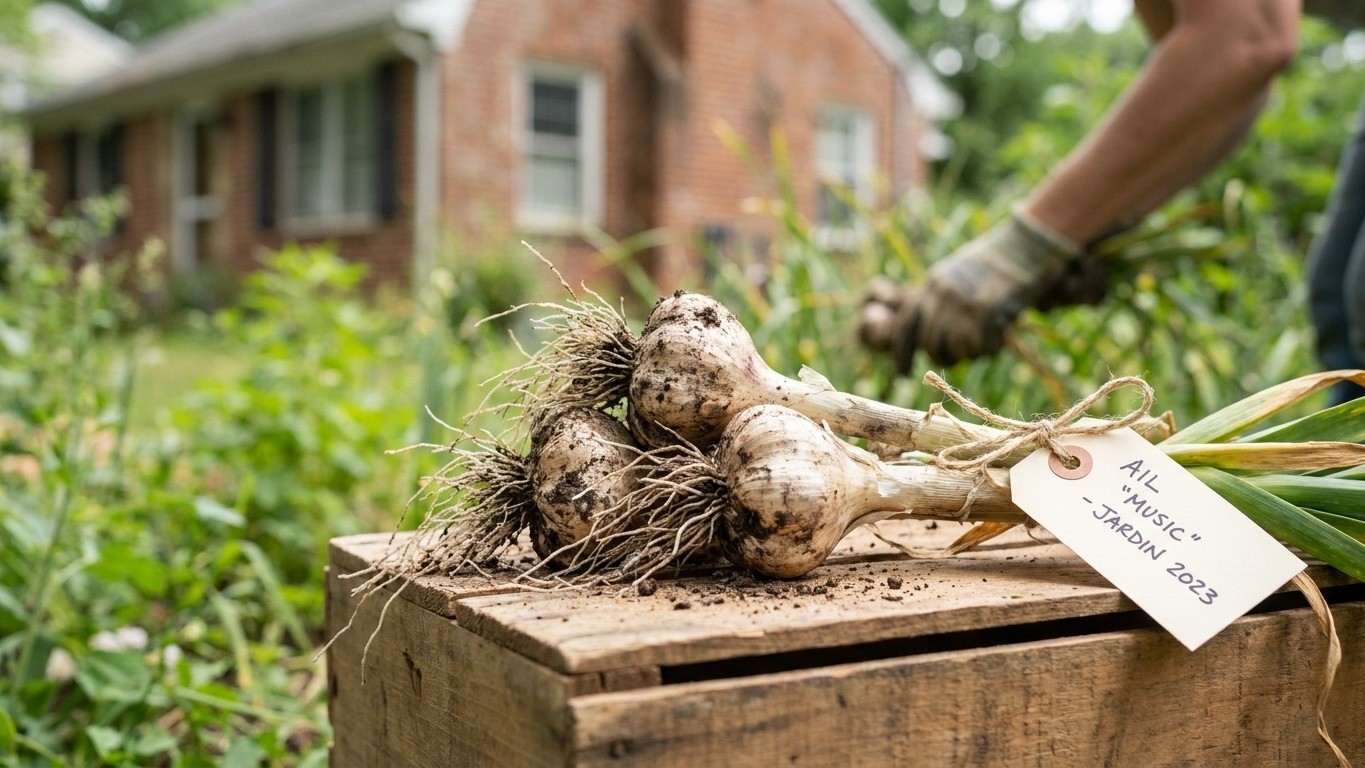

Maryland’s winter, away from the Bay’s immediate edge, gives hardneck garlic exactly what the textbooks demand: six to eight weeks below 40°F, the stretch that splits a clove into a proper head instead of leaving it a single round bulb. The Piedmont and points west clear that mark without effort most years. It’s really only the tidal fringe near the water where an unusually mild season pushes a grower closer to the margin, and even there, true failure to chill stays rare.
Will garlic get the cold it needs in Maryland

Garlic clove division depends on a real stretch of cold after planting. A clove that never gets enough chill simply grows into a single round bulb the following summer, not a head split into cloves. That’s the failure nobody warns beginners about, and it can happen even when everything else about the crop goes right, which is why choosing the right Garlic Varieties That Suit Maryland Winters matters as much as timing the chill itself.
The chilling threshold hardneck garlic needs
University of Georgia Extension bulletin C854 sets the benchmark at six to eight weeks with temperatures below 40°F before a hardneck clove reliably divides. Maryland, away from the immediate edge of the Chesapeake Bay, is a Mid-Atlantic state with a real winter attached, and most of it clears that threshold without much drama in an ordinary year. Central Maryland and the Piedmont see repeated stretches of sub-40°F weather from December into February. Western Maryland’s higher elevation around Garrett and Allegany counties brings that cold in earlier and holds it longer, so chilling there is rarely in question. The Eastern Shore and the immediate tidal edge near Baltimore run milder, and in an unusually warm winter a grower right on the water sits closer to the margin, though outright failure to chill is uncommon even there.
Growers farther north, covered in Growing Garlic in Massachusetts: Planting Dates, Varieties and Winter Cold, clear this threshold with room to spare most winters. Maryland’s margin is smaller but still positive across nearly the whole state, which is why hardneck garlic performs here without the workarounds a genuinely mild climate requires.
If your site runs mild
A rowhouse courtyard in Baltimore, a walled garden near the water, or simply a run of unusually warm winters calls for a backup plan rather than skipping garlic altogether. Refrigerate the cloves at standard refrigerator temperature for several weeks before planting to substitute for missing field chill, keeping them away from apples and other ethylene-producing produce that can damage the germ. Or plant a softneck variety instead, since softneck types divide reliably on far less cold than hardneck strains need. Neither option is a downgrade. It just matches the type to the site.
When to put the cloves in
Anchor the planting date on the season’s first fall frost, not on a date circled on a calendar, and consult When to Plant Garlic in Maryland for a full week-by-week breakdown. NOAA’s NCEI 1991-2020 climate normals put that first freeze, measured at Baltimore, at October 26 to November 5. That’s a range describing one reference station in the middle of the state, not a single safe day.
The frost-based window for Baltimore
Garlic wants enough time to grow roots before the soil freezes hard, but not so much time that it pushes tall green top growth that then gets caught by a hard freeze. In practice that means planting roughly two to four weeks ahead of the first frost date above, which lands the window at early to mid October for growers near Baltimore. That’s the window the varieties below are bred and sold around, and it matches what growers across the state actually use.
How elevation and the Bay shift it
Elevation moves the window earlier. Garrett and Allegany counties see their first freeze arrive well ahead of the Baltimore date, so cloves there should go in on the early side of the same general window, not later. The Chesapeake Bay’s moderating effect works the opposite way. The Eastern Shore and the immediate waterfront around Baltimore see frost arrive later than the inland normal, buying those growers a bit more room to plant into late October without rushing.
Don’t try to out-guess the range by fixing on one date inside it. Watch the soil instead. Garlic roots best once soil temperatures have dropped consistently, and a clove planted into still-warm October soil during a mild stretch roots just as well as one planted on a specific calendar day. If the ground is workable and the frost range above is approaching, that’s the signal to plant.
Which types suit Maryland
The hardneck versus softneck choice tracks winter cold more than personal preference. Hardneck garlic needs a real cold season to trigger clove division and to produce the sharper flavor many Mid-Atlantic gardeners prefer, but it stores for only a few months. Softneck garlic tolerates a milder winter, divides on less chill, and keeps far longer in storage, sometimes eight months or more under good conditions.
Hardneck: the default for most of the state
Given that most of Maryland clears the chilling threshold described above, hardneck varieties are the safer default across the Piedmont, western Maryland, and most of central Maryland. Reasonable choices from the catalog include German White, German Red, Duganski, Chesnok Red, Bavarian Purple, Blue Music, Georgian Crystal, and Georgian Fire, along with Fall Festival and Ivan. All of these are set out in the same early October to mid October window discussed above.
Softneck: for mild pockets and long storage
Softneck varieties are worth choosing deliberately, for a warmer microclimate right on the water, for a gardener who wants a braid that keeps well past the following spring, or as insurance in an unusually mild winter. Inchelium Red and Lorz Italian are both reliable softneck picks, alongside Early Red Italian and Italian Late. In warmer states like Growing Garlic in Tennessee: Planting Dates, Varieties and Winter Cold, softneck often carries the whole garden because the winter can’t be counted on for hardneck’s cold requirement. Maryland doesn’t force that trade-off on most growers, so the choice comes down to storage life and taste more than survival.
| Variety | Neck type | Set-out window |
|---|---|---|
| German White | Hardneck | Early to mid October |
| Chesnok Red | Hardneck | Early to mid October |
| Duganski | Hardneck | Early to mid October |
| Inchelium Red | Softneck | Early to mid October |
| Lorz Italian | Softneck | Early to mid October |
Soil and bed preparation
Garlic sits in the same patch of ground for eight to nine months, through every winter rain and thaw, so drainage matters more here than for almost any other crop in the garden. Standing water rots cloves long before white rot or any other disease gets a chance, and the heavy clay soil common across the Piedmont and parts of the coastal plain holds water exactly where a clove needs to breathe.
Work the bed weeks ahead
Loosen the soil to a full spade’s depth and work in a couple of inches of finished compost or well-rotted manure a few weeks before the October planting window, giving it time to settle rather than sitting loose and airy around the cloves. Avoid fresh manure. It carries too much nitrogen too fast, and it can bring in weed seed and pathogens that a garlic bed then hosts all winter.
Where drainage is genuinely poor, a raised bed or a mounded row beats fighting the native soil every winter. Even a few inches of raised soil is enough to shed the standing water that a flat clay bed collects after a winter storm. On the sandier coastal plain soils of southern Maryland and the Eastern Shore, drainage is rarely the problem. There, the bigger job is building organic matter back in, since sandy soil drains fast enough to leach nutrients right along with the water.
A soil test before planting settles the pH and nutrient question instead of guessing, and Maryland’s extension service runs that test county by county, covered further below.
What the climate here favours, and what it does not
UC IPM’s Pest Management Guidelines for Onion and Garlic, UC ANR Publication 3453, publishes the temperature ranges each major garlic disease needs to stay active. Those published thresholds are soil temperatures, and the figures below are monthly mean air temperatures for the Maryland growing season, so this section describes a tendency the climate opens up, not a soil condition actually measured in any one garden.
Where the risk concentrates
White rot, caused by Sclerotium cepivorum, has a published range of 50 to 75°F. Maryland’s growing-season mean air temperature falls inside that range in five separate months, September, October, April, May, and June, including one month at the pathogen’s published optimum. That’s the widest window of any disease on this list, and it overlaps both the fall planting period and the spring growth period. Fusarium basal rot, caused by Fusarium oxysporum f. sp. cepae, has a published range of 59 to 90°F and falls inside it in four months, September, May, June, and July, again including one month at its optimum.
Pink root, caused by Setophoma terrestris, has a narrower published optimum of 75 to 85°F, and Maryland’s growing season crosses into that optimum in July alone, around typical harvest time for many of the varieties above. Southern blight, caused by Sclerotium rolfsii, needs 86 to 95°F to hit its optimum, and no month of the Maryland growing season averages inside that band. That doesn’t make southern blight impossible here. It means the climate itself does less to favor it than it does the other three, and a hot, humid stretch or infected planting stock can still bring it in regardless of the monthly average.
None of this is a forecast for any one garden. A monthly average sitting inside a disease’s range means some days that month reach the right temperature and some don’t, and a single reference station never describes every farm and back lot in the state. Clean, certified seed stock and a well-drained bed do more to keep these diseases out than the weather ever will, since every pathogen on this list travels easily on infected cloves no matter what the thermometer says.
Getting it through the winter
Mulch is what keeps a Maryland winter from doing more damage than the cold itself. Garlic cloves want to sit with their tip a couple of inches under the soil surface, and a shallow-planted clove is exactly what a winter’s freeze-thaw cycle heaves up and out of the ground over a few months. Once a clove’s top is exposed to open air, its roots dry out and the plant’s whole spring is compromised before it starts growing.
When to lay it down and when to pull it back
Lay a heavy layer of clean straw or shredded leaves once the soil has cooled and the ground is heading toward its coldest stretch, not right at planting while the soil is still warm enough to root on its own. The straw’s job is to buffer the freeze-thaw swings that cause heaving, not to keep the ground warm, so timing it to the season’s cold arrival matters more than rushing it on in October.
How thick that layer needs to be tracks the same geography as everything else here. Western Maryland’s colder, longer winter calls for a heavier, more consistent mulch layer that stays put through repeated hard freezes. The Eastern Shore’s milder winter needs less insulation, and piling on too much mulch there risks trapping moisture against the cloves in a climate that already runs damp, inviting rot rather than preventing it.
Pull the mulch back gradually in spring once green shoots start pushing through, rather than stripping it all at once. Leaving it too thick too long shades and cools soil right when the plant needs to warm up and grow, while pulling it entirely too early exposes new growth to a late cold snap.
Harvest and curing here
Garlic planted in fall comes out of the ground the following summer, never in spring, and the calendar tells you far less than the plant itself does. Watch the leaves: garlic is ready to lift when the lower third to half have browned and died back while several upper leaves are still green. Pull too early and the bulb hasn’t finished sizing or formed distinct wrappers around each clove. Pull too late and the wrapper degrades underground, leaving cloves exposed and prone to splitting or rot in storage.
Curing in a humid Mid-Atlantic summer
Curing is where a lot of an otherwise good Maryland garlic crop gets lost, and it happens after the hard part of growing is already done. Maryland’s summer runs humid, and humid air is exactly what a curing bulb doesn’t want. Damp air trapped around a bulb for weeks encourages mold on the wrapper and rot at the neck before the garlic ever gets useable.
Cure in a shaded space with real airflow, a covered porch, an open garage, or a barn with the doors cracked, not a closed basement that holds humidity or a sunny spot that bakes the wrapper and cooks the cloves inside it. Spread bulbs in a single layer, or hang them, rather than piling them where air can’t move between them. Depending on how humid the stretch of weather runs, full curing can take a few weeks, and the wrapper should feel dry and papery, with the neck tight, before bulbs go into long-term storage.
Local help
County-level frost dates, soil test results, and variety performance notes vary enough across Maryland that a state-wide guide can’t replace a local answer. University of Maryland Extension runs soil testing and can help pin down a planting window for a specific county, from the mountains of Garrett County to the tidal edges of the Eastern Shore. That’s the first call to make before finalizing a planting date on marginal ground.
Common questions
Can I Plant Garlic in spring in Maryland instead of fall?
Not with good results. Garlic planted in fall gets the sustained cold it needs to divide into cloves, and a spring-planted clove that skips most of that chilling usually just grows into a single round bulb rather than a full head. If you must plant in spring, refrigerating cloves for several weeks beforehand substitutes for some of that missing field chill, but yields still run well behind a properly fall-planted crop.
What if I miss the early to mid October window?
Plant anyway if the ground is still workable, ideally by late October to give roots a few weeks to establish before a hard freeze locks up the soil. A later planting needs a heavier mulch layer applied promptly, since the clove has less time to root in before winter cold arrives in earnest.
Do I need to cut the scapes off my garlic?
Yes, on hardneck varieties. The scape is the curling flower stalk that hardneck garlic sends up in early summer, and cutting it once it curls redirects the plant’s energy into bulb size instead of that stalk. Softneck varieties rarely produce a scape worth cutting, so this step mostly applies to hardneck types like German White or Chesnok Red.
My garlic came up as one big clove instead of a full head. What happened?
That’s usually a sign the clove didn’t get enough sustained cold before spring growth started, or that a very small clove was planted to begin with. It shows up most often in garlic planted too late for a full chilling period, or in stock sourced from a warmer growing region. Planting within the local window and starting with a proper seed-size clove both reduce it.
Can I plant garlic from the grocery store?
You can, but it carries real risk. Grocery store garlic is often grown in a different climate zone entirely, isn’t bred for regional conditions, and can carry soilborne diseases like white rot or basal rot into a garden bed that then stays contaminated for years. Certified disease-tested seed stock from a garlic supplier costs more up front but avoids introducing a problem that outlasts a single season’s crop.