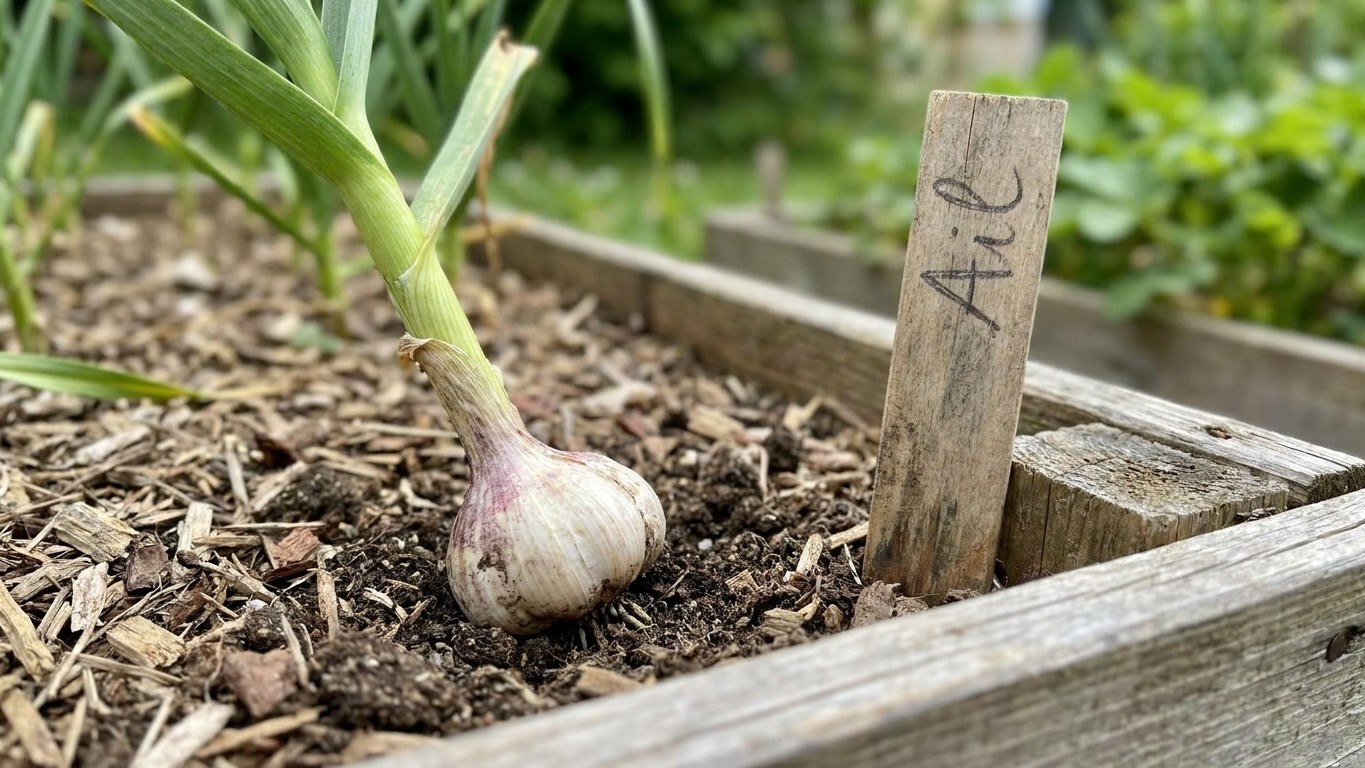

Massachusetts winters satisfy garlic’s cold requirement several times over, which is the whole reason variety choice here comes down to taste and storage life, not survival. Hardneck types like German Red, Duganski, and Chesnok Red thrive without any special treatment, forming fewer, larger cloves that peel easily. Softnecks handle the same cold surplus just as well. So the real question isn’t whether a variety will make it through winter — it’s which flavor and clove size you want on your kitchen counter next summer.
The short answer for Massachusetts

Both hardneck and softneck garlic grow well across the state, because Massachusetts winter cold clears the vernalization requirement several times over. That gap is why a grower here can choose a variety on flavor, clove size, and storage life rather than worrying about whether the winter is cold enough. For the steps that come before variety choice, like site selection and soil prep, see Growing Garlic in Massachusetts.
Hardneck and softneck options
Hardneck varieties that handle this climate without special treatment include German Red, German White, Duganski, Chesnok Red, Georgian Crystal, Georgian Fire, Blue Music, Bavarian Purple, Fall Festival, and Ivan. These form a hard central stem and divide into fewer, larger cloves, which makes for easy peeling.
Softnecks do just as well given the same cold surplus. Inchelium Red, Lorz Italian, Italian Late, and Early Red Italian all size up reliably across Massachusetts. Softnecks form more, smaller cloves in overlapping layers and tend to hold longer in storage than hardnecks do.
Anchor the planting date off Boston’s fall frost window. NOAA’s 1991-2020 climate normals, measured at Logan Airport, put the first fall freeze there between November 3 and November 14. Set cloves in three to four weeks ahead of that window, which lands in the mid-October to late October range every variety named above is suited to.
Working it out for your own garden
NOAA’s 1991-2020 climate normals put Boston’s first fall freeze at Logan Airport between November 3 and November 14, based on thirty years of probability data. That range is a midpoint, not a safe date. In roughly one year out of two, the actual first freeze falls later than this window, so treat it as a planning target rather than a guarantee.
Garlic needs three to four weeks of root growth before the ground freezes solid, enough time to anchor the clove without pushing top growth that an early hard freeze would damage. Counting back three to four weeks from November 3 to November 14 lands you in mid-October to late October, which is why every variety listed above carries that same window. For the full week-by-week breakdown of this countback, see When to Plant Garlic in Massachusetts: Counting Back From the First Frost.
Adjust for your own microclimate
The Boston figure is one station on the water, not a statewide average. A garden a short drive inland, at higher elevation, or away from any large body of water will see its own first freeze arrive on a different schedule, sometimes by a week or two in either direction.
- Higher elevation or inland valleys: expect earlier frost, and plant toward the early edge of the window.
- Immediate coastline or the Islands: expect later frost, and planting can wait toward the back of the window.
- Low-lying frost pockets, including valley bottoms with poor cold-air drainage, freeze earlier than the surrounding land regardless of elevation.
None of this changes how much cold the winter eventually delivers, only when it starts. Since Massachusetts already carries far more cold than garlic requires to divide, a week or two of drift in planting date does not threaten whether the bulb splits. It mostly affects how well roots establish before the ground locks up, which is the reason to lean early rather than late whenever you’re unsure of your own site.
What changes across Massachusetts
The NOAA figure above comes from Logan Airport, a waterfront, urban station and the mildest spot in the state. Inland and upland Massachusetts frosts noticeably earlier in fall and later in spring, which matters for a crop planted in autumn and lifted the following summer.
Where frost runs early or late
The Berkshires, in the western part of the state, sit at higher elevation and see frost arrive earlier than the Boston window suggests, sometimes by two weeks or more depending on the specific valley or ridge. The Connecticut River Valley, running through Franklin and Hampshire counties, runs a touch warmer than the surrounding hill towns because the river moderates the immediate air, but it still frosts well ahead of the coast.
Cape Cod and the Islands, Nantucket and Martha’s Vineyard, sit at the opposite end. Surrounded by ocean water that holds its warmth into fall, they see their first frost run later than almost anywhere else in the state, sometimes weeks behind inland Worcester County.
Eastern Massachusetts, from Boston through the immediate suburbs, tracks closest to the NOAA figure since that’s where the reference station sits. Even ten or twenty miles inland, the difference in frost timing becomes noticeable in a normal year. None of this changes which garlic varieties will grow, since every cultivar named above handles the state’s overall cold. What it changes is the calendar: a Berkshires garden should plant near the early edge of the October window, while a Cape Cod garden has room to plant later without risk.
The mistakes this climate punishes
Massachusetts’ problem is never too little cold. The mistakes that actually cost a crop here come down to timing, depth, and what’s in the seed you plant.
Planting too late
Cloves set in after the ground has begun to lock up don’t get the three to four weeks of root growth they need before frost. A bulb that goes in without roots established heaves out of the soil during winter freeze-thaw cycles and rarely recovers by spring. If you missed the mid-October to late October window and the ground isn’t yet frozen, get cloves in as soon as you can rather than waiting for spring.
Planting too shallow, or skipping mulch
Shallow-planted cloves are the first to heave, since repeated freeze-thaw cycles push anything not deeply anchored right out of the ground. A loose covering of straw or chopped leaves buffers the soil temperature swings that cause heaving, but it has to stay loose. Matted-down mulch traps moisture against the clove and can do more harm than no mulch at all.
Bringing in infected seed stock
Massachusetts air temperatures fall inside the published range for two soilborne garlic diseases for real stretches of the growing season, according to the UC IPM Pest Management Guidelines for Onion and Garlic (UC ANR Publication 3453). White rot, caused by Sclerotium cepivorum, is active between 50 and 75°F, a range Massachusetts air temperature sits inside for five months of the growing season, including one month at the disease’s own optimum. Fusarium basal rot, caused by Fusarium oxysporum f. sp. cepae, has a published range of 59 to 90°F, met here for three months. These are published soil-temperature thresholds compared against air temperature, and a monthly average hides the swing within it: a month averaging 65°F still has days near 50 and days near 80.
| Disease | Published range | Months in range (Sept-July) |
|---|---|---|
| White rot (Sclerotium cepivorum) | 50-75°F | 5, including 1 at optimum |
| Fusarium basal rot (Fusarium oxysporum f. sp. cepae) | 59-90°F | 3 |
Neither pathogen needs the climate to cooperate to take hold. Infected planting stock carries either disease into a garden in any year, cold or mild. Buying certified, disease-free seed garlic, and skipping grocery-store bulbs of unknown origin, does more to prevent both problems than any adjustment to planting date or depth.
Checking this against your county
The frost figures above come from one station, Logan Airport in Boston, and Massachusetts spans coastline, river valleys, and the Berkshire highlands, each running on its own calendar. UMass Extension, the state’s land-grant extension service, publishes county-level guidance on frost timing and site conditions at ag.umass.edu.
Common questions
What happens if I plant my garlic too early, like in September?
Cloves set into still-warm soil can push top growth before winter arrives, and that growth is more exposed to cold damage than a clove that’s only rooting below ground. Wait for the mid-October to late October window rather than planting as soon as bulbs arrive in the mail.
Can I use garlic from the grocery store instead of buying seed garlic?
You can, but it carries more risk of introducing soilborne disease since its growing history and health status are unknown. Grocery store garlic is also sometimes treated to prevent sprouting, which can affect how reliably it roots.
Do I need to mulch garlic every winter in Massachusetts?
Mulch isn’t optional here, since the same freeze-thaw cycles that give the state its long cold season also heave shallow-rooted cloves out of the ground over winter. A loose layer of straw or chopped leaves, kept loose rather than matted, protects against that without smothering the clove underneath.
What if I miss the October planting window entirely?
If the ground still isn’t frozen, get cloves in as late as you can rather than skip the season, since some fall growth is better than none. If the ground has already locked up, hold the bulbs in a cool, dry spot and plant them the following fall instead of trying a spring planting, which misses the extended cold garlic needs to divide properly.