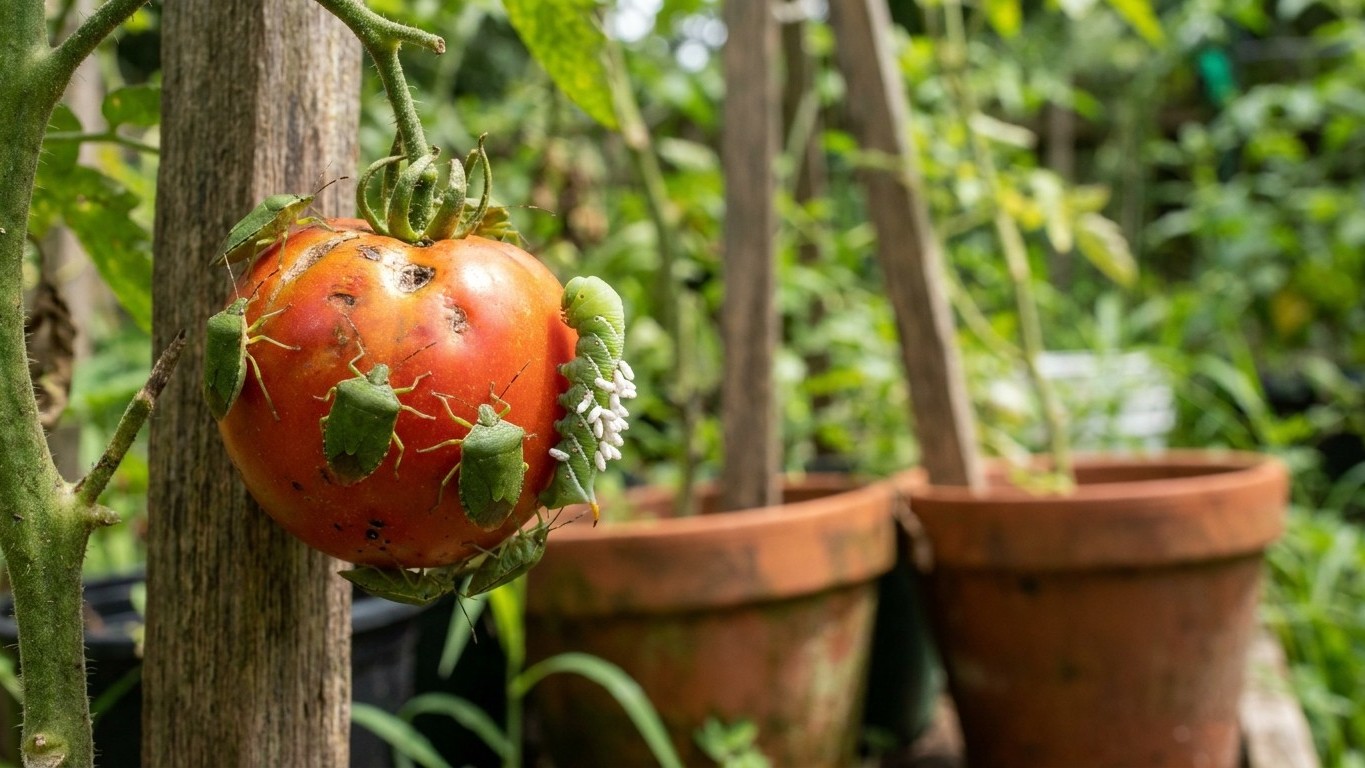

Louisiana’s tomato pests answer to heat and humidity, not frost. NOAA’s NCEI 1991-2020 climate normals put the New Orleans freeze window at January 18 to February 8 in spring and December 17 to January 8 in fall, and roughly one year in seven never freezes at all there, so insect populations rarely get a hard reset. Six pests account for nearly all the reported damage in home tomato patches in this state, showing up in a fairly predictable order as the season warms. Check the undersides of new growth every few days starting the week you set transplants out, since catching any of these six early is what keeps them from getting ahead of you.
What this comes down to in Louisiana

Aphids on the new growth first, then hornworms chewing through the stems, then stink bugs pricking the fruit once trusses set — that’s the order tomato trouble usually runs in a Louisiana garden, keyed more to the plant’s stage than to the calendar month. Six insects cause nearly every complaint gardeners bring in here, and each one arrives on cue with a particular part of the plant’s growth, not at random.
The insects that matter here follow the plant’s own calendar more than the frost’s. Sap feeders move in as soon as transplants take hold in warming soil, chewing caterpillars build through the vegetative stage, and the insects that damage fruit directly show up once the first trusses start to set. Six species account for nearly all the damage reported in home tomato patches in this state, listed below in roughly the order they appear.
Aphids

Aphids are usually the first pest of the season, clustering on the undersides of the youngest leaves and along tender stem tips as soon as transplants start putting on new growth. They’re soft-bodied and pear-shaped, pale green to yellow-green, rarely bigger than a pinhead, and colonies multiply fast because most of them are wingless females giving live birth without mating. Damage shows up as curled, yellowing new growth and a sticky honeydew coating that draws ants and grows sooty mold on the leaf surface below. A hard jet of water or a soap spray knocks back a light infestation, and pruning out a few heavily colonized stems is often cheaper than spraying the whole plant.
Tomato Hornworm

Hornworms turn up as plants move into their main vegetative growth, usually a few weeks after aphids. The damage is what you notice first: whole leaves and stem tips stripped down to bare stalks almost overnight, along with dark, pellet-shaped droppings on the leaves below. The caterpillar itself, up to four inches long with pale diagonal stripes and a curved horn at the rear, is surprisingly hard to spot against the foliage it matches so well. Hand-picking at dusk or dawn works on a home-garden scale, and Bacillus thuringiensis (Bt) sprays control young larvae without harming the parasitic wasps that naturally keep hornworm numbers down later in the season.
Leaf-footed Bug

This one arrives once fruit starts to set, and it’s one of the most reliably damaging pests on tomato in the Gulf South. Adults are brownish-gray, about three-quarters of an inch to an inch long, with a flattened, leaf-shaped widening on the hind legs that gives the insect its name. Young nymphs are smaller and bright orange to red, often found clustered together on stems and green fruit. Both stages feed by piercing the fruit and drawing sap, leaving pale, cloudy spots under the skin that show up clearly once the fruit ripens. Controlling this pest means scouting for and removing egg strings and nymph clusters before they scatter, since adults are mobile and hard to catch once established.
Stink Bug

Stink bugs overlap with leaf-footed bugs on the fruiting plant but tend to peak a little later, in the hottest part of the season. The common form here is bright green and shield-shaped, about five-eighths of an inch long, with the flat-backed pentagon outline that gives the family its name. Like leaf-footed bugs, they feed on developing fruit rather than leaves, and the damage looks similar: pale, hard, strawy patches under the skin at the feeding site. Both adults and nymphs cause this damage, and both are strong fliers as adults, which makes late-season control mostly about removing nearby weedy harborage rather than spraying the tomato bed itself.
Spider Mites

Spider mites show up in the driest, hottest stretch of the season, which in this climate can run for months. They’re barely visible without a hand lens, pale yellow-green with two dark spots, and they build colonies on leaf undersides that eventually show as fine, silvery webbing. Damage starts as a stippled, dusty-looking yellowing on the upper leaf surface and can defoliate a plant quickly once populations explode, since a single mite can go from egg to egg-laying adult in about a week under hot conditions. A strong water spray or insecticidal soap applied to leaf undersides is usually enough if caught early, but broad-spectrum insecticides used for other pests tend to make mite outbreaks worse by killing off their natural predators.
Whiteflies

Whiteflies are a late-season, hot-weather pest here, tiny and moth-like, pure white, and rarely more than a sixteenth of an inch long. They cluster on the undersides of leaves and rise in a small white cloud the moment a branch is disturbed, which is the easiest way to confirm you have them rather than aphids. Like aphids, they feed on sap and leave sticky honeydew behind, and heavy infestations weaken plants and can spread viral disease between them. Yellow sticky traps placed near the plants give an early warning, and insecticidal soap or horticultural oil applied directly to the leaf undersides is the standard home-garden response.
Working it out for your own garden
Diagnosing which of these six you’re actually dealing with comes down to two questions: what part of the plant is damaged, and what time in the season it is. A pest hitting new leaf growth in the first few weeks after transplanting is almost always aphids. Stripped stems and dark droppings mid-season point to hornworms. Damage on the fruit itself, once trusses have set, narrows things down to leaf-footed bugs or stink bugs, and the two are easiest to tell apart by looking closely at the legs, since only the leaf-footed bug has that flattened, leaf-shaped hind leg. Stippled, dusty leaves in the hottest, driest weeks point to spider mites, while a small white cloud rising off disturbed foliage in late summer is whiteflies.
A simple field check
Before reaching for any spray, do a five-minute check: shake a branch over a sheet of white paper and look for what falls off, turn over a handful of leaves near the growing tip, and look at any fruit showing pale or sunken spots under a hand lens. The insect you find, not the damage alone, should decide the response, since several of these pests produce similar-looking symptoms on the fruit or leaves.
| Pest | Typical timing | Plant part hit | Fastest tell |
|---|---|---|---|
| Aphids | Early spring, new transplants | New leaves, stem tips | Sticky honeydew, curled growth |
| Tomato hornworm | Mid-season, vegetative growth | Leaves, stems | Stripped stems, dark droppings |
| Leaf-footed bug | Once fruit sets | Green and ripening fruit | Flattened hind leg on adults |
| Stink bug | Peak summer heat | Fruit | Shield-shaped green body |
| Spider mites | Hottest, driest weeks | Leaves | Fine webbing, stippled leaves |
| Whiteflies | Late summer heat | Leaf undersides | White cloud when disturbed |
What changes across the state
Louisiana is not one climate, and pest pressure shifts with it. USDA’s 2023 Plant Hardiness Zone Map places the state anywhere from zone 8a in the north down to zone 10a near the coast, with New Orleans toward the warm end of that range. The practical effect is that a hard freeze reaches the northern parishes more reliably and knocks back overwintering aphid and mite populations there, while the coastal south goes into spring with pests that never really stopped.
Humidity matters almost as much as temperature. Areas close to the Gulf and the big lakes stay more humid through summer, which tends to suppress spider mites, a pest that thrives on dry heat, but does nothing to slow leaf-footed bugs or stink bugs, both of which breed in the weedy, humid margins common to south Louisiana farmland and garden edges alike. Drier inland pockets, by contrast, see worse mite outbreaks in a hot summer but somewhat lighter fruit-feeding bug pressure.
Elevation barely factors into it, since most of the state sits low and flat, but proximity to wooded or fallow land does. A garden backed by a woodlot or an unmowed field will carry heavier stink bug and leaf-footed bug pressure than one boxed in by lawn or pavement, because those insects overwinter and breed in exactly that kind of cover before moving onto fruiting tomatoes.
The mistakes this state punishes

The biggest mistake here is treating this like a place with a normal, short pest season. Because a hard freeze is not guaranteed, gardeners who spray once in spring and assume they’re done get caught by a second or third wave of aphids or whiteflies building through a long, mild fall. Scouting needs to continue through the whole growing season, not just the first month after transplanting.
The second mistake is reaching for a broad-spectrum insecticide the moment any bug shows up. Spraying early and often for aphids or hornworms wipes out the lady beetles, lacewings and parasitic wasps that would otherwise keep those same pests in check, and it tends to make spider mite outbreaks worse rather than better, since mites bounce back faster than their predators do. Spot-treating or hand-picking the specific pest found on the specific plant is nearly always the better call in this climate.
The third is ignoring variety choice as a pest-management tool. Some of the cultivars suited to Louisiana’s long, hot season, covered in more depth on Tomato Varieties That Ripen in Time in Louisiana, carry resistance to viral diseases that aphids and whiteflies spread, which cuts down the consequences of an infestation even when it isn’t fully prevented. Pairing a resistant variety with correct transplant timing, worked out in detail on Tomato Planting Dates in Louisiana: Counting Back From Your Frost Window, gives plants a head start before pest pressure builds with the summer heat.
Checking this against your county
The New Orleans figures used here are a starting point, not an instruction for every parish. Pest arrival dates shift by weeks depending on how far you are from the coast, how much cover surrounds your garden, and how the current season is running. The LSU AgCenter is the state’s land-grant extension service, and its county offices track current pest reports and can confirm what’s actually active in your area before you decide on a treatment.
Common questions
Why do my tomatoes keep getting bugs even in fall?
Because south Louisiana’s mild winters mean pest populations often never fully die back, especially in years without a hard freeze. Fall crops need the same scouting routine as spring transplants, not less.
Is it worth spraying preventively before I even see a pest?
No, not as a routine practice. Preventive broad-spectrum spraying kills the beneficial insects that would otherwise control aphids and mites for you, and most of the pests covered here are far easier to manage if you catch them at low numbers through regular scouting instead.
What’s the difference between a leaf-footed bug and a stink bug on my tomatoes?
Look at the hind legs and body shape. The leaf-footed bug is longer and narrower with a distinctive flattened, leaf-shaped widening on its back legs, while the stink bug is shield-shaped with a flat, pentagon-like back and no leg flare.
Do ladybugs actually help with aphids in a home garden?
Yes, both adult lady beetles and their larvae eat aphids in large numbers, and they’re one of the main reasons a light aphid infestation often clears up on its own within a couple of weeks if left unsprayed. Avoiding insecticide use on lightly infested plants gives these predators time to arrive and establish.