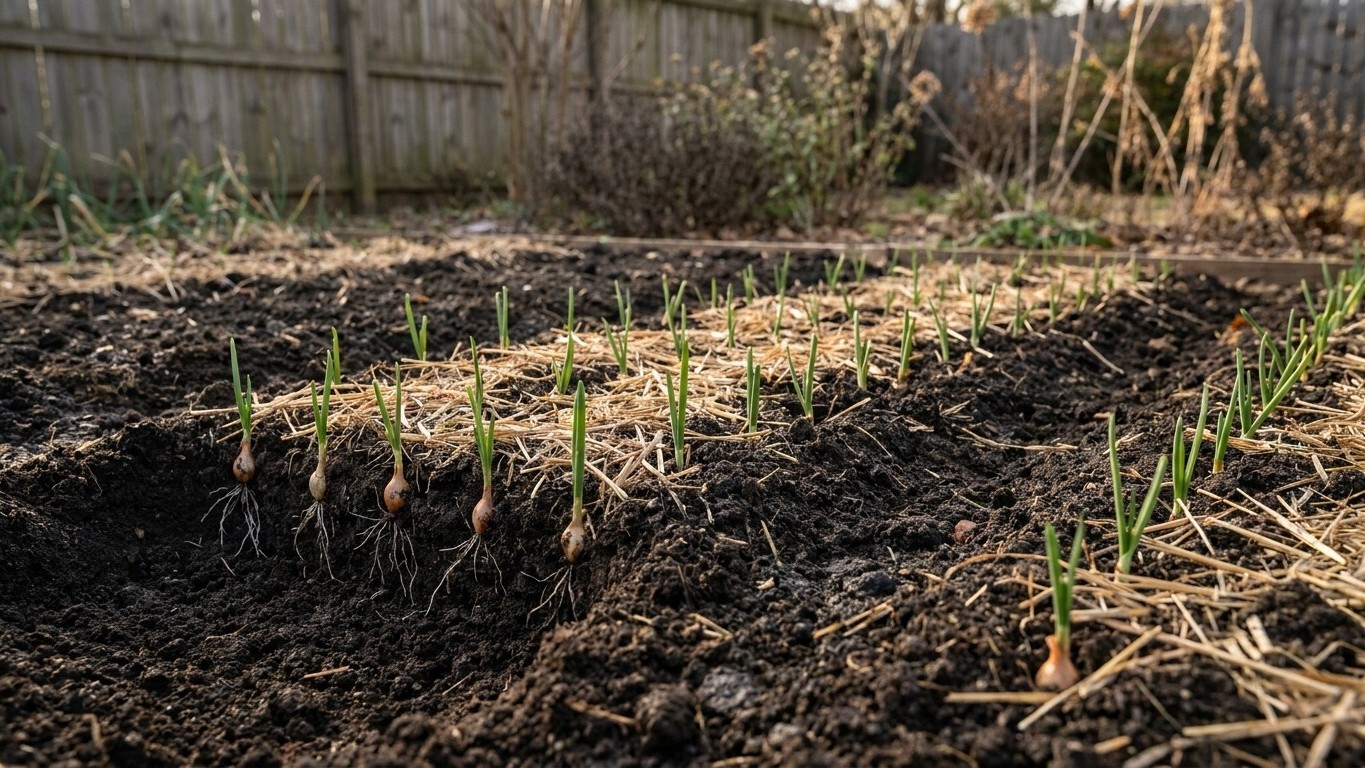

Garlic in New Brunswick gets eaten from three directions. Onion maggots and leek moth caterpillars chew in during spring and summer, wireworms and nematodes work underground, and voles raid cloves over winter. The damage mostly shows up the season after planting, but the choices that limit it are made in autumn, when the cloves go into the ground. That autumn timing comes with a number attached.
The short answer for New Brunswick
The autumn anchor is the first fall frost, which arrives on average October 2 at Moncton, according to Environment and Climate Change Canada’s Canadian Climate Normals for 1981-2010. That is a midpoint, not a safe date: in one year out of two, the frost falls later than October 2.
Why does a frost date belong in a pest article? Garlic here is planted in autumn and lifted the following summer, so it spends roughly nine months in the ground. Each pest strikes at a different point in that stretch, and planting date decides whether the crop meets them as a rooted, dormant clove or as a soft, early shoot. The frost date is where the calendar starts. The pest dates hang off it.
Here is the sequence a New Brunswick grower can expect, in the order the crop meets each threat:
- Voles and mice: late autumn through winter, once mulch is down and the cloves are buried and easy to find.
- Wireworms: in the soil from planting onward, tunneling into cloves and roots, worst in beds that were recently sod.
- Leek moth: caterpillars mine the leaves in spring, then bore toward the center of the plant, with a later generation possible in summer.
- Onion maggot: small white larvae feed at the base and in the bulb after the flies lay eggs near the plants in spring.
- Bulb and stem nematodes: they arrive in infested seed garlic, and the symptoms (twisted, yellowing growth and soft bulbs) appear as the plants grow in spring.
One limit on all this. Spring emergence dates for these insects depend on how fast the soil warms, and no verified emergence dates for New Brunswick are published here. The frost figure comes from a single station, Moncton, and northern or upland districts run weeks behind it. The 1981-2010 normals are also a different period from the 1991-2020 figures used for US states elsewhere on this site, so do not compare them one for one.
Working it out for your own garden
Start with the Moncton midpoint of October 2 and move it for your site. Elevation, a large body of water and the coast can each shift the date by two weeks in either direction. Do the subtraction and addition yourself: October 2 minus 14 days is September 18, and October 2 plus 14 days is October 16. A garden somewhere in that span is normal, and a few sites will fall outside it.
Next, replace the average with your own record. Neighbors who have grown anything tender, a farm stand, or the nearest Environment Canada station will tell you more than a province-wide number. If your low-lying lot is the first on the road to lose its tomato plants, your effective date sits at the early end. If you live on a bay or near the Fundy shore, it probably sits later.
Third, remember that the frost date is only the midpoint of a window. Half of all years bring frost after it, so a plan built to land exactly on October 2 will be wrong about half the time. Build in slack, and put the cloves in early enough that roots can form before the ground freezes. The When to Plant Garlic in New Brunswick: Counting Back From the First Frost page does that backward count in detail. The pest part comes from the same count, because a clove planted too early sends up top growth that a hard freeze can hurt. Damaged tissue is an easy entry for rot and for early-spring insects.
Then lay out the pest year on the same calendar. Autumn is for rodent control and clean seed. Winter is mostly a waiting period under snow. In spring, when green shoots show, the row cover goes on before the first flies and moths are active. After harvest the following summer, the bed gets cleared of leaves, culls and trimmings so overwintering moth pupae and maggot pupae have nothing to shelter in. Then comes rotation: keep onions, leeks, shallots and garlic out of the same ground for several seasons, since nematodes can linger in soil.
The normals are a 30-year average that ended in 2010. Recent autumns may differ from them, so a few years of your own written notes will beat any published figure.
What changes across New Brunswick
The province is small on a map but covers several climates. Moncton sits in the southeast, a fairly sheltered corner. Moving away from it in any direction changes the planting date, and the pest timeline shifts along with it.
| District | How the frost date compares with Moncton | Cause | What it means for pests |
|---|---|---|---|
| Moncton and the southeast | Reference point: October 2 on average | Station used in the normals | Baseline for all the timing in this article |
| Bay of Fundy coast (Saint John, St. Andrews) | Tends to run later | The cold water of the bay moderates air temperature and brings fog | Longer fall for roots, but damp conditions favor slugs and rot |
| Saint John River valley (Fredericton, Woodstock) | Variable: later on warm slopes, earlier where cold air pools on low ground | Valley topography and drainage | Frost pockets can catch early shoots; check your own low spots |
| Northern New Brunswick (Campbellton, Edmundston, Restigouche) | Runs weeks behind the Moncton figure | Latitude and interior upland terrain | Shorter fall and a later spring thaw, so insects tend to start later too |
| Northwestern and central highlands | Earlier frost, with snow cover that arrives sooner | Elevation | Plant earlier within the window and mulch against hard freezes |
The table describes tendencies, not measured dates, since only the Moncton figure is published here. Think of the Fundy coast as the mild end, the northern interior and highlands as the cold end, and the river valley as a patchwork.
Neighboring Atlantic provinces differ again. Garlic on the island of Newfoundland lives under a cooler, windier maritime climate, and the When to Plant Garlic in Newfoundland and Labrador: Counting Back From the First Frost page works through that comparison. For the general picture across New Brunswick, see Growing Garlic in New Brunswick.
The mistakes this climate punishes
The first is planting too early in a warm September. In a long, mild fall, cloves can push green shoots up before winter. A hard freeze then burns them, and the weakened plant starts spring behind and is easier for insects to damage. A drift of snow is the best blanket for garlic, and early shoots mean the clove is awake when it should be asleep.
The opposite error is just as costly: planting so late that roots never form. In the northern districts, where the frost date runs weeks behind Moncton’s, the ground can lock up before a clove has anchored itself. An unrooted clove heaves out of the soil in a freeze-thaw cycle, and wireworms and voles find it easily.
Mulch is the third trap. Straw laid on warm, unfrozen soil is a cozy winter home for voles and mice, and a buried clove smells like food. Wait until the ground has begun to freeze before mulching, and keep the layer to a modest depth rather than a thick blanket. If rodents have been a problem in the past, a hardware cloth barrier or traps near the bed are worth the effort.
Fourth, planting garlic straight into former sod or lawn invites wireworms, the larvae of click beetles, which live in grassy ground for years. A bed worked and cropped for a season or two beforehand carries a much lower risk.
Fifth, using seed garlic of unknown origin. Bulb and stem nematodes travel in infested cloves and cannot be treated once established, so buy from a grower who can tell you where the stock came from. Pick types that handle cold: the Garlic Varieties That Suit New Brunswick Winters page covers which ones, and the Garlic Varieties That Suit Newfoundland and Labrador Winters page is a useful comparison for cold, maritime sites.
Last, skipping the spring row cover and the fall cleanup. Leek moth and onion maggot do their worst in the spring after the plants emerge. A fabric cover set down at emergence keeps egg-laying adults off, and clearing the bed after harvest removes the pupae that would start next year’s cycle. A varietal choice cannot fix either of those two jobs, and neither takes much time.
Checking this against your county
Your own district’s frost date and pest pressure matter more than any provincial average. Agriculture and Agri-Food Canada, the federal department, is a starting point for crop protection guidance and for finding regional agriculture contacts who can identify a pest from a sample or a photo. Pest emergence dates for your district are not published on this page, so ask them when the local spring insect season usually begins.
Common questions
What is the most common cause of damaged garlic bulbs in New Brunswick?
Onion maggot, wireworm and bulb and stem nematodes all damage bulbs. Maggots leave small white larvae at the base, wireworms leave narrow, clean tunnels, and nematodes leave soft, shriveled, swollen tissue.
Is October 2 the day to plant garlic?
No. October 2 is the average first fall frost at Moncton, a midpoint that the frost beats in about half of all years. Use it as an anchor for counting backward, adjusted for your district.
Do I need to spray garlic?
Often not. Row cover in spring, clean seed, rotation, and removing crop debris after harvest cover most of the problem without any spray. Identify the pest first, since the wrong product does nothing for a nematode.
Can I plant garlic in the same bed every year?
It is a bad idea. Pests and nematodes build up in the soil when onion-family crops repeat in the same place, so rotate to a new bed and wait several seasons before returning.