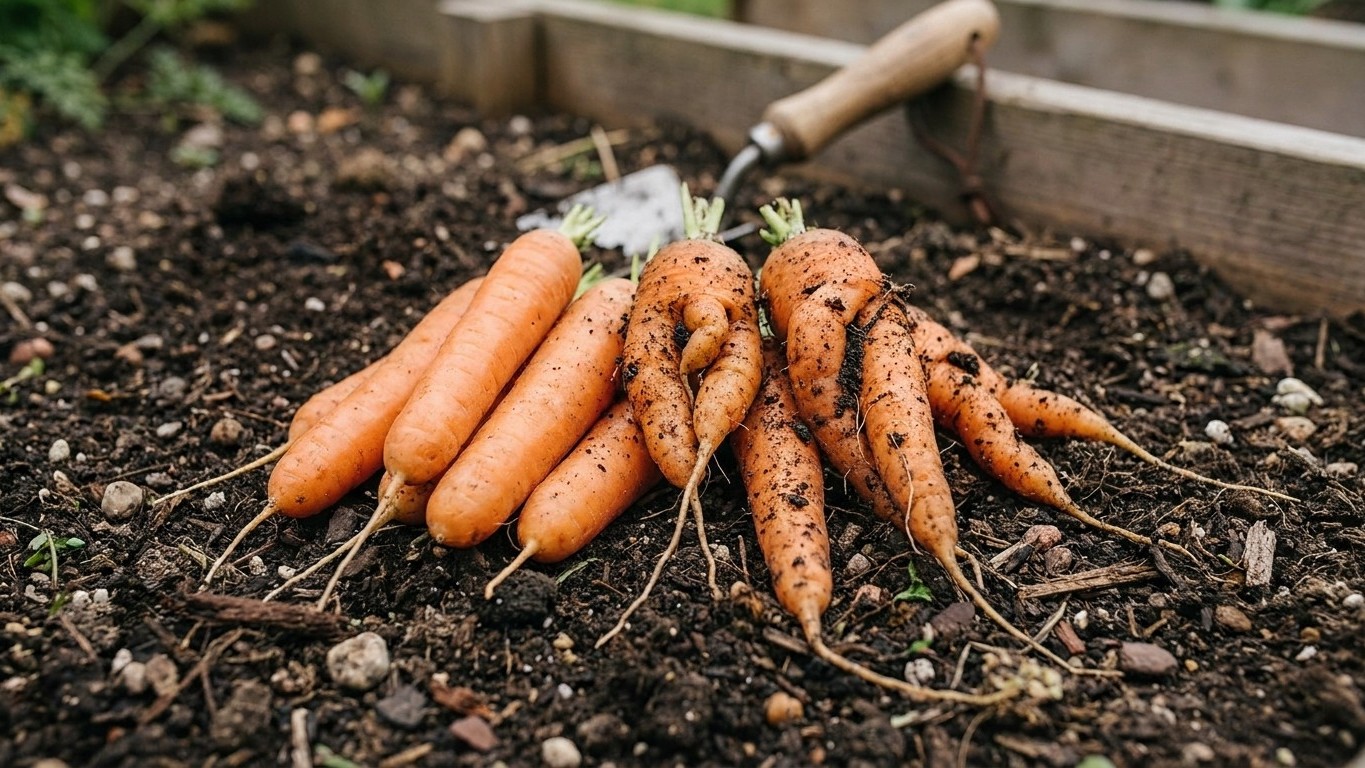

Carrots are seeded in place and never transplanted, so the clock starts the day the seed goes in. Clemson Cooperative Extension puts harvest at about 65 to 75 days after planting. Where winters freeze hard, as they do across Iowa, the deadline is the soil itself: lift the crop before the ground gets too stiff for a garden fork. Then cut the greens off and keep the roots cold and damp.
Keeping them, and for how long
The storage advice from Clemson Cooperative Extension’s Home & Garden Information Center is short and exact. Store carrots at 33 °F and high humidity to prevent wilting. That is barely above freezing, a good deal colder than a kitchen cabinet, a pantry or a typical basement shelf. A carrot is mostly water held in a thin skin, and in dry or warm air it loses that water quickly, turning rubbery and bendy.
The number to write down
Clemson says bunched carrots, meaning plants with the tops still on, can be stored for about 10 to 14 days. Carrots with the tops trimmed off keep for months. Treat both durations as ceilings reached under ideal conditions, not as guarantees. A root with a nick from the digging fork, a bag that has gone dry, or a spot that drifts a few degrees warm will give up well before the limit. At something like 50 °F, the temperature of a cool cellar, carrots sprout and soften in a fraction of that time.
Why the tops come off first
The leaves are the catch. A carrot with its greens attached keeps sending moisture up into the foliage, and the foliage keeps losing it to the air. The root works like a reservoir with a leaky straw in it. That is why bunched carrots last a week or two while trimmed ones last months.
So cut the tops the day you pull the carrots, before they go into the cold. Slice the greens off close to the shoulder of the root with a knife or shears, and don’t twist them off, which can tear the crown. The greens are edible, so use them fresh or compost them. Once the tops are gone, the root has nothing pulling water out of it, and the cold and humidity can do their work.
Pulling is part of the keeping, too. Loosen the row with a fork a few inches out from the carrots so you lift them rather than snap them. A broken tip or a gouged side is a doorway for rot, and those roots belong in tonight’s dinner, not in the storage bag. Brush off loose soil and let the surface dry for a short while out of direct sun. Sun on freshly pulled roots warms and wilts them.
Where in the house that actually is
Translating 33 °F into a real house takes some honesty about each room. A heated room, whether the kitchen, a pantry off the kitchen or a finished basement, is far too warm. The garage is cold in January but swings with the weather, freezing on one night and sitting mild on the next sunny afternoon. Carrots that freeze and thaw turn to mush. A freezing night in an attached garage also does not stay put; it comes and goes with the forecast.
The refrigerator comes closest to the target, and it is usually the right answer for a household-sized harvest. Its crisper drawer is built to hold humidity, and a perforated plastic bag inside it keeps the air around the carrots damp without sealing in condensation. The drawback is that fridges are not uniform. The spot against the back wall or near a cold vent can run colder than the rest and nip carrots with frost, while a door shelf runs warmer. For a bigger crop, an unheated basement room or cold cellar can work, but only in the depth of winter, and only if it actually holds the temperature.
Don’t guess. Put a thermometer in the spot you plan to use and read it for a couple of days before you commit the harvest to it, because skipping that step can cost you the whole crop to softening or to freezing. A cheap fridge or appliance thermometer will do. Check it morning and evening, and again after a cold snap if the spot is anywhere near an exterior wall. If it reads well above 33 °F, plan to eat the carrots sooner. If it dips to freezing, move them to a warmer shelf.
Keep the bag from becoming a trap. A tightly sealed bag with wet carrots will grow mold; a bag with a few small holes, or a container with a damp (not dripping) paper towel, holds the humidity that Clemson calls for without drowning the roots. Check the stash every week or so and pull out any carrot that has gone slick or soft before it spoils its neighbors.
Common questions
How many days until carrots are ready to pull?
Clemson Cooperative Extension gives about 65 to 75 days after planting, and seed packets commonly list anywhere from 70 to 100 days. Both counts start at seeding, because carrots are sown directly in the bed and are never transplanted. Cool weather, thin soil and crowded rows push the date later. The surest check is to pull one carrot: if its shoulder at the soil line has reached the width the packet describes and the color is deep, the row is ready.
Can carrots stay in the ground into the fall?
Often they can, and the soil acts as a cool, damp storage room for a while. The limit is a hard freeze that locks the bed. Aim to have the crop lifted before the ground is too frozen to take a garden fork without breaking roots. Leaving carrots in the ground also leaves them exposed to critters; What Eats Carrot in Iowa, and When covers who comes looking and in which season.
Will my carrots fork, and does it affect storage?
Utah State University Extension notes that carrots want deep, sandy, well-drained soil rich in organic matter, and that heavy or rocky soil makes the root fork. Iowa’s state soil, the Tama series, is a deep, dark prairie Mollisol that is well drained, with about 3.5 percent organic matter, a surface pH around 6.5 and a texture of 4 percent sand, 26 percent clay and 70 percent silt. That mix leans heavier than a carrot prefers. It is the soil that represents the state, though, not necessarily the soil in your yard. River bottoms, hill country and any ground a builder scraped or filled will differ.
To settle it at home, fill a straight-sided jar one-third with soil, top it up with water, shake it and let it sit. The layers that settle out show how much sand, silt and clay you have. A county extension office can also run a soil test for your own numbers. If the jar shows a thick clay layer, the answer is a raised bed or double digging with plenty of compost, not a different variety. Will Carrots Fork in Iowa Soil? goes into the details. Forked carrots are harder to clean, so many gardeners use them first.
Should I wash carrots before storing them?
Most gardeners brush off the loose soil and wait to rinse until just before cooking. A wet root sealed into a bag invites rot, while a dry brushed one in a ventilated bag holds humidity without trapping standing water. If you do wash a batch, let it dry thoroughly first. Either way, cut off the tops first and sort out any cut or cracked roots to eat right away. For the full picture of the crop from seed to harvest, see Growing Carrots in Iowa.