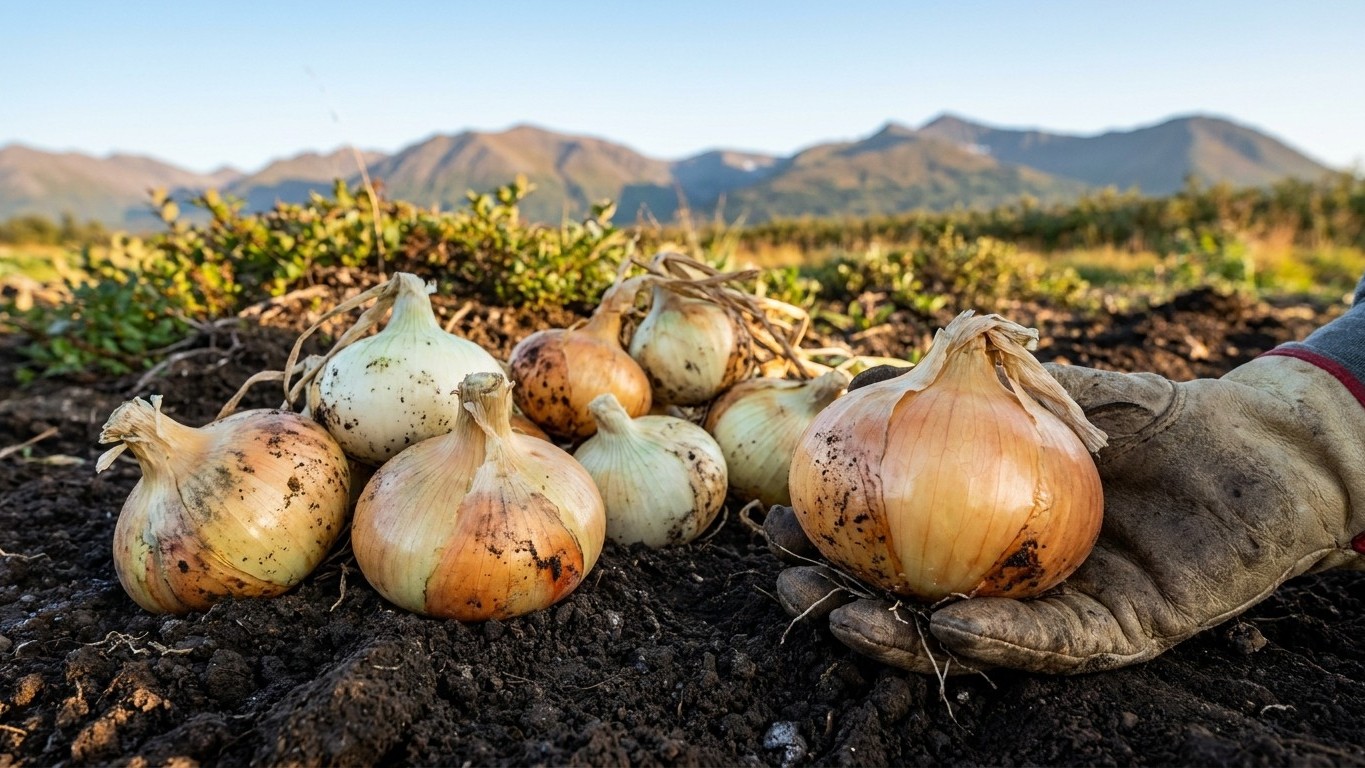

Lift onions when the tops have fallen over and the necks have gone soft. Then cure them in the shade with moving air, until the necks are tight and the skins rustle like paper. Cured bulbs keep best in a cool, dry spot between 45 °F and 55 °F. Pull them early, skip the curing, or grow a sweet variety, and the storage time shrinks fast.
When do you lift onions in Arkansas, and how do you cure them?
Day length sets the calendar. Little Rock sits at 34.73 degrees north and gets 14 h 20 of daylight on the longest day of the year. Clemson Cooperative Extension (HGIC) puts the bulbing trigger for short-day onions at about 12 hours, so those plants start swelling in spring, well before the solstice, and the tops fall in early summer. Long-day varieties wait for 14 to 16 hours. Little Rock barely reaches the bottom of that range, and only around the solstice, so those plants mostly make leaves. Gardeners in the far north or far south of the state should check their own latitude, because the daylight shifts a little with it. The The Best Onion Varieties for Arkansas page matches types to this daylight.
How do you know an onion is ready to lift?
Watch the tops. When most of them have flopped over and the necks have gone soft and thin, the bulb has stopped growing. Stop watering as the first tops fall, then wait for a dry stretch. Loosen the soil with a garden fork, lift the bulbs gently, and shake off loose dirt without banging them together. A bruised bulb is a bulb that rots in storage.
Sort as you pull. Bulbs that are damaged will not last, so set them aside for the kitchen. The What Eats Onion in Arkansas, and When page covers which damage to expect and when it shows up.
How do you cure onions before storing them?
Spread the bulbs in a single layer, tops still attached, somewhere shaded, dry and breezy. A screened porch, a barn aisle or a carport with a box fan works well. Raise them off the ground on racks or old window screens. Direct sun can scald the skins, and rain restarts rot. Where summers are hot and humid, curing runs slower, so give them extra days and extra airflow.
The bulbs are cured when the neck is tight and dry with no moisture when squeezed, the outer skins are papery, and the roots are wiry. Then trim the tops, snip the roots, and brush off the dirt. Do not wash them. Any bulb with a thick, soft neck stays out of storage and goes into the next few meals.
Keeping them, and for how long
Clemson Cooperative Extension’s Home & Garden Information Center states it plainly: “Ideal conditions are between 45 °F and 55 °F, and 50 to 60 percent humidity.” The range to write down is 45 °F to 55 °F with 50 to 60 percent humidity. The full guidance is in the Clemson fact sheet on onions, leeks, shallots and garlic.
Onions want dry air. That is the opposite of carrots, beets and other roots, which keep best in damp cold. A single cellar cannot hold both well, so if you store root crops, the onions need their own spot. Curing comes first, always. Bulbs go into storage once the necks are tight and the skins papery, never straight from the ground.
Any keeping time you read for onions is a ceiling, reached only when the bulb was cured, undamaged and held in that range. A few degrees warmer, a damp week, or one bruised bulb in the bin shortens the clock. Check the stored bulbs regularly and pull out anything soft or sprouting, because one rotting onion can spoil its neighbors.
Variety matters as much as the room. The University of Missouri Extension (publication G6355, on planting, growing and harvesting onions) says it directly: “As a rule, ‘sweet’ onions do not store as well as the more pungent types.” The reason is chemical. The bite of an onion comes from volatile sulfur compounds, and those same compounds help protect the bulb in storage. A sweet variety carries fewer of them, so it tastes better raw but will not last the winter.
That trade-off lines up with day length. Short-day types run sweeter, and long-day types keep longer. A southern garden therefore gives onions to eat soon after harvest, while a northern one gives onions that last into March. Never count on a sweet onion to store. Eat those first, and save the pungent ones for the cold months. The Onions in Arkansas hub covers how to plan a planting around that split.
Where in the house that actually is
A 45 °F to 55 °F, 50 to 60 percent humidity range sounds easy until you walk through a house looking for it. A domestic refrigerator runs colder than that range, and its crisper drawer is humid on top of that. Whole cured onions sit poorly there, and they can pick up moisture. Cut onions are a different matter, since those belong in the fridge, wrapped.
A heated living space is the opposite problem. Most rooms people keep comfortable sit well above 55 °F, and bulbs in a warm kitchen sprout and soften sooner. A garage swings with the weather. It can sit in the 50s on a calm morning, then climb on a mild afternoon, and then drop below freezing during a cold snap. Frozen onions turn to mush once they thaw. An attached garage on the north side stays steadier than a detached shed, but it still needs checking.
The closest match in most houses is a cool interior spot: a closed-off spare room with the vent shut, a closet on a north wall, or an unheated pantry away from the stove and water heater. Cellars and basements hold the temperature well, but in humid climates they usually run damp, and that invites mold and soft necks. Dry out the air or look elsewhere.
Do not guess. Set a min-max thermometer and a hygrometer in the spot before the onions go in, and read both daily. Skip it and you may lose the crop to a spot that looked cool to the hand but ran warm at night or damp after rain. Store the bulbs in mesh bags, slatted crates or baskets so air moves around them, and keep them out of plastic bags and sealed tubs.
Common questions
Can I keep cured onions in the refrigerator?
Whole cured onions do better in a cool, dry room at 45 °F to 55 °F. A refrigerator is colder than that range and humid inside, which can lead to soft spots. Refrigerate only onions you have already cut, and keep them wrapped so the smell stays contained.
Should I wash onions before storing them?
No. Brush off dry soil once the bulbs are cured and trim the tops and roots. Water on the skins brings back the moisture that curing worked to remove, and damp bulbs rot faster in storage.
What if the onion has a thick, soft neck?
A thick neck stays open and lets rot enter, so that bulb will not keep. The same goes for any onion that has sent up a flower stalk. Use those first, and store only the bulbs with tight, dry necks.
Can I store sweet onions through the winter?
Plan on eating them early. Sweet types hold fewer of the sulfur compounds that protect a bulb in storage, so they soften and sprout sooner than pungent types, even with perfect curing and a cool, dry room. Save the more pungent varieties for winter storage.