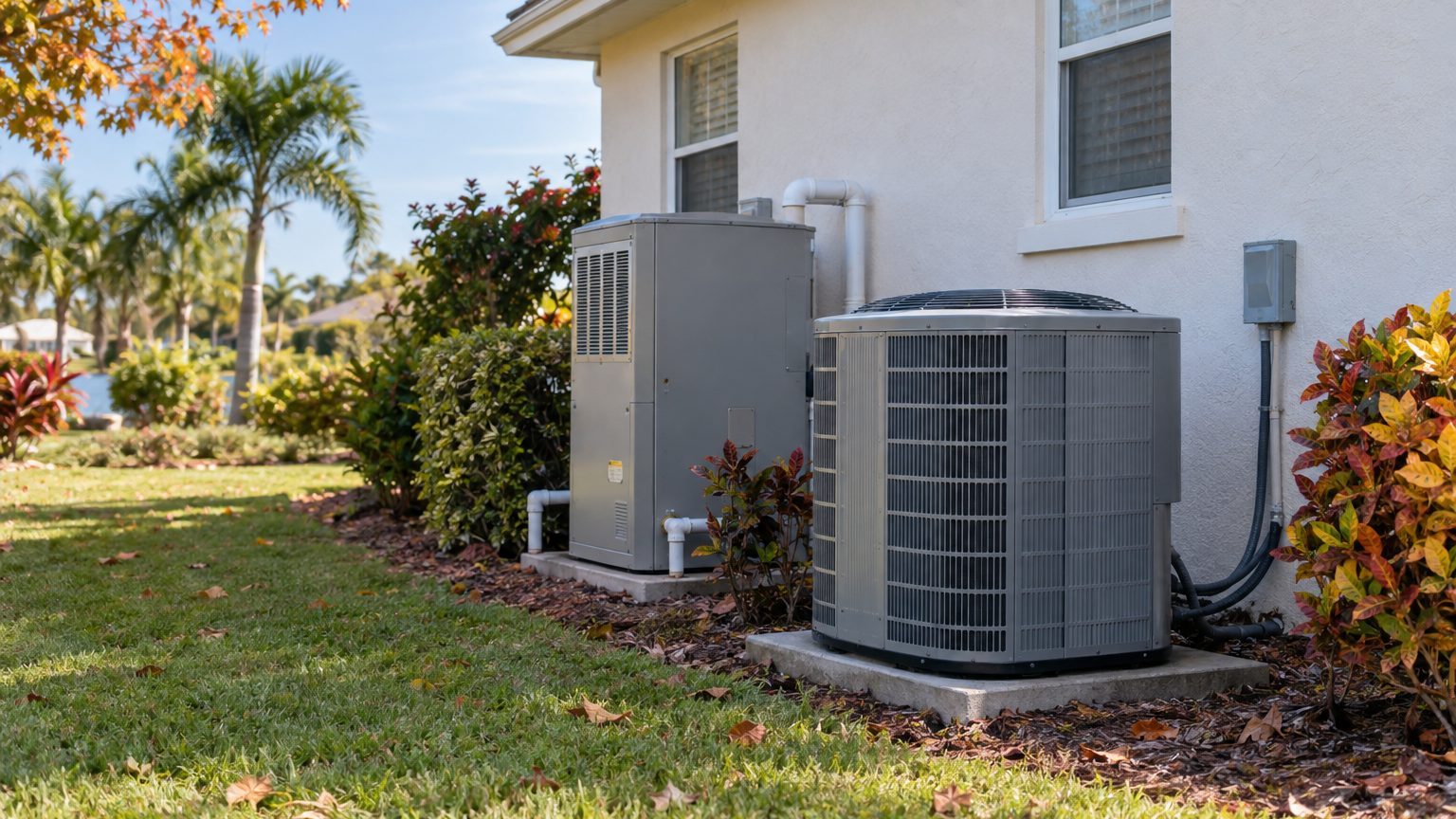

In Arkansas, an electric heat pump costs less to run than a high-efficiency gas furnace, and far less than baseboard heat. The gap between the heat pump and gas is real but modest. That makes your gas service, your ducts and the age of your current equipment matter as much as the fuel price.
The short answer for Arkansas
The U.S. Energy Information Administration (EIA) publishes average residential prices for electricity and natural gas, and ENERGY STAR publishes efficiency levels for the equipment. Combined, they give the cost of delivering one million Btu of heat to a house. A heat pump at 8.1 HSPF2 (a seasonal COP of about 2.4) delivers it for $16.80. A natural gas furnace at 95% AFUE delivers it for $19.54. Electric resistance, such as baseboard at 100% efficiency, costs $39.89. The heat pump is the cheapest to run here, $2.74 less per million Btu than the gas furnace.
Read that number for what it is. It compares running cost on the same unit of delivered heat, nothing more. It is not a yearly bill, which depends on the size of the house, its insulation and the thermostat setting. It also says nothing about what the equipment costs to buy and install. Both prices are statewide averages, so your own rate plan and your gas utility’s current rate can move the result. Your gas rate is printed on your utility bill.
The heat pump figure also uses the ENERGY STAR minimum for a ducted system, which is a seasonal average. A better-than-minimum unit does better, and the coldest nights do worse. Baseboard sits at more than twice the heat pump’s cost, so a house heated that way has the most to gain. For a house that already has gas service, the heat pump is the cheaper system to run, by $2.74 per million Btu. Whether that margin justifies a changeover is a separate decision, covered below.
What each option costs to run in Arkansas
| System | Efficiency used | Cost per million Btu delivered |
|---|---|---|
| Electric resistance (baseboard) | 100% | $39.89 |
| Heat pump | 8.1 HSPF2 (seasonal COP about 2.4) | $16.80 |
| Natural gas furnace | 95% AFUE | $19.54 |
Electricity in Arkansas averages 13.61 cents per kWh for residential customers, year-to-date through July 2026, according to the EIA Electric Power Monthly, Table 5.6.B. The natural gas side uses the EIA average residential gas price. Electricity converts to heat at 3,412 Btu per kWh, and gas at about 1,037 Btu per cubic foot. Utilities and rate plans differ across the state, so treat both prices as a way to compare fuels, not as your bill.
Why does efficiency matter as much as the fuel price?
Electricity costs more per unit of energy than gas. Baseboard turns each kWh into exactly one kWh of heat, so it loses badly. A heat pump moves heat instead of making it, and at a seasonal COP of about 2.4 it returns more than twice the heat that the electricity contains. That multiplier is what pulls it below a gas furnace that wastes only 5% of its fuel.
The efficiency rating on the label carries real money. ENERGY STAR asks 8.5 HSPF2 of a non-ducted split system and 8.1 of a ducted one, because a ductless unit has no duct losses and has to be better to earn the same badge. What HSPF2 Measures, and Why Ductless Asks for More explains the reasoning. HSPF2 rates heating and SEER2 rates cooling (15.2 is the ENERGY STAR floor for both system types), so compare the same letter when you line up two quotes. Compare the cost of delivered heat per million Btu, never a kWh price against a gas price.
How cold it gets, and what that does to a heat pump
The reference city is Little Rock, where NOAA’s 1991-2020 normals count about 3,165 heating degree days a year (base 65°F). Degree days add up how far each day’s mean temperature sat below 65°F, so twice the degree days means roughly twice the fuel for the same house. The mean daily minimum in the coldest month is 30.9°F, just under freezing. That describes a heating season that is moderate and fairly long, with few brutal stretches. Northern and higher-elevation counties in the state can run colder than the reference city, so expect a heavier load there.
Moderate winters help a heat pump, since the $16.80 figure is built on a seasonal average and mild days sit above it. The cold hours sit below it.
What happens on the coldest nights?
A heat pump gets less efficient as the outdoor temperature falls. In deep cold it may not keep up on its own, so most systems pair it with resistance strips or a furnace to carry the coldest nights. Heat from resistance strips is priced like baseboard, at $39.89 per million Btu. In a climate where the coldest month averages a low just under freezing, those hours should be a small share of the season. They are still the reason the seasonal figure is an average and not a promise for every night.
How a heat pump behaves across the temperature range is covered in How Cold Is Too Cold for a Heat Pump. Ask your installer how the backup heat is sized and controlled, and expect the coldest nights to cost closer to baseboard rates.
What homes in Arkansas already heat with
According to the EIA’s 2020 Residential Energy Consumption Survey, 60% of Arkansas homes use a furnace as their main heating equipment, and 19% use a central heat pump. By fuel, electricity leads at 46%, natural gas follows at 43%, and propane serves 4%. For steam or hot-water boilers, the survey found too few households to publish a share, and fuel oil or kerosene is in the same position. Those are state shares from a national survey, not a count for your county.
These numbers show what was installed, which tells you which fuel was cheap when the houses were built. They are not a recommendation. Electric heat is the largest single fuel, yet only 19% of homes run a central heat pump. A good share of electric homes probably run resistance heat in some form, and those are the homes with the most to gain. Moving from baseboard at $39.89 to a heat pump at $16.80 is a far bigger step than swapping gas for electricity.
The house itself changes the comparison. A home with no gas line should weigh a heat pump against resistance or propane, and a quote from the gas utility for running a line, before the gas furnace gets any consideration. A home heated by a boiler and radiators has no ducts, so the conversion is a different job, usually a ductless system. The state-level picture of how Arkansas homes stay warm is in Heating a Home in Arkansas. Start with what is already in the house: a gas line, ducts, or neither.
When the other choice wins
The cheaper-to-run system is not always the right call. The $2.74 gap is thin enough that a lower local gas rate, or a higher electric rate plan, can erase it. A house with a gas line and low gas bills may not recoup the cost of a changeover on running savings alone. Ask your gas utility for its current rate before you decide.
An old system with years left is the second case. A working furnace that gets regular service costs nothing to buy, and the heat pump’s savings accrue slowly. The calculation shifts once repair bills start arriving, and Repairing a Furnace or Replacing It walks through that point.
Cooling pushes the other way. The reference city logs about 1,989 cooling degree days a year, a real air conditioning load. A heat pump does both jobs, so if the air conditioner is aging too, one outdoor unit replaces two. Whether that unit feeds ducts or serves rooms individually is the question in Ductless or Central.
A dual-fuel setup splits the difference: a heat pump handles most of the season and a gas furnace takes over on the coldest nights, avoiding resistance strips. It needs a gas line and two systems to maintain. Keep a working furnace until repair bills or a failing air conditioner make a single replacement worth planning.
Common questions
Is a heat pump cheaper to run than a gas furnace in Arkansas?
Yes, on average prices. Delivered heat costs $16.80 per million Btu with a heat pump at 8.1 HSPF2 and $19.54 with a 95% AFUE gas furnace. Your actual savings depend on your house and your local rates.
Does a heat pump keep up with Arkansas winters?
Little Rock’s coldest month averages a daily low of 30.9°F, a moderate winter. Efficiency drops in the deepest cold, and backup heat covers those nights.
Is electric baseboard heat expensive to run?
It is the costliest of the three, at $39.89 per million Btu delivered. Replacing it with a heat pump cuts that to $16.80.
Is a ductless heat pump more efficient than a ducted one?
ENERGY STAR requires at least 8.5 HSPF2 from a non-ducted split system and 8.1 from a ducted one. Ductless units avoid duct losses, so they must be more efficient to earn the same label.