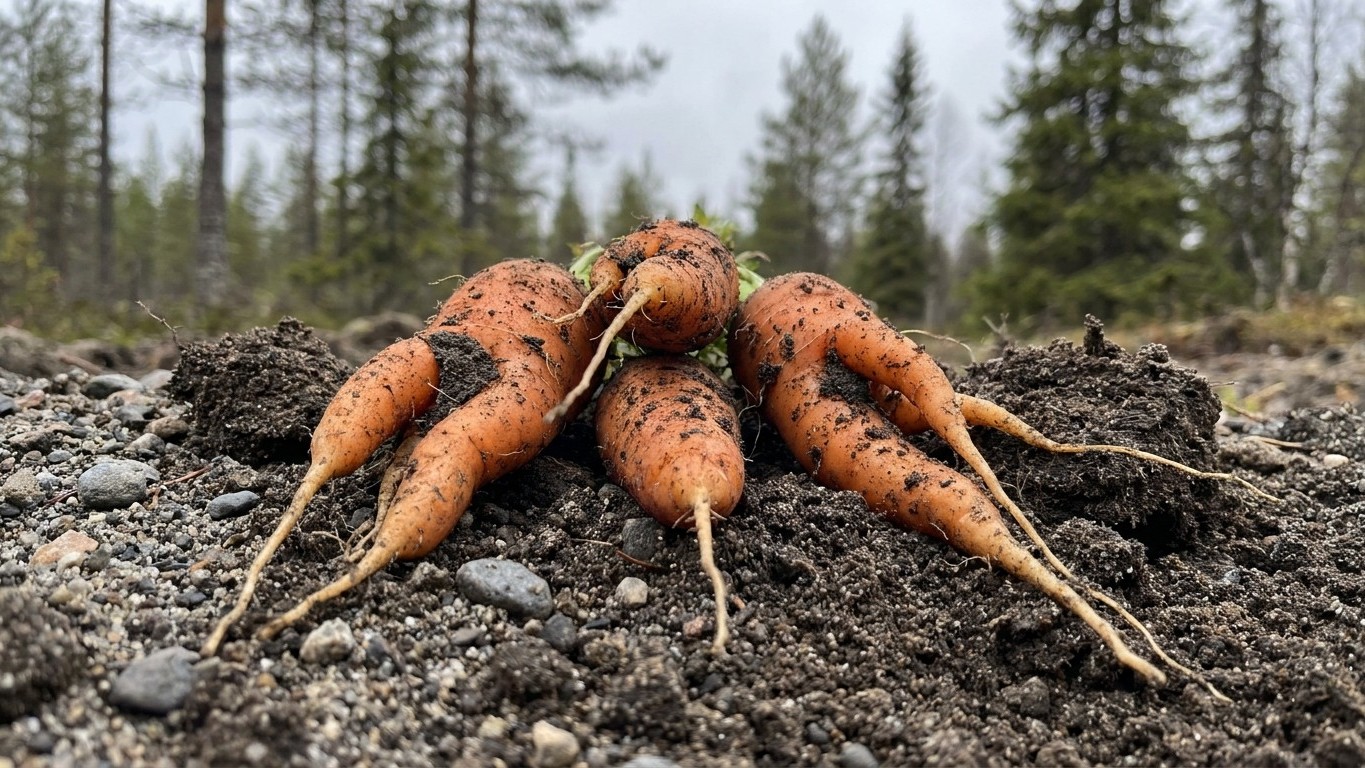

Pull carrots about 65 to 75 days after planting, according to Clemson Cooperative Extension. Carrots are sown in place, so that count starts at seeding, and many seed packets list 70 to 100 days depending on variety. After harvest, cut the tops off and hold the roots at 33 °F in high humidity. With the tops left on, they last only 10 to 14 days.
Keeping them, and for how long
The storage advice from Clemson’s Home & Garden Information Center is short: store carrots at 33 °F and high humidity to prevent wilting. That is barely above freezing. A carrot is mostly water held in a thin skin, and cold air that is also moist slows two things at once: the root’s own breathing, and the moisture loss that turns a crisp carrot rubbery. Warm the storage spot and both processes speed up. Roots go soft, then start to sprout at the crown. A pantry shelf or a cabinet might feel cool to you, but for a carrot it is warm.
The same Clemson factsheet gives a duration for bunched carrots, meaning plants with the tops still attached: about 10 to 14 days. Treat that as the ceiling, reached only when the temperature and humidity are right. A bunch sitting in a warm kitchen will not get there. A bunch with a few nicks or bruises will fade sooner.
Why do the tops shorten storage life?
The leaves keep drawing moisture out of the root long after harvest. Leaves have a large surface and open pores, so they lose water to the air. They pull it from the only supply they have left, which is the carrot. Within days the root shrinks and bends. That is why trimmed carrots keep far longer than bunched ones. Under cold, humid conditions, trimmed roots can last for months. Cut the tops off at harvest, leaving a short stub, and do not wait until the bunch looks tired.
Trimming also makes the carrots easier to pack. Brush off loose soil, but skip a hard scrubbing, since a skinned carrot rots at the scratch. If you wash them, dry them well before they go into a bag or bin.
When is a carrot ready to pull?
Count from the day the seed went into the ground. The shoulders of the root usually push up at the base of the leaves and show orange, and their width gives a rough idea of the root’s thickness. Pull one test carrot and compare it with the packet description for length and color. If it falls short, give the rest another week. In the Deep South, where winters are mild, carrots often hold in the ground through cool weather and can be pulled as needed. Long hot spells and heavy rain are harder on them. Roots left too long can split, turn woody or rot, and pests that feed on roots have more time to find them. Our guide on What Eats Carrot in Mississippi, and When covers those.
Where in the house that actually is
A target of 33 °F rules out most of the house. Any heated room, including the kitchen counter, the pantry and a hall closet on an interior wall, sits well above it. Stored there, carrots lose firmness quickly and start growing at the crown. A garage is a poor choice for a different reason: it follows the weather. On a mild January day it may be cool enough, and a week later a cold snap can freeze the roots, or a warm spell can heat the space well above what carrots tolerate. Very few Mississippi homes have a root cellar, since many sit on slabs and the water table is often high.
In most homes, the refrigerator comes closest. Use the crisper drawer if there is one, because it holds humidity better than an open shelf. Put the trimmed carrots in a perforated plastic bag, or in a closed container lined with a slightly damp paper towel, so they stay moist without sitting in water. A refrigerator can also be colder than the carrots tolerate in spots. The back wall of a shelf, directly under the cooling vent, may drop to freezing and leave them glassy and limp once they thaw. Keep the carrots toward the front.
The only way to know your own numbers is to measure. Put a refrigerator thermometer in the crisper drawer for a full day before you commit the harvest to it, and read it again after the door has been opened a few times. If it reads well above 33 °F, turn the dial colder a notch at a time and recheck the next day. Skipping that check is how a whole basket of homegrown carrots ends up rubbery. If the drawer runs too cold, move the bag forward on the shelf and check again.
If the harvest is larger than the drawer can hold, split it. Eat the thickest, most damaged roots first, since those spoil soonest, and keep the best-looking ones for the longest storage. Check the bag every week or so and pull out any carrot that has gone slimy, because one bad root can spread rot to its neighbors.
Common questions
How many days after seeding are carrots ready to pull?
Clemson Extension puts harvest at about 65 to 75 days after planting. Seed packets commonly list 70 to 100 days, depending on the variety. Carrots are never transplanted, so count from the day the seed went into the ground. A test pull near the early end of the range tells you more than the calendar does. If the root is thinner than the packet describes, leave the rest a little longer.
Should I cut the tops off before storing carrots?
Yes, and do it at harvest. The leaves keep pulling water out of the root, so carrots with tops attached keep only about 10 to 14 days at 33 °F and high humidity. Trimmed carrots keep much longer. Twist or cut the tops off, leave a short stub, and get the roots into the cold the same day.
Will Mississippi soil make carrots hard to pull?
It can. Mississippi’s state soil, the Natchez series, is a loam to silt: about 5 percent sand, 13 percent clay and 82 percent silt, well drained, with surface organic matter near 1.8 percent. Silt packs and crusts as it dries, and Utah State University Extension notes that carrots want deep, sandy, well-drained soil rich in organic matter, while heavy or rocky ground makes the root fork. For your own garden, treat that as a starting point. A state has hundreds of soil series, and river bottoms, hill country and scraped or filled lots differ a great deal. A county extension soil test gives the real numbers, and a jar test shows how much sand, silt and clay you have. Water the bed the day before pulling and loosen the row with a garden fork. More on forking is in Will Carrots Fork in Mississippi Soil?, and the full season is in Growing Carrots in Mississippi.
Can I leave carrots in the ground instead of storing them?
Often, yes, where winters are mild, as long as the roots are not splitting, rotting or being eaten. It works as storage for a few weeks at a time, but it has limits. Heat and heavy rain push the roots toward woodiness and decay, and soil pests keep working on them. Pull a few at a time and check each one. If the roots look past their best, bring them all in, trim them and refrigerate them.