
New Hampshire tomato growers deal with a fairly short, predictable list of pests, and most of them show up in a fairly predictable order across the season. Knowing which one you’re looking at, and when it’s likely to appear, saves you from spraying for the wrong thing or missing the window when control actually works.
What this comes down to in New Hampshire

Around Manchester, where the last spring frost typically falls between April 16 and April 27, tomato transplants usually go into the ground once that window has passed, and the pest calendar for the season starts almost immediately after. The pests that matter here are tied to soil temperature and plant stage, not to a fixed date, so the order below matters more than any calendar you’d pin to it. Gardeners in colder pockets of the state, or at higher elevation, will see the same sequence shifted later.
Cutworms

Cutworms turn up right at transplant time, when young stems are still thin and tender. You’ll find the damage before you find the culprit: a seedling snipped clean through near the soil line, sometimes toppled over with no obvious insect in sight. A cardboard or foil collar pushed an inch into the soil around each transplant stops most of them cold, and it costs almost nothing.
Flea beetles

Flea beetles arrive early too, often within the first couple of weeks after transplanting, and they hit hardest while plants are still small. The tiny shot-holes they leave look worse than they are on an established plant, but a heavy hit on a young seedling can stunt it. Floating row cover over transplants keeps the adults off until the plant has enough leaf mass to shrug off minor feeding.
Colorado potato beetle

This one shows up as plants are bulking up their foliage, usually a few weeks after the flea beetles. Both the adult and the larva feed on leaves, and a heavy infestation can defoliate a plant fast enough to set back fruiting. Handpicking works if you catch it early and check the undersides of leaves for the clusters of orange eggs.
Aphids

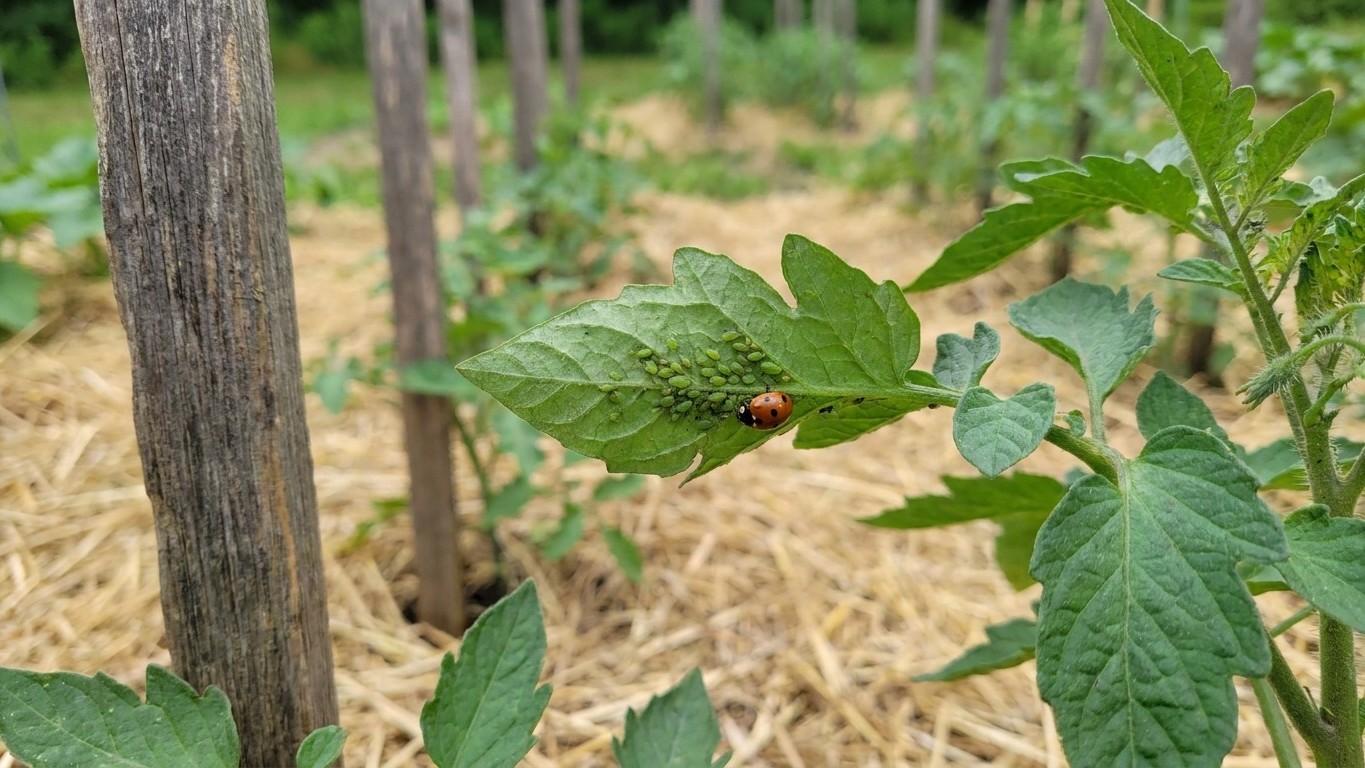
Aphids build up steadily through the growing season rather than arriving on one date. They favor new growth and the undersides of leaves, and a light infestation rarely does real harm. A strong jet of water knocks most colonies down, and ladybugs and other predators usually keep populations in check if you haven’t already wiped them out with a broad-spectrum spray.
Tarnished plant bug

This pest tends to show up as flowering and early fruit set get underway, feeding on buds and small green fruit rather than leaves. The result is misshapen, pitted tomatoes rather than obvious leaf damage, which is why growers often blame the wrong thing. Keeping the garden free of flowering weeds nearby cuts down on the population that moves in.
Tomato hornworm

The hornworm is a mid-to-late-summer problem, once plants have put on substantial growth and fruit is sizing up. Its camouflage is good enough that most people spot the frass droppings or the stripped branch before they spot the caterpillar itself. Handpicking at dusk or dawn, when they’re most active, is still the most reliable control for a home garden.
Working it out for your own garden
Matching the pest to the timing
The fastest way to identify what’s chewing on your plants is to line up the damage with the stage your plant is in, since that maps closely to the sequence above. A snipped-off seedling right after transplant reads as cutworm, not hornworm. Shot-holes in the first true leaves a week or two later read as flea beetle. Skeletonized leaves and black droppings on a plant that’s already fruiting almost always means hornworm, since it doesn’t show up until the plant has real size to it.
The same logic applies to when you plant in the first place. If you’re still working out your transplant date, count forward from the frost window rather than backward from a single day: soil needs to warm up after the Manchester frost range of April 16 to April 27 before tomatoes go in, and that warming period is itself a range, not a fixed point. The full method for pinning that down, including how days-to-maturity figures on a seed packet interact with your local frost window, is covered in Tomato Planting Dates in New Hampshire: Counting Back From Your Frost Window.
Variety choice affects pest exposure too, mostly through timing rather than resistance. A plant that’s still small and tender when flea beetles peak will take more damage than one transplanted a bit later into warmer soil, and a fast-maturing variety may finish fruiting before the tarnished plant bug population builds up in mid-summer. If you haven’t settled on which cultivars fit your season, Tomato Varieties That Ripen in Time in New Hampshire works through that calculation with named cultivars.
What changes across the state
New Hampshire runs from the seacoast up through the White Mountains, and pest timing shifts with that geography even though the cast of characters stays roughly the same. Places at higher elevation or further north warm up later in spring, which pushes the whole cutworm-to-hornworm sequence later in the year, sometimes by a fair margin. The Manchester frost figures used above come from a single reference station, and gardens in valleys, near large bodies of water, or up in elevation will run on a different schedule.
Proximity to water moderates temperature swings, which can mean a slower ramp-up in spring but a longer stretch of pest activity into fall before the first freeze. Inland and northern gardens tend to get a shorter, more compressed pest season, with less time between when flea beetles show up and when hornworms take over. None of this changes which pests you’re dealing with, just when in the calendar you should start looking for each one.
The USDA hardiness zones across the state run from about 3b up through 6a, which is a wide enough spread that a grower in the coldest zone is working with a noticeably shorter frost-free window than one near the coast. That difference matters more for which cultivars finish on time than for which pests appear, but it does mean a gardener up north should expect the whole sequence, cutworm through hornworm, to run later and possibly get compressed into fewer weeks.
The mistakes this state punishes

The most common mistake is treating a warm stretch in early spring as a green light to transplant, then losing seedlings to a late frost or to cutworms that are still active in cold, wet soil. Soil temperature, not air temperature, decides when a tomato transplant is safe, and a few warm days doesn’t mean the soil has caught up. Wait until the ground itself has warmed, not just the afternoon air.
The second mistake is ignoring flea beetle damage on the theory that it’s cosmetic, then watching a small transplant get set back hard enough that it never really catches up before frost cuts the season short. On a state with a tight growing window already, a stunted start can be the difference between a full harvest and a handful of green tomatoes at frost. Cover young plants until they’ve built up enough leaf area to absorb some feeding without real harm.
The third is waiting too long to start checking for hornworms once plants are fruiting, since a light infestation can go from a few chewed leaves to serious defoliation within a week or two in warm weather. Check the undersides of branches and look for frass on the leaves below, especially once you’ve had a run of warm nights. Catching it early means a few minutes of handpicking instead of a stripped plant.
Checking this against your county
Everything above is a starting point built around a single reference station near Manchester, and your own county can run a week or two earlier or later depending on elevation, water, and local microclimate. Before you commit to a transplant date or a pest-control plan, check your own conditions against what’s typical for your area.
The UNH Cooperative Extension, at extension.unh.edu, publishes tomato guidance specific to New Hampshire and can point you to your county office for questions about what’s actually showing up in your garden this year. If you haven’t already worked through the basics of growing tomatoes in this state, that’s worth reading before you fine-tune pest timing, and you can find that overview at growing tomatoes in New Hampshire.
Common questions
Do I need to spray for hornworms every year?
No, not automatically. Some years the population is light enough that handpicking a few caterpillars off a handful of plants is all it takes, and spraying preventively before you’ve actually seen damage usually does more harm to beneficial insects than good.
Are the little white cocoons on a hornworm bad or good?
Those are good news, not more pests. They’re the pupal cases of a parasitic wasp that’s already killing the hornworm from the inside, so leave that caterpillar on the plant rather than removing it, since it’s doing your pest control for you.
Why are my tomatoes lumpy and pitted but I don’t see any bugs?
That’s the classic sign of tarnished plant bug feeding on the flower or young fruit weeks earlier, and by the time the fruit shows the damage the insect has often already moved on. Look at flower buds and small green fruit rather than the ripe tomato itself if you want to catch it in the act.
Can I use the same pest control timing every year?
Treat last year’s timing as a rough guide, not a fixed schedule, since a warm or cold spring shifts the whole sequence earlier or later. Checking plant stage and actual damage is more reliable than checking a calendar date from a previous season.