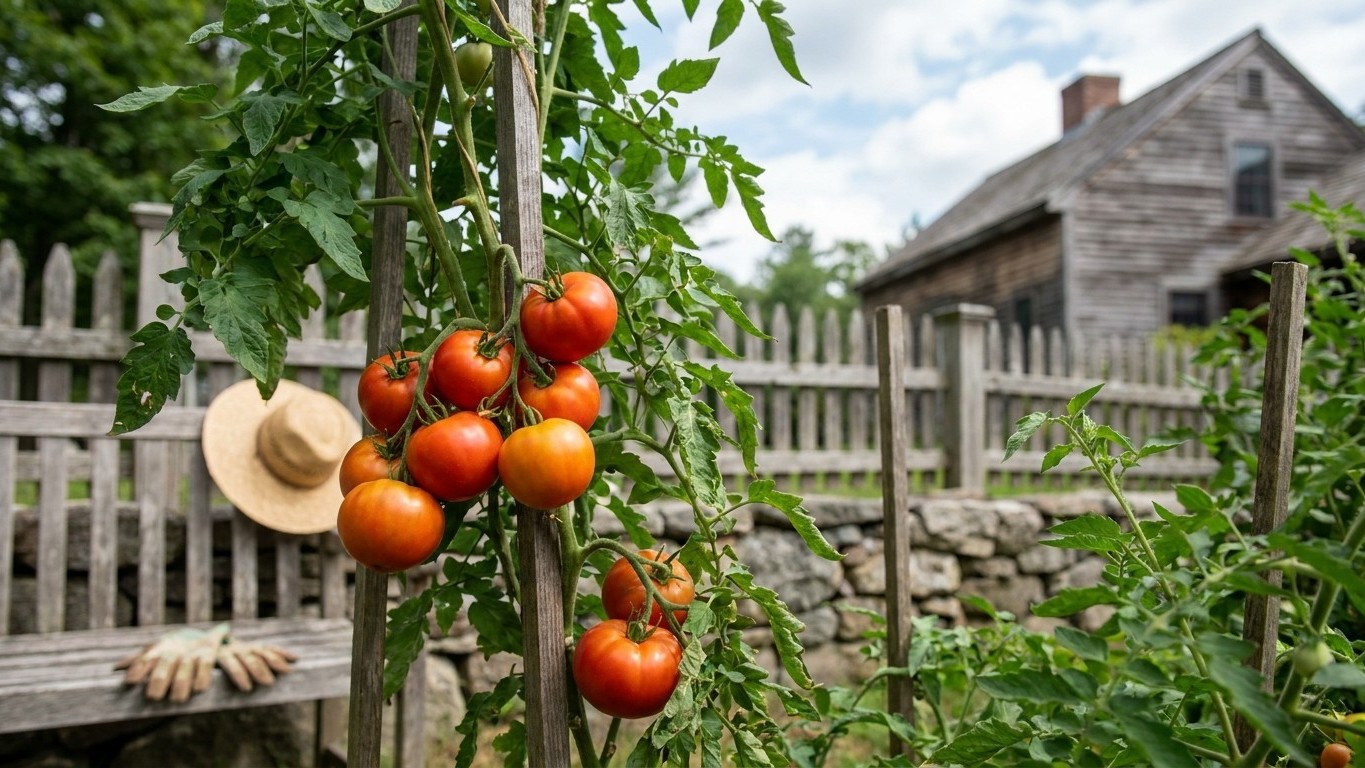

NOAA’s 1991-2020 climate normals put the last spring freeze at Manchester, measured at the airport weather station, between April 16 and April 27. That’s a 30-70% freeze-probability window, not a guarantee, and it comes from one station in one city. Check your own town’s frost record through UNH Extension before you set a single tomato plant outside, since gardens elsewhere in the state, particularly at elevation or in the North Country, tend to run later.
When to plant Tomatoes in New Hampshire

Memorial Day weekend gets treated as the safe transplant date everywhere in the state, but that’s really a Manchester date, and it quietly fails gardeners further north or at elevation, where frost risk lingers into June. The gap matters more than the calendar square: it changes when you should have started seed indoors back in March, how long you harden plants off, and whether that “safe” weekend actually protects anything you’ve grown.
Starting seeds indoors
Tomatoes need six to eight weeks of indoor growth before they’re ready to go outside, counted back from your expected transplant date rather than from any fixed calendar day. If you expect to transplant in the last days of April, closer to the Manchester date, start seed indoors in early-to-mid March. If your garden runs later into mid-May, which is common outside the immediate Manchester area, push seed starting back to late March or the first days of April. Sow seed a quarter inch deep in a seed-starting mix under strong light, and keep the soil around 70 to 80 degrees until germination, which usually happens within a week.
Once seedlings have their first true leaves, pot them up into larger cells or four-inch pots so the root system has room to develop before it goes into garden soil. A leggy, root-bound seedling struggles far more after transplant than one that had space to grow properly indoors.
Hardening off and moving plants outside
Give transplants seven to ten days outdoors in increasing doses of sun and wind before they go into the ground for good. Start with an hour or two in a sheltered, shaded spot and build up daily. Skipping this step is the single most common reason transplants sit stunted and pale for two weeks after planting.
Move plants into the garden only after your local frost risk has genuinely passed, not just after the Manchester date has come and gone on the calendar. For most of southern and central New Hampshire, that means a window running from late April into mid-May. Gardeners further north, at elevation, or in low-lying frost pockets should expect to wait longer, sometimes into late May, and should watch the forecast rather than a date on paper. If you’re timing other crops to this same frost window, our New Hampshire guides cover planting dates for the rest of the vegetable garden.
Soil and site preparation
Tomatoes want a minimum of six to eight hours of direct sun a day, more if you can give it. Pick the sunniest, most open spot in the yard, away from the shade line of trees and buildings as the sun tracks lower in early spring and late fall. Good air movement around the site matters too. Tomatoes packed against a fence or a wall with no airflow are the ones that come down with fungal disease first.
Soil texture is the other half of the equation. Tomatoes want a loose, well-drained loam that neither waterlogs after rain nor dries out in an afternoon. Heavy clay soil, common in parts of New Hampshire, benefits enormously from several inches of compost worked in the fall before, or at minimum a few weeks before spring planting, so it has time to break down and improve structure rather than sitting as a raw amendment. Raised beds or ridged rows help clay ground drain and also warm up faster in a cool New England spring, which matters more here than in milder states since tomatoes stall in cold soil regardless of air temperature.
In the weeks before planting:
- Clear the bed of the previous year’s tomato, potato, pepper or eggplant debris, which can carry over soilborne disease.
- Work in two to three inches of finished compost across the planting area.
- Set stakes or cages in place before transplanting, not after, to avoid damaging roots later.
- Space plants 24 to 36 inches apart, with 3 to 4 feet between rows, so mature vines don’t crowd each other into a fungal problem by midsummer.
Bury transplants deep, up to the first set of true leaves, since tomato stems root readily along their buried length and a deeper root system handles a dry spell better. This is one of the few vegetables where planting deeper than the seedling was growing in its pot is the correct move, not a mistake.
Varieties that suit New Hampshire
The traits that matter most here are days to maturity and disease resistance, in that order. A short growing season means a slow 85-day heirloom needs an early, generous transplant date to ripen a real crop, while a 55 to 60-day variety gives you room for a poor spring or a late frost without losing the season entirely. Days-to-maturity figures on seed packets are counted from transplant, not from seed, and they shift by a week or more depending on how warm and sunny the actual season turns out to be. Use them as a planning tool, not a promise.
| Variety | Type | Days from Transplant | Disease Resistance | Best For |
|---|---|---|---|---|
| Sun Gold | Indeterminate cherry | 57 | Tobacco Mosaic Virus (High), Fusarium Wilt race 1 (High) | Earliest ripe fruit, snacking |
| Sakura | Indeterminate cherry | 55 | Nematodes (Intermediate), Tomato Mosaic Virus (High), Fusarium Wilt races 1,2 (High) | Fastest to ripen, salads |
| Supersweet 100 | Indeterminate cherry | 60 | Verticillium Wilt (High), Fusarium Wilt race 1 (High) | Heavy cherry yields |
| Juliet | Indeterminate grape | 60 | Late Blight (Intermediate), Early Blight (Intermediate) | Blight-prone gardens |
| Jasper | Indeterminate cherry | 60 | Late Blight (High), Early Blight (Intermediate) | Wet, humid seasons |
| Amalfi | Determinate paste | 68 | Nematodes (Intermediate), Late Blight (Intermediate), Early Blight (Intermediate) | Compact sauce crop |
| Cherokee Purple | Indeterminate slicer | 72 | None listed | Flavor-first slicing tomato |
| Big Beef Plus | Indeterminate slicer | 72 | Nematodes (Intermediate), Gray Leaf Spot (High), Tomato Mosaic Virus (High) | Reliable main-season slicer |
| Tiren | Indeterminate slicer | 75 | Verticillium Wilt (High), Tomato Mosaic Virus (High), Fusarium Wilt race 1 (High) | Disease pressure years |
| Granadero | Indeterminate paste | 75 | Nematodes (Intermediate), Verticillium Wilt (High), Tomato Mosaic Virus (High) | Canning and sauce |
| San Marzano II | Indeterminate paste | 78 | None listed | Classic sauce tomato |
| Celebrity Plus | Determinate slicer | 78 | Nematodes (Intermediate), Gray Leaf Spot (High), Tomato Mosaic Virus (High) | Compact space, disease pressure |
| Brandywine | Indeterminate slicer | 78 | None listed | Heirloom flavor, long vines |
| Amish Paste | Indeterminate paste | 85 | None listed | Only for an early, protected start |
What to pick for a short or late season
If your transplant date lands in late April near Manchester, Sun Gold at 57 days should begin ripening from late June into mid-July, and a longer-season paste tomato like San Marzano II at 78 days should start coming in from mid-July into early August. Push transplanting to mid-May, which is common outside the Manchester area, and both dates shift roughly two to three weeks later. That gap is the reason a fast cherry tomato and a slow heirloom paste tomato behave so differently in the same New Hampshire garden, and why it’s worth growing at least one short-season variety even if your main interest is a slicing heirloom.
Cherokee Purple
Cherokee Purple carries no listed disease resistance, so it leans on a healthy, well-spaced planting and clean garden hygiene rather than built-in defense. At 72 days from transplant it fits comfortably inside a New Hampshire season started on time, and its flavor is the main reason gardeners keep growing it despite the extra disease risk.
Amalfi
Amalfi is one of the few determinate varieties on this list with intermediate resistance to both early and late blight, the two fungal diseases that hit New Hampshire gardens hardest in a wet summer. Its compact, determinate habit also suits a smaller raised bed or a season where staking a sprawling indeterminate vine isn’t practical.
What to plant alongside
Basil is the pairing most gardeners already know, and it earns its place for a practical reason rather than folklore: it stays low, doesn’t compete for the same root depth as tomatoes, and draws pollinators to the same bed. Borage does something similar and is often visited heavily by bees at the same time tomato flowers need pollinating. Carrots and onions tucked at the base of a tomato row use a different root zone and don’t compete meaningfully for water or nutrients.
Marigolds are worth planting for their own sake, but the claim that they repel tomato pests in the open garden has little solid evidence behind it. Where marigolds do show a real effect is in suppressing certain root-knot nematodes when grown as a cover crop and tilled in ahead of time, which is a different use than tucking a few plants between tomatoes for the season.
Keep tomatoes away from potatoes and eggplant, both in the nightshade family and both hosts for the same early and late blight fungi and the same Colorado potato beetle. Planting them in the same bed, or even the same corner of the garden year after year, builds up soilborne disease pressure that shows up as an early blight problem the following season. Corn is another one to keep at a distance, since it shares a pest, the corn earworm, which feeds on tomato fruit under the name tomato fruitworm. Fennel is best grown well away from the vegetable garden altogether, since it releases compounds that can slow the growth of nearby plants, tomatoes included.
Watering, feeding and support
Tomatoes want deep, even watering rather than frequent light sprinkling. A soaking that reaches six to eight inches down, delivered once or twice a week rather than a little every day, pushes roots deeper into the soil and makes the plant far more tolerant of a dry stretch in August. Water at the base rather than overhead, since wet foliage sitting overnight is one of the easiest ways to invite fungal disease into the bed. Uneven watering, a dry week followed by a heavy soaking, is the single biggest driver of both blossom end rot and fruit cracking, so consistency matters more than volume.
A two to three inch layer of straw or shredded leaf mulch, laid once the soil has warmed after transplanting, keeps that moisture even and also stops soil from splashing onto lower leaves during rain, which cuts down on disease spread. Feed lightly at planting with a balanced fertilizer worked into the hole, then side-dress once the first fruit sets with a fertilizer lower in nitrogen and higher in phosphorus and potassium. Too much nitrogen through the season produces a lush, dark green plant with plenty of leaves and very little fruit.
Staking, caging and pruning
- Indeterminate varieties keep growing and fruiting until frost, and need a tall stake, a sturdy cage, or a trellis string system to stay off the ground.
- Determinate varieties, like Celebrity Plus and Amalfi, stop growing at a set height and set most of their fruit at once, so a shorter cage is usually enough.
- Prune suckers, the shoots that form in the joint between the main stem and a branch, on indeterminate vines to improve airflow and speed ripening, but leave determinate types largely unpruned since removing growth reduces their total yield.
In much hotter growing regions, watering rhythm and heat-driven fruit set problems look very different from what a New Hampshire garden deals with, and that comparison is worth a look in Growing Tomatoes in Texas: Planting Dates, Varieties and Local Pests if you want to see how differently the same crop behaves further south.
Common problems

Most tomato failures in a New Hampshire garden trace back to weather swings and soil moisture rather than an exotic pest, though a handful of insects and fungal diseases show up reliably enough to plan for.
Blossom End Rot
A flat, sunken, leathery patch turns dark brown to black on the bottom of the fruit while the rest ripens normally. It’s a calcium delivery problem caused by inconsistent watering rather than a soil calcium shortage in most gardens, and the fix is even moisture, not adding lime.
Fruit Cracking
Concentric rings or radial splits appear on ripening fruit, almost always after a dry stretch followed by heavy rain or a sudden deep watering. The fruit swells faster than the skin can stretch. Mulch and a steady watering schedule cut this down considerably.
Early Blight
Brown-black spots with concentric target-like rings show up on the lowest, oldest leaves first, usually with yellowing around each spot. It spreads upward in wet weather and overwinters in soil and plant debris, which is why crop rotation and clearing old vines in fall matter. Amalfi and Jasper carry intermediate resistance to this disease, which helps but doesn’t eliminate the need for good airflow and clean garden hygiene.
Poor Fruit Set
Flowers open, wilt, and drop without any small green fruit forming behind them. Temperature extremes, either a stretch of very hot nights or a cold snap right after transplanting, interfere with pollen viability more than any pest or disease does. There’s usually nothing wrong with the plant itself, and fruit set typically resumes once temperatures settle into a more moderate range.
Tomato Hornworm
This caterpillar strips foliage fast and is easy to miss until the damage is already done, since its green color and white stripes blend almost perfectly into tomato leaves. Hand-picking works well since infestations are rarely large. Leave any hornworm covered in small white rice-like cocoons alone, since those are parasitic wasp eggs already working to control the population for you.
Aphids
Small clusters of pale green to black insects build up on new growth and the undersides of leaves, leaving a sticky residue behind called honeydew. A strong jet of water knocks most colonies down, and lady beetles typically move in and finish the job if the garden isn’t sprayed with a broad-spectrum insecticide that would kill them off too.
Fungal pressure from humid summers is a shared challenge across the Northeast. Gardeners in New Jersey deal with a similar mix of early and late blight most seasons, covered in more detail in Growing Tomatoes in New Jersey: Planting Dates, Varieties and Local Pests.
Pests that actually show up in New Hampshire
UNH Cooperative Extension’s pest list for the state includes nine beetles and bugs that gardeners commonly report, but most of them never touch a tomato plant. Striped cucumber beetle and squash vine borer feed on squash, cucumbers, and other vine crops. Rose chafer and Asiatic garden beetle chew ornamentals and turf roots. Lily leaf beetle sticks to lilies. If you grow those crops alongside your tomatoes, watch for them there, not here. Four pests on the same list do go after tomatoes, and each leaves a different calling card.
Tarnished plant bug shows up as distorted, catfaced fruit with rough scarring near the blossom end rather than any visible insect, since the adults feed and move on before you spot damage. It’s most active from late spring into summer. Keeping the garden free of weedy hosts nearby and checking plants weekly for the small, mottled brown-and-yellow bugs helps you catch an infestation before fruit is set.
Japanese beetle skeletonizes leaves down to a lace of veins, working from the top of the plant. UNH Extension’s beetle fact sheet puts the adult emergence at late June to early July, with damage heaviest from mid-July through August. Handpicking into a jar of soapy water in the morning, when the beetles are sluggish, controls light infestations well enough that most home gardens don’t need a spray.
Flea beetles leave a signature you’ll recognize instantly: dozens of tiny, round shot-holes peppering young leaves, sometimes bad enough to stunt a transplant. Damage is worst in spring and early summer while plants are small, then tapers off as the tomatoes size up. Floating row cover over transplants until they’re established blocks the beetles at the stage when the plant can least afford the loss.
Brown marmorated stink bug feeds directly on the fruit, leaving pale or yellowish cloudy spots under the skin that show up more clearly once you slice the tomato open. It tends to build through late summer as populations move from wild hosts into the garden. There’s no single spray that clears it reliably in a home planting, so the practical control is picking ripe fruit promptly and checking under leaves for the shield-shaped adults before numbers climb.
Harvest and end of season
Pick tomatoes once they’ve reached full color for the variety, whether that’s the deep red of Celebrity Plus, the golden-orange of Sun Gold, or the dusky purple-brown of Cherokee Purple, and once the fruit gives slightly to gentle pressure. Twist gently or snip with scissors rather than pulling, which can tear the stem and open the plant to disease. Fruit picked a little early, once it’s showing full color but still firm, ripens just as well on a kitchen counter out of direct sun and often has better texture than fruit left to soften on the vine in hot weather.
As frost approaches
NOAA’s climate normals cover spring freeze dates for Manchester, but fall frost timing isn’t something to guess at from a single figure, since it varies by county and by elevation more than spring frost does. Watch your local forecast closely from late summer onward, and treat any frost warning as the signal to bring in everything worth saving. Pick all fruit showing any color change before a hard freeze, since green tomatoes that have started to turn will still ripen indoors, while fruit still fully green and hard often just rots in storage.
Wrap individual green tomatoes in newspaper and store them in a single layer in a cool, dark spot, checking every few days for ones ready to move to the counter to finish ripening. Fully ripe tomatoes keep best at room temperature out of direct sun for about a week, since refrigeration dulls both flavor and texture. Pull spent plants at the end of the season and clear the bed of dropped fruit and foliage, since leaving debris in place carries blight spores over into next year’s soil.
Local help
County-level frost dates, soil test results, and current pest alerts all vary enough across New Hampshire that a statewide article can only get you started. UNH Extension runs soil testing and offers county-specific planting guidance that accounts for your actual elevation and microclimate rather than the Manchester airport average. Reach them through UNH Extension before you finalize a planting date if you garden anywhere outside the immediate Manchester area.
Where to Go From Here
Everything comes down to timing, and timing starts with your frost dates. If you haven’t nailed those down yet, the tomato planting calendar walks through counting back from the Manchester station’s typical frost window — last spring frost between April 16 and April 27, first fall frost between October 13 and October 26 — so you know when to start seed indoors and when it’s safe to set plants out.
Once you’ve got your dates, the next question is which plants can actually use that window. The page on varieties that ripen in time lays out what “ripens in time” means here: coloring up before that same October frost, which gives you roughly 80 to 100 safe days from a late-April or mid-May transplant to work with.
And once the plants are in the ground, you’ll want to know what’s coming for them. New Hampshire doesn’t have an endless list of tomato problems, but it does have a predictable one — the guide to tomato pests that actually show up here covers which ones to expect and roughly when in the season each tends to appear.
Common questions
Can I grow tomatoes in containers if my yard is mostly shaded?
Yes, and containers are often the better option in a shaded yard, since you can move a pot to chase the sun through the day. Use a container of at least five gallons per plant, more for an indeterminate variety, since a smaller pot dries out too fast and stunts growth.
Frost is forecast and I already transplanted, what do I do?
Cover plants overnight with an upturned bucket, a cardboard box, or a lightweight frost cloth that reaches the ground, and remove the cover in the morning once temperatures rise. A light frost often only damages exposed leaf tips if plants are covered in time, but an uncovered plant can be killed outright even by a brief dip to freezing.
Is it too late to plant tomatoes in June in New Hampshire?
Not for a short-season variety. A cherry tomato like Sakura at 55 days or Sun Gold at 57 days can still ripen a real crop from a June transplant in most of the state, though a slow 85-day paste tomato like Amish Paste is a poor bet started that late.
Can I save seed from my own tomatoes to plant next year?
You can, but only from open-pollinated or heirloom varieties like Brandywine, Cherokee Purple, or Amish Paste, since seed saved from a hybrid variety won’t grow true to the parent plant. Ferment the seed and pulp in water for a few days before drying to remove germination inhibitors on the seed coat.
Do I really need to rotate where I plant tomatoes each year?
Yes, and this is one of the easiest disease preventions to skip by accident in a small yard. Avoid planting tomatoes, potatoes, peppers, or eggplant in the same soil for at least two to three years, since all four share soilborne diseases that persist in the ground long after the plants are gone.